


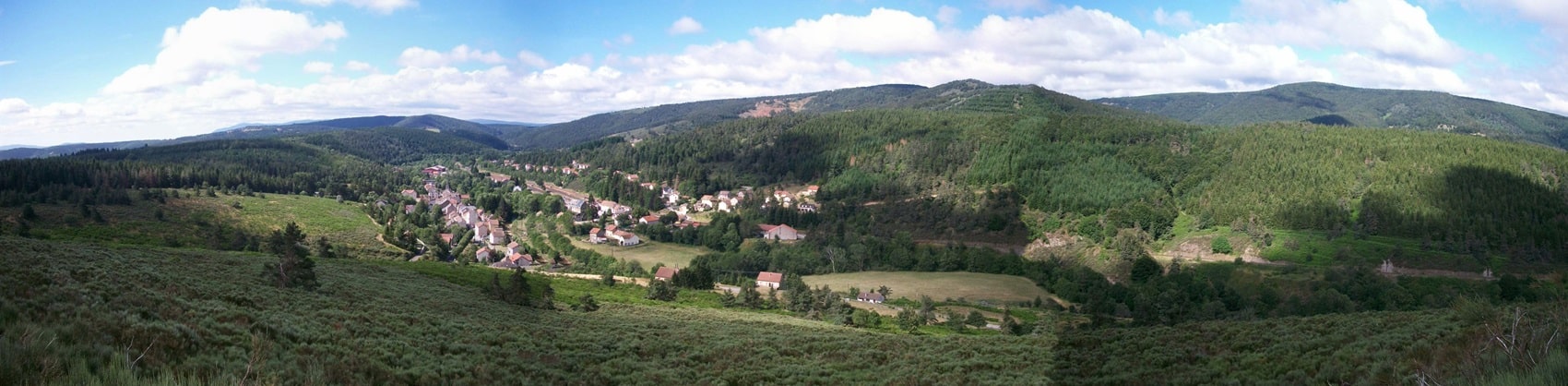
"Are you dining with us? The trout was caught this afternoon and the soup is homemade. Plus, the aperitif is on the house..." This warm invitation comes from the owner of L'Etoile Maison d'hôtes in La Bastide-Puylaurent—perched at an altitude of 1,024 meters. He is a friendly giant of about thirty-five who welcomes us before showing the room. Two beds, a sink, and an old bistro table with a wooden top, perfect for evening writings, make up the decor with a direct view over the Allier river. The donkey has made herself at home. She will sleep in a barn right at the foot of the river, near an old bridge. She seems to deeply appreciate the place; here, even the ducks look like they're on vacation.
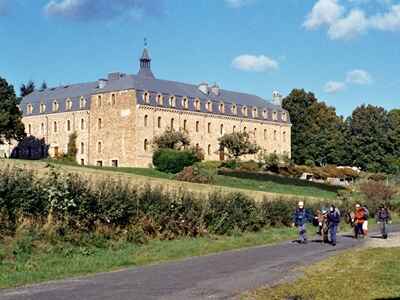
"Have you come from far away?" After Saint-Flour-de-Mercoire, we followed the river as closely as possible, avoiding Fouzillic and Fouzillac due to the weather, and passing through Cheylard-l'Evêque to arrive before evening. At Luc, it was straight ahead, or almost. We initially wanted to climb up to the Trappist Abbey of Notre Dame des Neiges, but with the donkey, the expedition proved too complicated... No regrets, though: according to our host, we made the right choice. It is situated high up and still a long way off; despite the clear night, we would likely have gotten lost. You really have to know the area, as it's wild up there. Besides, the abbey's inn is only open to retreatants.
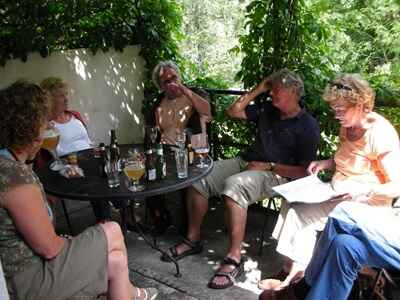
"Belgian beer for everyone?" And there we go, Belgian beer all around. We are comfortably settled in front of the warm fire in the large room that serves for both dining and relaxation, when two new hikers drop their heavy backpacks: Raoul, from Saint-Etienne, and Graeme, an Englishman from Bristol. Finally, Billy arrives, the guesthouse's gentle ginger Labrador. Outside the cities, there is no need for long introductions. We don't display colors; we don't raise any flags. The tired backpacks are more than enough to establish true complicity.
The owner returns with his arms full of dried fruits. Tongues start to loosen. After a long day's hike, a guy sharing your dinner table instantly becomes a friend. Questions about the journey arise. The only one who shares a bit more about himself is the gîte owner: "My name is Philippe Papadimitriou. I am half Belgian, half Greek, and the rest of the time, Lozérien." Before permanently settling in La Bastide-Puylaurent and attaching himself to Lozère, he wandered around Australia, searched for gold in California, and crossed France on horseback. That is exactly how he discovered Lozère and fell in love with the place. Two horses, his girlfriend with her own mount, and two dogs. He settled down and, six months later, bravely started the guesthouse adventure.
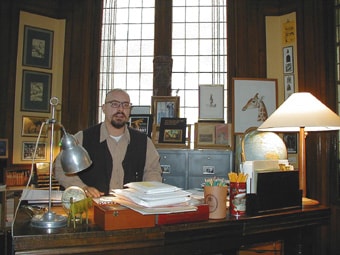
"I love it, I feel like I have a boat. Since then, I’ve been putting my back into it. Life is precious." Then he recounts the brief history of his house: it was once a proper family boarding house, the Hotel Ranc. Gentlemen used to bring their wives and children here to get some fresh air, before hurrying off to meet their mistresses on the Riviera. Philippe actively seeks to preserve that family boarding house aspect, even if only for one night. "When you leave my place, you should have only one desire: to return as soon as possible."
He spares no effort to increase his loyal clientele: impeccable food, spacious rooms, and a unique atmosphere. Not to mention his dry humor and a great aptitude for happiness. Philippe has the sacred fire; he refuses to give up, "even if this country is not his, precisely because this country is not his." He occasionally curses the labor force that seeks to escape toward Le Puy-en-Velay, Saint-Etienne, or the South. What will they find to do more in Montpellier? But he blames no one; he knows perfectly well that twenty-five years in Lozère can give someone a desire for elsewhere and a definitive escape. He, however, enjoys himself immensely here.
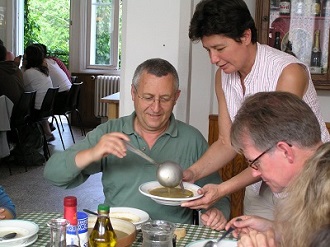
The soup smells wonderfully like the garden vegetables, the flesh of the trout is perfectly firm, and the homemade crepes are served without restriction. The stylish little wine from Notre-Dame-des-Neiges perfectly accompanies the whole meal. Fruit wine and communion wine—everything goes down the same tube. If Stevenson had known the L'Etoile guesthouse, there’s no doubt he would have stayed there. At the table, everyone shares their anecdotes and slightly disordered impressions of the places they have crossed. Raoul, the guy from Saint-Etienne, recounts his exploits; he went to Corsica this summer. Graeme, the slender Englishman and a specialist in German romanticism and *Sturm und Drang*, almost regretfully moderates the true importance of Stevenson on English soil. "Travels with a Donkey in the Cévennes, for us, is a children's book, a dictation book. A charming text used to learn spelling." He then proudly displays his guidebook: a small red book, illustrated and dog-eared, which constantly accompanies him during his hike. "When I talked about my trip to my friends back home, they were utterly astonished. In our country, Stevenson is seen merely as a storyteller of beautiful stories, a popular writer..."
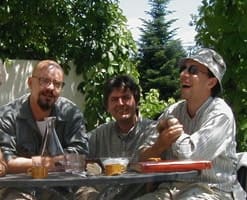
Having been a French teacher for several years in the Languedoc, it’s actually in France that Graeme truly discovered the *Journey*. He does not regret the hike and wants to finish it without delay, because for him, arriving in Saint-Jean-du-Gard means the end of the holidays. He has to return to England in just a few days, but he happily raises his glass to his French encounters.
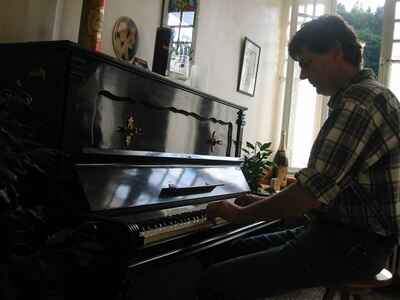
Philippe takes the opportunity to bring out coffee, pear brandy, and delicious Belgian cinnamon cookies. He sets the tray down and casually grabs his guitar... "I traveled the world and California, I put my hands in the mud to find gold, I’m a gold seeker." Singing Bob Dylan, Neil Young, the Eagles, and songs from his own repertoire—of which he has no reason to be ashamed—he continues his fascinating story of a modern cowboy.
A fresh log crackles in the hearth, and a folk ambiance settles in. These boots are made for walking... Raoul takes the opportunity to carefully monitor his emerging blisters. Coffee, beer, and Leonard Cohen. The songs warm you up right to the core. After sleeping under the beautiful stars, the beautiful gîte of L'Etoile. When Graeme the Englishman asks the Belgo-Greek if he has read Travels with a Donkey in the Cévennes, the latter simply smiles: "I’ve read two books in my entire life. My library is in my head. On the road at fourteen. Working on farms, sleeping in barns, and then America. Those are my books."
Monks in the mountains. And I gave thanks to God for being completely free to wander, free to hope, free to love...
***

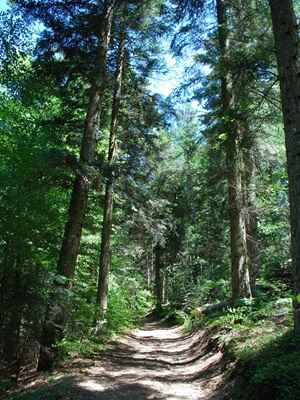
At the exit of La Bastide-Puylaurent, in the dense, silent forest wedged tightly between Vivarais and Gévaudan, we are looking for the path that leads to the Trappe, a retreat place for the monks. The sun manages to beautifully illuminate the beeches, ashes, and firs, just like on a bright summer morning. Noah's load is sensibly weighed down with a few sandwiches kindly prepared by Philippe.
A rustling of foliage. A walker emerges from the deep woods and quickly hides a basket of mushrooms behind his back. He is a local farmer and surprisingly talkative. "Why are you doing that?" he asks, pointing to our walking shoes and mimicking the carrying of a heavy backpack. "We do 'that' because if we hadn't, we wouldn't have met you..." we reply. "That's not stupid... there's a lot of truth in that, my good man!" he retorts. Satisfied with an answer he considers simple but sensible, he unpacks everything he knows—or thinks he knows—about the Trappe. Regarding their turnover, it is whispered in the village (not by him, mind you!) that it is one of the most important in Ardèche. The second largest, right after the cement factories. You absolutely must not repeat it; that's just what people say, not him, right... "They also say" that Brother Régis, the superior, is on very familiar terms with the most important political leaders of Ardèche. He supposedly even affectionately nicknames a local bigwig 'Jeannot'!
Our makeshift informant reveals other hushed confidences and wild rumors verified by his cousin's sister or by the man himself... "Don’t repeat this either, but all the political and economic decisions in the region are supposedly made up there. In the village, on quiet winter evenings, some have seen official cars going up to Notre Dame des Neiges. Only in winter, on snowy or foggy evenings. When no one is hanging around in the streets..." Listening to him, the Trappe sounds like an Ardèche Monopoly board. The man continues: "I quite like the brothers myself, but generally, in La Bastide, there is a lot of local jealousy. The monks are viewed poorly. People do not like their quiet, steady success. The monks may suffer a bit from it, but after all, it perfectly suits them to be left alone." Before turning on his heels, whether inadvertently or out of sudden trust, he finally pulls his basket from behind his back and leaves us with these proud words: "They're beautiful, my vines, aren't they?"
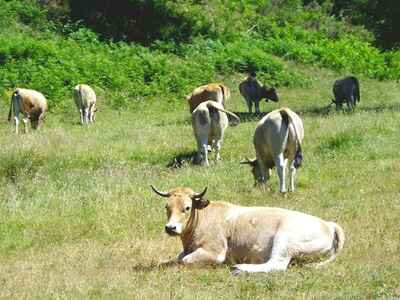
Notre-Dame-des-Neiges... In the bare and cold fields surrounding the Trappe, an old Renault 4L turns in all directions like a swarm of crows. "Brother Zéphyrin, he is always out on the roads around the trap; you will see, he is a very kind man," Philippe had told us. He comes bouncing in our direction. We introduce ourselves. The monk, with a lovely pink face and laughing eyes, places his hunting rifle casually on the passenger seat. Responsible for the agricultural operations, he takes great care of the cows and the surrounding woods. This morning, he is looking for fresh traces of wild boars. "They came last night; they start by eating a mouse, and then the whole family passes by." The monk, with a face as round as the moon, is also a passionate racing car enthusiast. "If I hadn't been a monk, I would have definitely been a driver. Not necessarily a world champion, but a good driver." When a car race is organized in the area, it is useless to look for Brother Zéphyrin. He always finds a good reason to urgently go racing in town. And occasionally, he goes down to drink a cold beer at L'Etoile, provided it is brewed by Cistercian Trappists, as required by the brotherhood. He eagerly directs us to the trap's bar: "Brother Jean will be happy to serve you the aperitif and have a little conversation."
Brother Jean stands proudly behind the counter, which is about twenty meters long. He vigorously promotes Quineige, an aperitif specially developed and sold by the monks. The bistro brother serves every single day of the year without exception and has only left the trap once in twenty years. "To go to the doctor; otherwise I don't have time, I have to work hard, even at night sometimes." A true jack-of-all-trades, he serves, smiles, and strictly monitors the entries and exits of provisions. The bar resembles an Ali Baba cave dedicated entirely to Lady Food. They sell barrels of all sizes, hollow Virgins—ready to fill—decorated carafes, sweet chestnut jam, regional sweets, fine wine, and spirits!
Brother Jean carries his eighty years like others carry good luck. He must be about one meter fifty tall and frequently climbs onto an old wooden box to bring his face up to counter height. Behind him, Auvergne hams, monumental sausages, and huge cheeses patiently wait to be taken down. Brother Jean is fully used to working hard while holding a long conversation. Like a seasoned guide, he recounts the life of the monks, the deep history of the trap, and its complex functioning...
At the end of the 11th century, Robert de Molesme and Saint Bernard left the Benedictines of the Cluny Order. They strongly wished to find a more rigorous faith and strictly apply the teachings of Saint Benedict. The Benedictines share their time between prayer and study; we Cistercians add demanding physical work... Moreover, Brother François-Régis, the superior, is currently absent; he is monitoring the grape harvest in Bellegarde, between Nîmes and Tarascon. That is exactly where we buy our grapes. We trust them, of course, but it is always better to be on site. We buy a very nice Merlot. Go down to the cellars to taste it...
Despite the many visitors waiting to place orders, the monk takes his sweet time. Brother Jean is never in a hurry. He weighs a heavy mountain sausage and pitches it to a little round lady who is getting visibly impatient. A cohort of tourists waits their turn. While he serves, the grocer-brother continues his fascinating lecture. The first trap was tragically reduced to ashes in 1912. Today, thirty-five monks live in the mountains and in silence, according to the strict rules laid down by Saint Benedict. Prayer and work. "They will really be monks if they live from the work of their hands," said the saint.
The monks pray four full hours a day, from the office at four-thirty in the afternoon to the one at nine at night... Today, many young people are heavily tempted by a temporary or permanent isolation to piece together the complex puzzle of their lives. Thus, the hiker who arrived one day with a simple backpack and who, after a short retreat, never left again. Here, one can comfortably live apart from the grand spectacle of society and, at the exact same time, undertake a profound spiritual and personal journey within oneself. In the middle of the forest and at the very heart of the world, just like Saint Francis.
Upon closer inspection, there are actually two traps clinging tightly to the mountain. The first is strictly for the monks, invited religious, and lay retreatants; the second is for eager tourists—great consumers of holy pork, shiny rosaries, and napkin rings bearing the likeness of Charles de Foucauld (who famously stayed here in 1890 before dying in the harsh Sahara desert in 1916). At the trap, the visitor can pray and consume in total peace. The brothers of the mountain gladly accept all magnetic cards, by the way.
Like that of all Cistercian monks, the day of the Ardèche monk begins with waking up at four o'clock sharp, followed by the office where the beautiful psalms are solemnly sung. From five to seven o'clock, deep meditation and personal reading occupy the monk's time. At seven o'clock, the lauds are held in honor of Creation, followed by the Eucharist—always celebrated with great, respectful sobriety. During the rest of the morning, the monks passionately engage in their respective professional activities, perfectly according to the rules laid down by Saint Benedict: cooking, sewing, demanding farm work, beekeeping, or wine work. Lunch is taken in absolute silence, and the afternoon is once again devoted to manual activities. Then, around six-thirty, the vespers are celebrated. After a very frugal supper, the monks attend the compline, the very last ceremony of the day addressed to the Heavenly Father and Mary. All then silently retire to their modest cells for the night. Saint Benedict openly invites the monks to contemplation to better overcome the chaotic agitation of the outside world.
Brother Jean tells his story with a glimmer of absolute grace and forgiveness in his eyes. We have been told—there's a lot of "they say" in the Ardèche mountains—that he maintains his unshakeable good humor, his monastic calm, and his divine optimism from another grueling stay in a cell, this time one of pure horror. He was a "resident" at Auschwitz and solemnly promised to enter religion if he ever got out of the nightmare. The miraculous brother, with a face deeply marked by suffering and eyes burning fiercely like the biblical bush, is a striking mix of a magnificent beggar engraved by Jacques Callot and a tragic victim drawn in ink by Zoran Music in the camps of the abominable. When we leave the giant pantry, the brother, who warmly crushes our hands, smiles brightly at us once again.
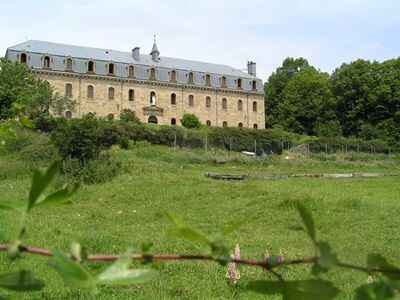
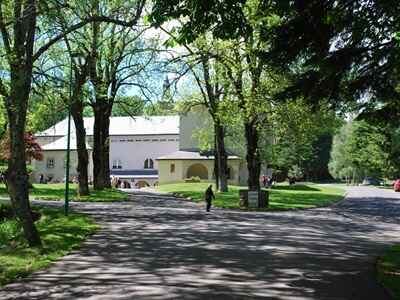
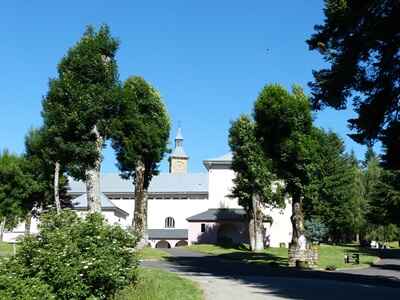
After safely tying Noah at a good distance, we take a long walk within the estate. The long, austere buildings, the heavy majesty of the silence, and the piercing blue sky calm the visitor instantly and force him to respectfully bow. At the top of the mountain, in what could almost resemble a heavily fortified estate, there is no flashy architecture; only a simple, discreet bell tower rises above the roofs. The few crossing monks smile gently and greet us silently.
In the shop, the small business is thriving: visitors are offered lapel pins, ridiculous painted metal pieces that the customer can proudly pin on the edge of his jacket, decorated plates, varnished sticks for those who suddenly feel like true pilgrims, and many works dedicated to the life of the order. There is no trace of the illustrious Scotsman, I specify this because an English tourist couple absolutely wants to bring back a literary souvenir: "You understand, we came especially from London, we are retracing Stevenson's mythical journey... in a Jaguar coupe!" In the thick monastic silence, one could almost hear the sweet, steady music of the cash register.
In the cellar, the wines gracefully age in thick, imposing oak barrels. The dedicated monks of the Abbey Notre-Dame-des-Neiges buy the grapes, expertly vinify them, and closely monitor the aging process. We taste immediately—or rather, straight from the barrel—a simple, honest, and generously fleshy Merlot, a true country wine as rocky and robust as the winemakers who produce it. For aging and selling, the monks do not hesitate to hire additional staff (from the wine technician to the mechanic, from the agricultural worker to the skilled carpenter), thus actively and concretely contributing to lowering local unemployment rates.
In the deafening silence of the tuff vaults, tourists eagerly extend their containers and employees hustle at the foot of the giant stainless steel tanks with the efficiency of a busy gas station on the highway of the sun on a major departure day. The long, dark corridors house the giant barrels and the precious, blessed wines. Amen! The absolute highlight of the production remains the *Fleur des Neiges*, a light sparkling wine that the poet Kenneth White sometimes enjoyed when he lived and meditated in Gourgounel, his quiet retreat perched a few leagues from here.
At the sawmill, brother "grumpy" strictly and scrupulously supervises the cuts. Philippe Papadimitriou, the Greek from L'Etoile, is busy preparing to load the few heavy cords of fir he has fiercely negotiated to feed the impressive chimney of his guesthouse. With the time of a helping hand, we quickly become lumberjacks for a day, in the purest respect of the monastic rule: prayer and work. The prayer, however, will definitely wait until much later.
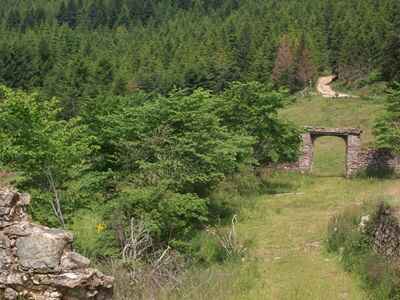
Since the accommodation at the trap is completely full, we will have to content ourselves with the edge of the forest. We are directed to the Mas de Félgière, an old house of prayer and charity that miraculously remained standing after the Revolution. "After the last buildings, it's straight ahead, just follow the gorse... Get some good supplies at Brother Jean's and go lie down in the soft, fresh grass." The walk is slow, slowed down by Noah, who always hesitates just as much to put her delicate hooves in the freezing rainwater puddles. The day quickly dwindles over the cedars and pines, the blue nuances of the sky giving way to the first orange and flaming glimmers of twilight. A wild pheasant suddenly appears. Long, tense seconds of motionless face-to-face follow. Then, the pheasant flies away noisily. Will we see, in the heart of this night, the famous short-winged and round-eyed little owl that my grandfather so often told me about? How to recognize it in the dark? If I hear a soft hoot, it will definitely be a little owl. Nothing simpler.
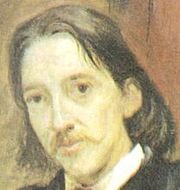
On September 26, 1878, after four or five grueling days of walking, picturesque wandering, and exhausting negotiating with Modestine, Robert Louis Stevenson finally stops at the trap. He approaches it with measured steps, filled with sincere, deep anxiety. As the son of strict Scottish Presbyterians, he knows nothing of the customs of the place and greatly fears the welcome that awaits him in this Catholic enclosure. Brother Apollinaire, pushing his modest wheelbarrow, is exceptionally pleased and amused to meet his very first Scotsman. The other monks hurry over to meet him... Then come the porter brothers, in charge of hospitality, and finally the abbot who graciously receives Stevenson in person. During his stay, the writer carefully observes the minute-by-minute life of the monks with the eye of a learned entomologist, and inevitably compares the monastery to his own youthful experiences in bohemian communities—which were far more devoted to the intoxicating cult of wine, women, and revolution than to strict prayer.
The superior of the place, Father Michel, very courteously offers the newcomer an invigorating aperitif and dinner. At the table, the writer meets a country priest and a retired soldier who, unfortunately, openly show deep intolerance towards other faiths. While gravely threatening the Scottish traveler with the eternal torments of hell and vigorously condemning Protestantism with undisguised force ("it is a sect, nothing more, nothing less," they assert), they clumsily try to convert him. Stevenson gets a bit angry but takes care to strictly maintain a distinctly British politeness. He proudly defends the religion of his mother and his distant childhood, then finally abandons the two devotees to their sectarian faith. At the warm invitation of an Irish brother, he visits the imposing library of the abbey where Chateaubriand, Victor Hugo, and the mischievous Molière stand peacefully alongside the great foundational and sacred texts. Then, in the quiet evening, he finds himself entirely alone in his small cell. Stevenson begins to question his own faith, which he tries to disguise as best he can. He profoundly fears the silence and solitude of the place above all, even going so far as to secretly compare the monks to the living dead. This is why he scrupulously notes in his travel journal a cheerful, old French song, as if to better mask his true state of soul... The real, deeper doubts will come later.
What beautiful girls you have,
Giroflée,
Girofla !
What beautiful girls you have,
Love will count them!
Behind the jingle and the polished book he intends for the general public, a feverish and much lesser-known Stevenson opens up without disguise. This is the other Stevenson, the one from the true Journal and the harsh, unforgiving road. A pilgrim who does not yet realize it and actively doubts in the crushing silence of Vivarais. A feverish pilgrim in perpetual search of true love and faith, who desperately seeks to silence his mystical mood. Stevenson then writes a touching Prayer to friends that he will take great care never to include in the published book. Previously, he had taken the time to specify, with disturbing lucidity, that a journey is, at best, a revealing fragment of autobiography.
You who have given us love for the woman and friendship for the man, keep alive in us the feeling of communion and lasting tenderness; let us forget offenses and remember the services rendered; protect those we love in all things and accompany them with kindness, so that they lead a simple and suffering-free life and finally die in peace and with a calm spirit.
At Notre-Dame-des-Neiges, in the very heart of the world and yet so far from it, a young man finally falls asleep. His numerous childhood chimeras—the tormented stories, the violent nightmares of the night, and the old Scottish legends—are vividly revived. A young man prey to deep hesitations, inner tremors, and the fervor of piety falls peacefully asleep in the heart of the world and far from the world. Behind the chaotic emotions he seeks to erase, the existential questions that await vainly for answers—which are always the exact same ones—arise implacably like specters.
Stevenson has heavy accounts to settle with his native Scotland, a land he is preparing to leave forever, without actually being able to leave it entirely: the distant Scotland of childhood, of strict spiritual formation and his haunting intimate demons; the Scotland of great suffering and austere Calvinist education; the highly affective Scotland of his first solitary walks on the windy heath, of bleak, foggy suburbs and black, industrial towns. He has other, no less painful major accounts to settle with his own family because, in openly choosing to love Fanny, he has completely opposed his father head-on. This inflexible, rigid Presbyterian father has always exerted a massive financial and moral yoke over his only son. And behind the formidable figure of the father is the whole of England and its right-thinking literary milieu that strongly hates waves, or at least those who dare to create them... But Stevenson will brilliantly rebel, and this very rebellion will birth the immense writer...
When he creates, during his tumultuous adolescence, with his indispensable cousin Bob and other agitators among their friends, a small secret, highly subversive, and resolutely provocative society, one of their very first established articles demands a complete and simple rejection of everything their parents may have taught them. A radical motto that absolutely passes over any other comment.
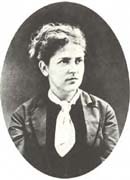
Stevenson also has intense accounts to settle with the question of faith and its creeping, profound doubts, a complex and sneaky mixture of religious resurgence (does not his very first text, self-published with the care of his father, directly address the fierce, bloody rebellion of Scottish Puritans?) and creeping, rebellious atheism, even pure, affirmed anticlericalism. Finally, and above all, there is the beautiful Fanny, always Fanny, the primary central subject of this initiatory journey and his absolute (un)reason mistress. She discretely hides behind each of the words he puts on paper, accompanies each of his soft steps on the steep paths, and brightly illuminates each of his thoughts. Fanny, ten long years his senior, both embodies the woman, the reassuring mother, and the protective father. Fanny, the bold, intrepid adventurer who completely disregards all the social conventions of her time and proudly assumes the role of strict literary coach. Fanny, the incredible woman to come. His most beautiful future.
Lying in my warm sleeping bag, by the glowing wood fire in a dark barn, I reread with passion and carefully compare the different texts. In the true travel journal, Stevenson freely pours out and gives in to his honest, raw emotions without restraint. In the published Journey, he heavily moderates his hesitant faith and instead finds a much sharper, distant tone. He crosses out carefully, deletes at will his most personal experiences. Anyone wishing to truly and authentically travel with Stevenson in the Cévennes must necessarily equip themselves with this famous Travel Journal to discover the other hidden side of the mountain. The Hyde mystery. The secret, intimate meaning of this journey, as he himself wrote in his revealing preface. Only there, and only there, does the man completely reveal himself. The definitive, rewritten edition for the general public gives absolute pride of place to the flashy writer anxious to look good, while this Travel Journal acts as a flawless seismograph of formidable precision of his tormented spirit. Back in comfortable shelter, wisely seated in front of a sturdy desk, Stevenson intervened violently on this fragile seismograph, strongly tempered his warm, on-the-spot written reflections, and heavily censored himself. Original text by Eric Poindron. Beautiful stars. With Stevenson in the Cévennes. Publisher: Flammarion. Collection: Gulliver.