


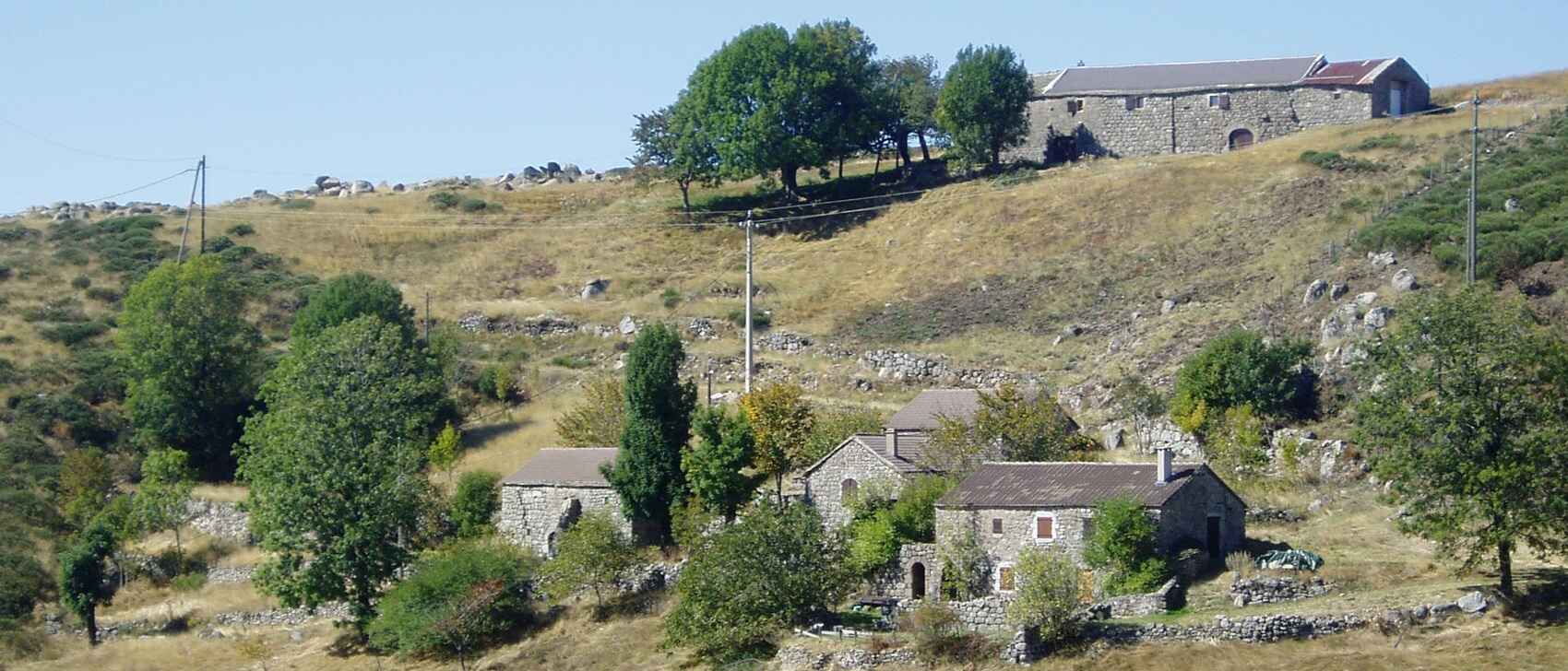
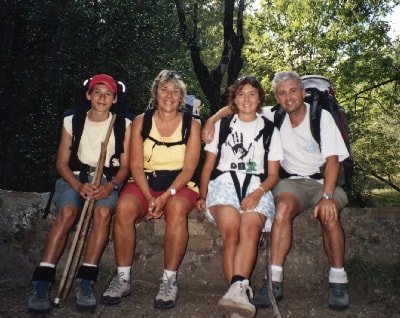
During the second half of August, we decided to set off as a family, along with our 14- and 17-year-old children, to hike the Cévenol trail. The idea of backpacking from lodge to lodge thrilled us immediately. It was a true first for us—an adventure inspired by a hiking friend whose stories had left us eager to hit the trail.
But where should we go? This initial dilemma seemed tough to crack given our strict criteria: a route that wasn't too flat nor too steep; good chances of fair weather without stifling heat; a loop rather than a long, linear trek; and a strong desire to avoid walking along roads, even country lanes. We quickly set our sights on the Cévenol. This regional long-distance trail (GRP) felt like the perfect compromise: daily stages of about 15 kilometers on well-marked paths, right through the heart of untouched and protected nature.
We chose La Bastide-Puylaurent as our starting point and stayed at L’Étoile Guest House. Philippe, who acts as both host and conductor (he runs everything!), welcomes you with such warmth that you feel like old friends. The accommodation is unpretentious yet high quality, the meals are wonderfully abundant, and the homely atmosphere exudes unparalleled hospitality.
And we’re off! For an 8-kilometer warm-up, we head out at a leisurely pace toward Saint-Laurent-les-Bains, passing by the Notre-Dame-des-Neiges Abbey. The route begins with a gentle 6-kilometer climb through rolling meadow landscapes, followed by a rather steep 2-kilometer descent into Saint-Laurent-les-Bains, guided by the ruins of an old observation tower. We spend our first and only night at the "Le Chat Bleu" lodge.
The next day, the real challenge begins as we head toward Montselgues. The terrain is quite rugged, and it’s fascinating to watch the vegetation shift with the altitude and sun exposure: chestnut forests gradually give way to vast expanses of heather, painting the landscape in striking shades of deep purple. The path then winds peacefully through idyllic rural scenery and the charming hamlets of Laval-d'Aurelle and Ourlette. Halfway through, we enjoy a well-deserved picnic by the crystal-clear, bracingly cold waters of a local river.
It is exactly here that the hike gets demanding. The subsequent steep climb almost makes you regret taking a break, as your cooled muscles must now tackle two major inclines that push us from 700 to 1,100 meters in elevation. Our water supply dwindles quickly, but luckily, we run into two young vacationers in Pradon who kindly refill our bottles. Upon arriving in Montselgues, an incredibly peaceful village, we receive a warm welcome at the stage lodge. A generous dinner awaits us—shared with a couple from the Sauternes region who are hiking the exact same route and whom we’ll bump into again later—followed by a deeply restorative night's sleep.
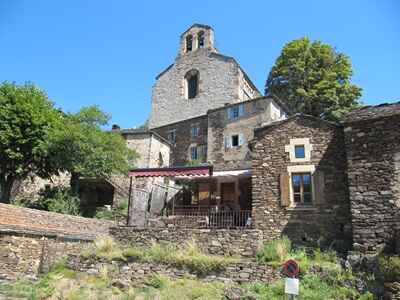
A long descent then leads us to the foot of Thines, a picturesque village perched on a rocky spur. A break here is essential, giving us the chance to top up our drinking water at the local fountain (actually a cemetery tap, where the water is so highly oxygenated it looks cloudy). This is followed by another climb through a highly fragrant forest of cork oaks and maritime pines, bringing us up to nearly 900 meters. We briefly follow a section of an old Roman road before descending toward Dépoudent, where Monsieur Chat is waiting for us at his cozy dormitory lodge.
This was an unforgettable stop. In this delightfully rustic setting, with a pergola-shaded terrace offering sweeping views of the Chassezac valley, we receive the most authentic welcome from our septuagenarian host. He makes a point of treating us to local country fare: chestnut chicken, a fresh tomato salad straight from his garden, home-grown kiwis and sun-ripened plums, all paired with his homemade wine...
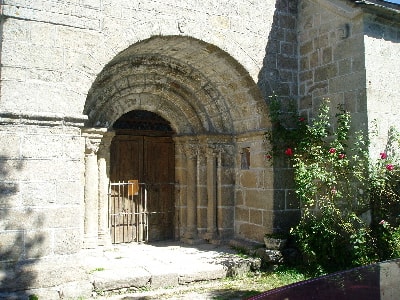
The next day’s itinerary is demanding: a very long descent with steep, rocky sections where the footing is tricky and the risk of twisting an ankle is very real. However, the effort pays off as we pass through Saint-Jean-de-Pourcharesse, an astonishing little hamlet whose church boasts five steeples—though only one actually houses a bell! By the time we reach Chambonas, we are officially past the halfway point. We decide to take a rest day in this charming village dominated by its castle, booking two nights at "Les Sources" bed and breakfast (Gîtes de France No. 206). Fully equipped with modern comforts and a lovely pool, it’s the perfect spot to recharge. The only downside: the lack of a table d'hôtes means we have to walk 2.5 kilometers to Les Vans to find the nearest shops.
The break was a lifesaver, as the following stage proves significantly tougher. Past Les Vans, a strenuous climb spanning more than 4 kilometers with 400 meters of elevation gain takes us up to Brahic. The subsequent descent is sharp: a 300-meter drop over 2.5 kilometers, half of which happens in less than a single kilometer. At the bottom, a small river practically begs us to stop for a picnic—especially since we already have 9 kilometers under our belts. As is often the case, getting moving again is brutal, facing a sharp, 250-meter climb over barely a kilometer. The heat beats down, and our water situation becomes a genuine concern: we are down to just one liter for the four of us!
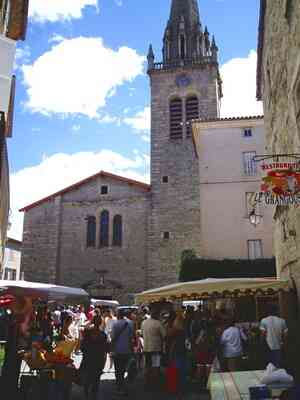
Thankfully, the worst is over, and we ease into a peaceful two-kilometer descent. It’s here that the exception proves the rule: while we had never struggled to find water before—with many locals spontaneously offering it—our arrival in Safrenière brings a bizarre surprise. Spotting a child playing in a large garden boasting a pristine pool and a luxury SUV, we ask if his parents might let us refill our bottles at the tap. To our utter disbelief, his mother comes out to firmly declare that the tap water is polluted, that they don't have enough bottled water to spare even one, and that our best option is to hike back to Les Vans to buy some! Why certainly, madam, that’s exactly where we just came from, we’ll turn around right away...
We naturally press on, finishing with a beautiful ascent to the charming La Pauze lodge. Our hostess, Madame De Roo, is a dynamo who runs her home with masterful efficiency. Upon inquiring, we quickly learn that the region's tap water has, in fact, never been polluted! No matter, we easily forget our exhaustion (and the Safrenière anecdote) lounging by the pool in the company of the property's two incredibly affectionate dogs. That evening, we dine at a table d'hôtes that is, quite honestly, worth the trip all on its own!
The next morning, after a breakfast that perfectly matched the excellent hospitality, we hit the trail once more. The tone is set the moment we step past the property’s boundary wall: this is going to be a sporty stage! The path climbs relentlessly, taking us from 420 to 880 meters in altitude in under 6 kilometers, featuring some highly demanding stretches. But the physical toll is well rewarded: from the heights, the panoramic view from the observatory is pure bliss. The sight stretches endlessly across the Cévennes and the Ardèche, with the majestic silhouette of the medieval Château d'Aujac looming below.
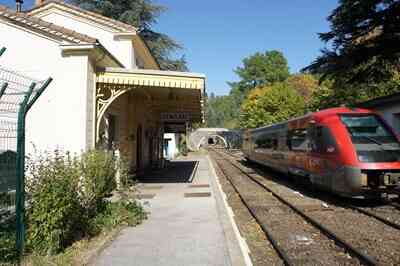
Even once we leave this magnificent viewpoint behind, the difficulties aren't quite over. The remainder is grueling: a dizzying 560-meter descent over less than 4 kilometers, finally depositing us on the banks of the Cèze at an altitude of 320 meters. The spot is strikingly beautiful, an ideal place to linger over a long picnic. Afterward, unless you set off at the crack of dawn, you'll need to hit the turbo to reach Génolhac on time and avoid missing the return train. It would be a great shame, however, to have to rush so much that you neglect the superb scenery at the end of the route. After all, we are on vacation, and the 18:40 train will safely carry us home, unveiling a panorama that only true hikers can fully appreciate. Magis Family