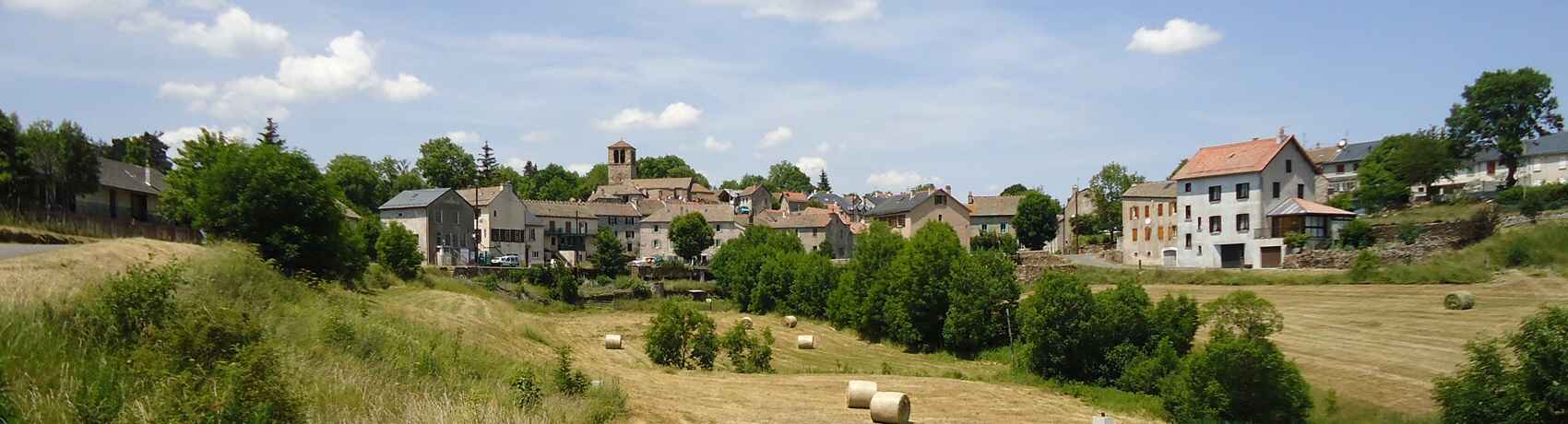
 Heading toward Chasseradès—some ten kilometers of single-track railway—we follow the Allier River. Wedged between the river and the railroad ties, our small party resumes its march. It is a trail reminiscent of the Far North: tall firs, a biting wind, and the sound of footsteps in the forest. Shouts, too, sounding almost like songs. The stark white light overexposes the scenery, seeming to distort it. Suddenly, this could be anywhere... Where are we, in what distant land? In Alaska, perhaps... White worlds must look like this... It is neither the right country nor the right season, and yet the light resembles snow. The spirit of the wilderness, the call of the forest in the cold early morning. The ground is hard and frozen, and the fallow fields look as though they are blanketed in snow. I hear murmurs from underground, the wind howling beneath my boots. Everything rumbles, steeped in white. Capturing the spirit. We must press on despite cramps, grief, and doubt.
 "California, near the Oregon border at Eagle Creek... My first nuggets, measuring 1.5 by 2 centimeters, brought me 1,500 dollars. Gold fever gives you incredible strength. I was living among Vietnam veterans who took me for a greenhorn. They wait to see what you're made of. One evening, I smoked a joint of the marijuana they grew and polished off a bottle of vodka. I was blind drunk, stark naked, and I waded into the river to pan for nuggets..."
"On Midsummer's Day, we went bear hunting. The hippies, the gold prospectors, and eight- or nine-year-old kids rode bareback and stark naked like Indians. After that, I sank even lower; I lost my mind..." Such are the words of Philippe, the owner of L'Étoile Guest House, the Greek of La Bastide-Puylaurent and a distant cousin of Jack London. He spent a good part of the night telling us how the twentieth century could still resemble the Last Chance Saloon—Jack London's cursed tavern. The Belgian talks like a writer. "Damn it, get moving!" And that is exactly what we do... Eagle Creek...
It feels as though I am walking through the Far North of the Cévennes. Dreaming out loud. Leaving, just leaving. The North, the white world, the white worlds. The Grizzly King by James Oliver Curwood, in the classic French Bibliothèque verte youth edition, was my very first book, my first encounter with the Far North. All around me, in the imagined blizzard, are the ghosts of prospectors, painted warriors, and invisible bears. After several days in Gévaudan, there is still no sign of wolves. In my imagination, the Beast has become an elusive white wolf stalking us, while we are trappers wandering among abandoned mines. Anyone who doubts it can try walking for fifteen days far from any town... They will understand.
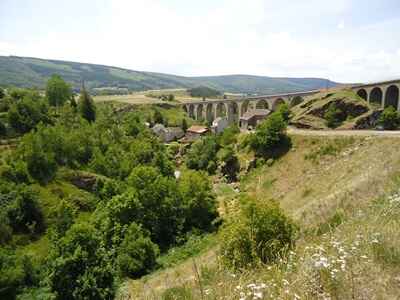 Shamanic wisps of smoke rise, and the ground appears snow-covered like the Klondike. Tall pines on the hillside, towering firs, and here and there the sound of lumberjacks clearing the forest... I hear the tunnel, the lynx; I hear the echo of Gévaudan and its lament. I shift latitudes and longitudes. Messages carried on the breath of the wind. I set about reuniting the continents. Footsteps echo like bells in the mist. My heart races, my breath smells of seaweed and gunpowder. In this barren field, white with silence and dreamed-of snow, I imagine this could be Patagonia—amid cheap clichés, indispensable barbed wire, and mirages. Give it a try... The moment you start walking, you are traveling around the world. Or almost...
Along the railway line running from Mende to Montpellier via La Bastide-Puylaurent, Villefort, Génolhac, Chamborigaud, Alès, and Nîmes, many small stations have turned into ghosts. Sometimes they are renamed, downgraded to mere SNCF request stops. Despite the slight, they retain their bygone charm and, even without a stationmaster, keep their high roofs as elegant as vintage parasols. Here, just as in Africa or South America, all you have to do is wave your arm to flag down a train... At the next stop, indifferent passengers will step off the train under the steady, ungrudging gaze of the wayside halts. Stations in retirement...
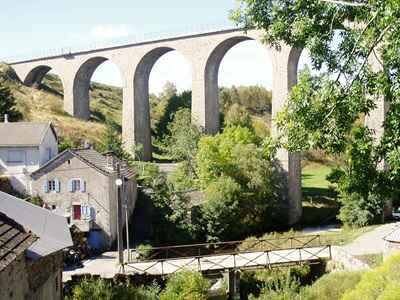 Back on foot along the tracks, with neither train nor fanfare. A pity, for those traveling without a donkey—or without "donkey status"—can simply raise an arm for a lift along the rails. La Bastide-Puylaurent – Chasseradès – Belvezet – Allenc – Mende and Marvejols... Up here, the train crawls along and drops hikers off at the foot of Mont Lozère. The Mirandol viaduct conjures up sepia-toned photographs from the days when trains were pulled by two massive locomotives belching smoke past unbothered cows—just like the vintage reward cards handed out in French schools. Yet beneath the imposing viaduct today, I hear only the echo of Noé's hooves and the gentle murmur of the little Chassezac River. The weather is gray and cold, but our stride remains that of wanderers. And if we see mirages, they are high above our heads. We walk slowly; they have the wings of giants.
In the hamlet of L'Estampe, a grandmother with the strength of an ox has been splitting wood since dawn. She hauls her cart alone, unloads it panting for breath, and stacks the logs into wall-high piles with the patience of someone building a house of cards. To fend off winter here, you roll up your sleeves and meet it head-on. She welcomes us in for a moment over a cup of coffee and tells her story without a word of complaint or self-pity. Of the hamlet's seven inhabitants, five are over eighty-five years old. In this rugged corner of wild Gévaudan, it is not uncommon for a farmer to raise a family of three children on the backs—or rather the milk—of thirty lean cows.
 The journey—do we make it, or does it take charge of us? I am not the first to ask the question. From Nikos Kavvadias to Nicolas Bouvier, no one—neither sailors nor writers—has a ready-made answer. My heart goes out to this woman from the hamlet as I leave her empty-handed, when she has given me the very ingredients and spices for my little chronicles. And so my pen, scratching across the logbook, pays tribute to her. It is not I who make the journey: this woman and all the others carry it forward. We think we master the road, yet we remain its hostages.
Montagne du Goulet must be tackled with courage. We barely seem to move forward; the mountain is teasing us. Fourteen hundred meters of elevation is nothing to a donkey and nothing on a map, but for childlike legs it is a humbling ordeal. Deep in the state forest, the overcast sky presses down heavily on the young conifers. Now and then the sun pierces the clouds, tinting the trees in shades of green and silver. The ground is strewn with gleaming quartz, making it look as though springs are bubbling up everywhere. The wind in the treetops sounds like a Celtic harp, and the tiniest blade of grass begins to chime: an enchanted forest, worthy of Brocéliande.
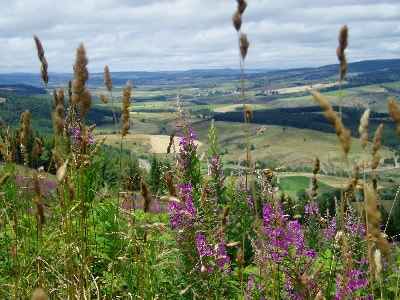
At the summit, in the heart of silence and mist, resting becomes an ascetic discipline. The conifers and autumn undergrowth, so reminiscent of Scotland, must surely shelter fairies. There is no sign of human life or civilization, save for the narrow road and the old stone mileposts. All around us grow heather, thistles, and wild blackberries. Gently, heading toward Le Bleymard—the village that serves as a hyphen between Montagne du Goulet and Mont Lozère—we resume our walk. Slow, very slow, our descent following part of the Lot River is a pure joy and a welcome rest. Excerpt from "Belles Étoiles", Avec Stevenson dans les Cévennes, Gulliver collection, edited by Michel Le Bris, Flammarion.