


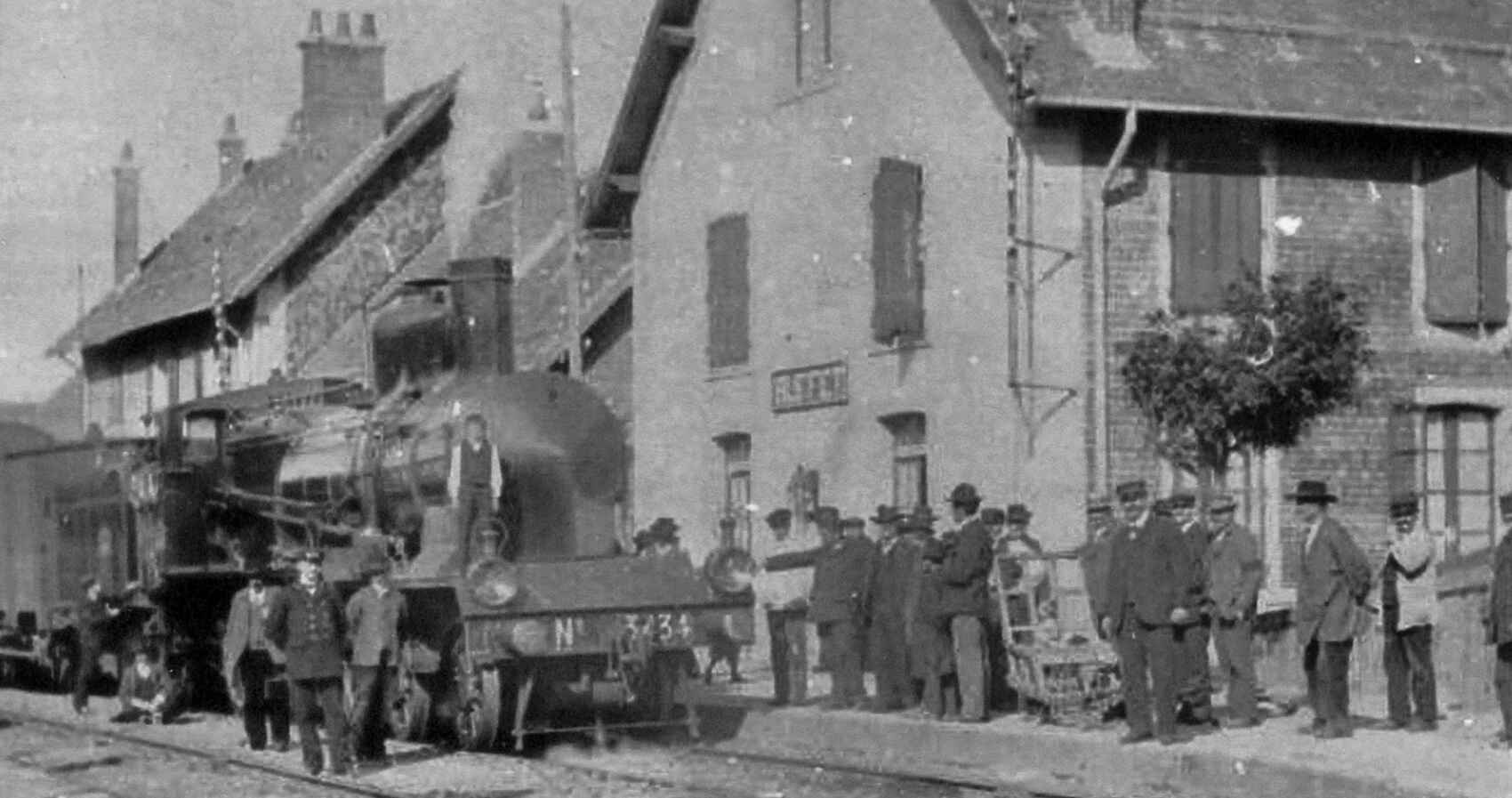
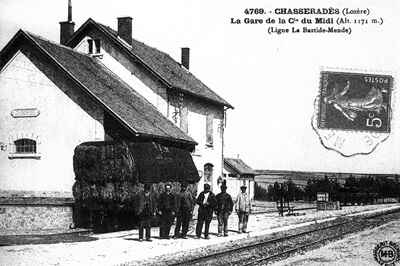
Here is a memory that awakens the sleeping echoes of our family's lovely summer months, spent in the shade of tall fir trees, along green meadows, or in the hollows of lazily winding streams. I must warn you right away: getting to Chasseradès had to be earned! First of all, you should know that at the time, the steam train reigned supreme. And it’s no exaggeration to say that these steam trains traveled at a Very Low Speed! The Nîmes-Paris route, via the Massif Central, was no exception to the rule.
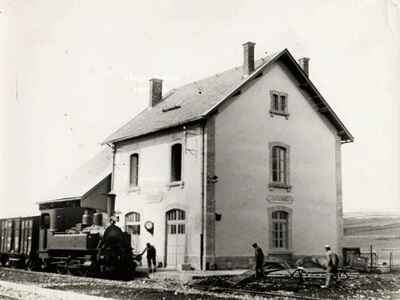
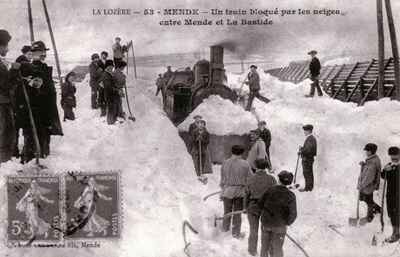
In its southern section, the line had served the towns of Alès and La Grand-Combe since 1841 to meet the growing needs of the coal mines. However, it would take another quarter of a century for this section to be connected all the way to Clermont-Ferrand. It took no less than two powerful locomotives, coupled together, to tackle the steepest inclines. They were so steep that the two locos would arrive exhausted, panting, and laboring heavily. One might almost regret having nicknamed them "steel monsters."
At the departure station, the strong smell of platforms blackened by smoke already set the mood. Then, alongside the steam came the smoke, and with the smoke came the soot from the coal—the very coal that boiled the water in the boiler, turned the pistons, and moved the machine. By the time we arrived at the terminus, we would be so black with coal dust that our own mothers wouldn't have recognized us. We learned the station master's whistle by heart—there were so many stations, and at each one, a new master. We stopped at all of them, even though sometimes, where we stopped, there wasn't even a village! That says it all: nothing, nobody lived there... but there was a station and a master, so we stopped! And then there were those impractical toilets, with a bowl through which you could see the wooden sleepers and track ballast whizzing past at full steam.
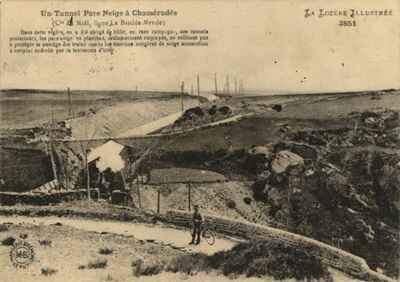
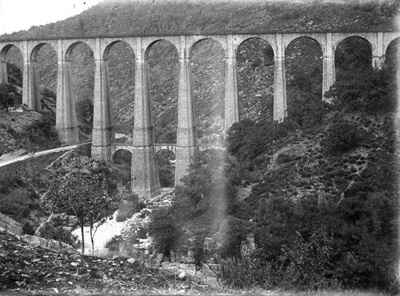
I prefer not to even mention the countless tunnels that allowed the train to pass straight under the mountains! There were so many mountains, and so many tunnels, that most of the time we were plunged into complete darkness. In the meantime, you had to hurry to open the windows because the intense heat made us suffocate! But beware if you didn’t close them back up in time! Smoke, soot, and glowing sparks would then penetrate the entire carriage. However, it was so hot inside that as soon as we came out of the tunnel and back into daylight, everyone rushed to reopen them. These windows protected us from the choking smoke but, when opened, allowed the stifling air—amplified by the sun's rays beating down on the bare roofs—to circulate! It never stopped, and it took hours and hours before the station master’s voice sounded the saving announcement: "La Bastide! La Bastide-Puylaurent! Three minutes stop! Passengers heading to Mende remain on the same side of the track to catch their connection!" This was the highest point of the line, sitting at 1,025 meters in altitude, right next to the station. How beautiful that little red and yellow railcar (the Micheline) was!
Initially, its wheels were equipped with special tires developed by the Michelin company, hence its name. It was easily recognizable, with its distinctive horn and all the passengers gathered together inside due to the lack of separate compartments. After the massive locomotives we had just left behind, the bluish-gray plumes from its diesel engine were actually quite pleasant to us. Two or three more stops, and we could already feel that the air was different. And then, we finally arrived at our terminus. Stunned by the noise and fatigue, thirsty and hungry, we stepped off the train, incredulous and astonished to have finally reached our Promised Land, our Nirvana: Chasseradès!
The farmer renting out the accommodations was waiting for us. He had wasted no time in replacing his lucrative wartime black market—from which he had reaped nothing but profits. In the absence of local resistance fighters (the maquis), he hadn't even been bothered during the war. It was 1948, and he compensated for his loss of wartime income through the summer rental of two small lodgings. The dear, very dear man! He certainly knew how to count things other than just his profits. For one day, he would undoubtedly have to render many other accounts... whether here on earth or elsewhere! But for now, all that remained was to load up the bags, trunks, women, and children. The owner of the place let out a sharp oath. Armed with a long stick, he poked his cattle in the rear. Onward! My God, how relaxing it is to travel... in an ox cart!
We climbed from the station toward the village, passing it on our right. At its edge, the meadows rippled like a long, flowing dress adorned with thousands of multicolored flowers. We passed a few dry-stone walls, completely free of barbed wire along the pastures and enclosures. There were no visual or physical interruptions back in those days when meadows and woods were left unfenced. What use would fences be, anyway, when the herds of cows were guarded at very little cost by young children?
These orphans, or cataloged delinquents, were entrusted by the social services (DASS) for a fee—always money!—to local farmers who sometimes exploited them shamelessly, as they had no children of their own. Unless the herd could be watched over by an older family member. But even then, a kid could very well be assigned to much harsher tasks. Upon arriving at the farm, we entered the large common room.
What a shock! The chill of the place, its darkness, and the strong smell of the stable immediately seized the visitor. This was because right next to the common room—and separated only by a flimsy wooden door—was the stable itself. I was captivated by red and black ribbons hanging from the ceiling. Imagine my surprise upon discovering that these ribbons were coated in red glue, onto which thousands of flies flocked!
A huge wood stove ensured the food was cooked and heated the space for three-quarters of the year. The rusticity of the place was glaringly obvious. There was a massive, extremely long table flanked by wooden benches, a buffet, and a heavy trunk. And then there was the monumental fireplace, featuring a stone bench built for two right underneath its mantle, on the right side of the hearth. It was a stark reminder of the harshness of local winters. Suddenly, the landlady rushed in to chase away the poultry that was busy clearing the table of our breakfast crumbs...
The hens protested with a vehemence that spoke volumes about the habits they had formed in this house. The dogs came sniffing at my legs, sticking close to me, hoping for an improbable lunch. We sat down, just to gulp down the lukewarm lemonade accompanying a meager biscuit, carefully chosen from among those that weren't moldy.
Only one thing truly mattered to us: paying for the stay, grabbing the keys, and finally settling in! During the summer, my dad would join us to spend his two weeks of annual leave there. These were holidays where he gladly traded his pastis and card games for trout fishing and barrels of local red wine—a passion he practiced for hours on end. He also loved climbing, taking long walks, and enjoying long naps. Those holidays were true happiness for him...
Excerpt from "Je connais des histoires: Une enfance nîmoise de 1946 à 1967" by Gilbert Michel. Published by Editions Edilivre.