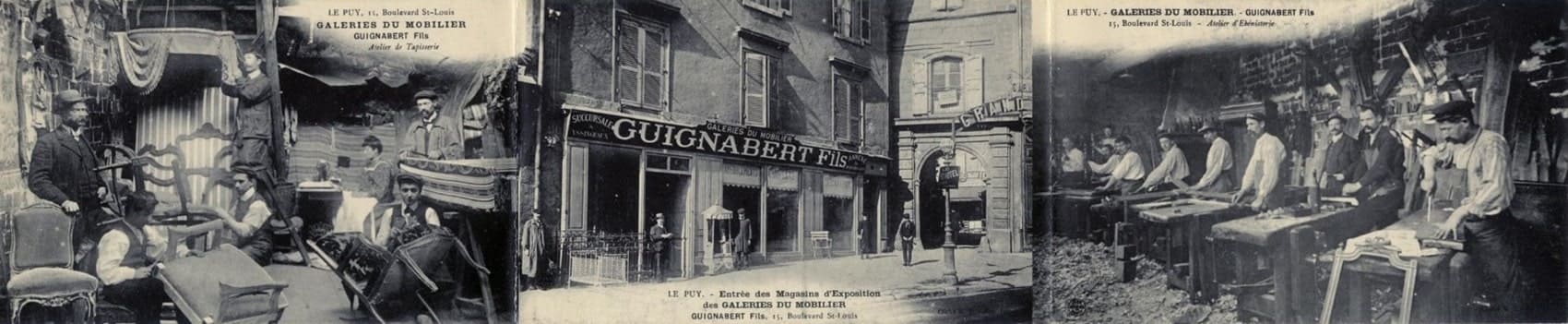
 The rise of tourism in the early 20th century
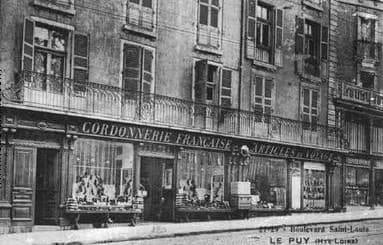
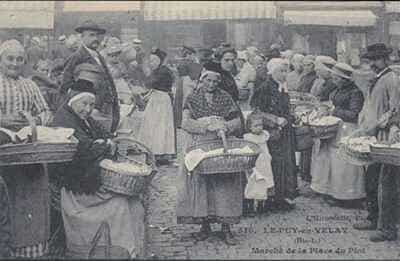
At the turn of the twentieth century, Le Puy-en-Velay slowly but surely established itself on the map of national tourism. The improvement of transportation infrastructure, notably the expansion of the railway, made the Haute-Loire city far more accessible to visitors. They were primarily drawn by the exceptional richness of its religious and architectural heritage, dominated by the Notre-Dame Cathedral—a millennial pilgrimage site—and the spectacular Saint-Michel d'Aiguilhe rock. The local tradition of lace-making also began to capture the interest of curious travelers seeking authentic craftsmanship. A more structured, albeit modest, hospitality industry emerged to welcome this new clientele.
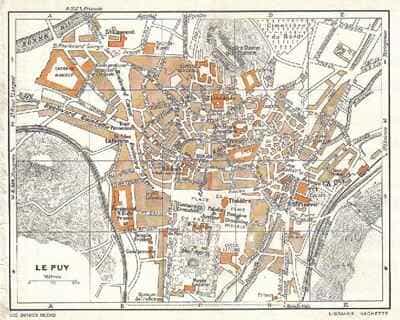
Situated about 3 km from the left bank of the Loire, between the Borne and the Dolaison rivers, it leans against the southern slope of an isolated hill, Mount Anis, from which emerges the gigantic Corneille rock, crowned since 1860 by a colossal statue of the Virgin. This hill occupies the center of a vast circus, surrounded by mountains, which takes on an impressively original character due to the strange volcanic rocks emerging from all sides: to the North, Aiguilhe and its Saint-Michel church, Polignac and its keep; to the West, Espaly where a huge statue of St. Joseph stands, alongside Arbouisset and Ceyssac.
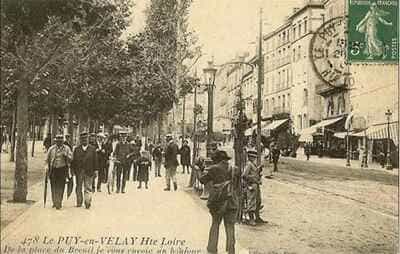
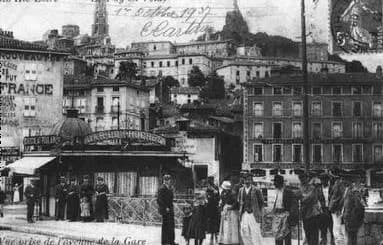
The old town, or holy city, renowned for its pilgrimage, displays its red roofs and terraced alleys that give it an extremely curious, archaic appearance at the foot of its magnificent Romanesque cathedral. The modern districts, wide and airy, extend across the plain around the vast Place du Breuil, the lively center of the city. It sits at an altitude of 625 m, while the viewing platform on the Corneille rock reaches 755 m.
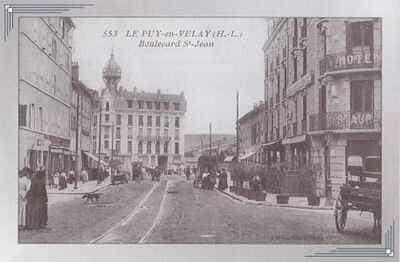
 Transport, accommodation, and local life
Le Puy-en-Velay, boasting quality hotels, is an excellent tourist center and one of the classic stops between Paris and the Mediterranean south. Railway (S.N.C.F.): Le Puy-en-Velay is connected to Paris by three lines: via Saint-Etienne (590 km), via Vichy (536 km), or via Clermont-Ferrand (567 km).
Car and bus services (departing from Place Michelet): for Yssingeaux and Saint-Etienne; Yssingeaux, Tence, Saint-Bonnet-en-Velay, Lalouvesc, and Annonay; Saint-Agrève; Saint-Julien-Chapteuil and Fay-sur-Lignon; Laussonne; Le Monastier-sur-Gazeille; Landos, Pradelles, and Langogne; Cayres, Le Bouchet-Saint-Nicolas, Chapeauroux, and Chambon-le-Gâteau; Monistrol-d'Allier, Saugues, Le Malzieu, and Saint-Chély-d'Apcher; Siaugues and Langeac; Brioude; Blanzac and Saint-Paulien; Allègre, Sembadel-Gare, and La Chaise-Dieu; Craponne; etc.
 Hotels:
Hotel Bristol and Taverne Lyonnaise, 7 av. Maréchal-Foch (40 rooms; tel. 13-38).
Hotel Regina, 34 bd Maréchal-Fayolle (45 rooms; tel. 14-71).
Grand Hotel Lafayette, 17 bd Saint-Louis (37 rooms; tel. 2-21).
Hotel du Cygne, 47 bd Maréchal-Fayolle (30 rooms; tel. 0-88).
Hotel Terminus, in front of the station (40 rooms; tel. 13-60).
Hotel du Parc, 4 bd Alexandre-Clair, in front of the Vinay garden (35 rooms; tel. 1-44).
Hotel du Velay, 5 av. Charles-Dupuy (14 rooms; tel. 5-81).
Restaurants:
Café de Paris Restaurant, 33 pl. du Breuil (tel. 2-37).
 Taverne Lyonnaise Restaurant, 7 av. Maréchal-Foch (tel. 5-42).
Poste Restaurant, 53 bd Saint-Louis (tel. 3-75).
Petit-Vatel Restaurant, 6 pl. Michelet (tel. 10-08).
Cafés:
Place du Breuil.
Post Office:
Av. Charles Dupuy (Pl. D3).
Taxis:
At the station and Place du Breuil.
Tourist coaches:
Organized tours by the Tourist Office during the season: La Chaise-Dieu, Mézenc, Gerbier-de-Jonc, lakes of Issarlès and Bouchet, Vals, Vallon, Pont d'Arc, Aven d'Orgnac.
Entertainment and sports:
Municipal theater, Place du Breuil; 4 cinemas; tennis; fishing.
Specialties:
Lace; Velay liqueurs: verbena, gin, sloe; green lentils.
Tourist Office and Velay Initiative Association:
Theater hall, Place du Breuil (open every day; information; coach tour bookings; reading room; tel. 11-88).
 The lace industry: an essential Velay tradition
Industries:
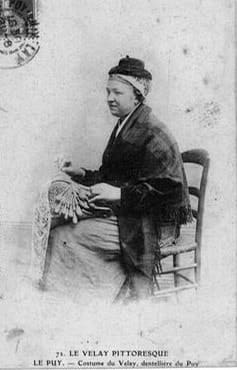
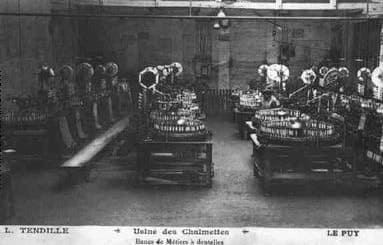 The primary industry, not only in Le Puy but throughout the Velay region, is the home production of bobbin lace, generally crafted from linen, wool, silk, as well as gold and silver threads. This craft has persisted since the 14th century and has consistently been the traditional work of the women of Velay. It once employed about 70,000 women but has experienced a decline since 1914 due to the rural exodus of young women and competition from mechanized production.
Lace makers, seated on low chairs, rest their lace-making pillows on their laps. They enjoy working together: in winter at the home of the best-housed among them, and in summer in the shade of a wall. The groups they form, called semblées or couviges, give the villages of the Le Puy-en-Velay region one of their most characteristic and charming appearances during the warmer months.
In Le Puy-en-Velay itself, many lace makers can still be seen working, notably along Rue des Tables and behind the cathedral. The city is also a major center for machine-made lace, veils, nets, trimmings, and hosiery. Additionally, the city hosts significant liqueur distilleries and serves as a considerable market for dried vegetables, particularly its famous green lentils.
 A millennial history: from Antiquity to Liberation
In the 1st century AD, the land of the Vellaves had its capital at Ruessio or Revessium (now Saint-Paulien), which gained a bishopric by the end of the 3rd century or, more likely, in the 4th century. The Anicium mentioned by Gregory of Tours must have gained or retained some importance due to its strategic military position next to Revessio. Thus, the bishops were compelled by invasions to transfer their seat there in the 6th century. The new capital of Velay (Podium Aniciense, the Puy of Anis) soon gained extraordinary fame and great prosperity due to the pilgrimage centered at its cathedral. Throughout the Middle Ages, this pilgrimage to the Black Virgin of Le Puy was the most famous in France alongside those of Chartres and Boulogne. Among the popes and kings who visited were: Urban II, Innocent II, Charlemagne, Philip Augustus, St. Louis, Charles VI, Charles VII, Louis XII, and Francis I.
 At the beginning of the feudal era, Velay was part of the Duchy of Guyenne; however, in 1162, William of Auvergne, who was Count of Puy, mistreated the bishop and was dispossessed by the king of his county in favor of the bishop, who thereafter lived under the king's protection. This operation, along with a similar one carried out in Mende for the county of Gévaudan, allowed the Crown to establish contact with the Occitan-speaking regions before the Albigensian Crusade.
In 1307, Philip the Fair completed Louis VII's work by signing a treaty of co-lordship with the bishop-count, effectively making himself co-lord of Velay. The bishops also had to struggle against communal demands. During the Hundred Years' War, the city remained loyal to the King of France. Later, when the nearby Cévennes embraced Protestantism, the city resisted attacks from the Reformed, sided with the Catholic League in 1588, and only recognized Henry IV after his abjuration.
In 1944, Le Puy-en-Velay was liberated by the Lafayette group of the F.F.I. (French Forces of the Interior). The German garrison, attacked on August 18 at 9 PM, surrendered on Saturday, August 19 at 4 PM.
Le Puy-en-Velay has been the birthplace of several notable figures, including: Cardinal de Polignac (1661-1742); General Mouton-Duvernet (1769-1816); sculptor-founder Charles Crozatier (1795-1855); writer Jules Vallès (1833-1885); Dr. Chantemesse (1851-1919), inventor of the antityphoid vaccine; and Marshal Fayolle (1852-1928), who commanded the reserve army group that halted the major German offensives in March and May 1918.
 Discovering the modern city and the Crozatier museum
A comprehensive visit to Le Puy takes a full day. The old town can only be properly explored on foot. A stroll through its winding alleys in the moonlight will leave you with unforgettable impressions. However, it is possible to drive up to the cathedral and then proceed directly to Aiguilhe by car. Motorists can leave their vehicle at Place du Greffe, from where they can comfortably visit the cathedral, the cloister, and the Corneille rock on foot.
 The modern city and the museum. From the station, one descends to Place du Breuil via Avenue Charles-Dupuy and Boulevard du Maréchal-Fayolle. At the bottom of the first avenue, you can spot the new post office on the left, and right next to it, the Saint-Pierre church. Originally a Carmelite church from the 14th or 15th century, its aisles were added later, and the façade was reconstructed in the 19th century. Behind the church, a small public garden has been created on the site of the old Carmelite cemetery. Opposite, cross the Dolaison river over a picturesque old bridge and join Boulevard du Maréchal-Fayolle, which leads directly to Place du Breuil.
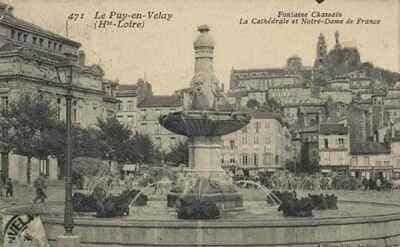
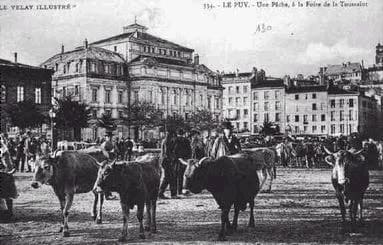
Place du Breuil, the vital core of the city, is a vast, tree-lined esplanade decorated in the center with a monumental fountain erected in 1857 thanks to the generosity of the sculptor and founder Crozatier. It is adorned with four large statues representing the Loire, the Allier, the Borne, and the Dolaison rivers, and below them sit four groups of bronze genies sculpted by Bosio the nephew. The southern side of the square is bordered by the Prefecture, behind which stretches the Vinay garden. On the eastern side, the theater and the courthouse separate Place du Breuil from Place Michelet.
South of Breuil, behind the Prefecture, lies the Vinay garden, a delightful public promenade shaded by beautiful trees. Here, you can admire: a Romanesque portal retrieved from a priory in Vorey; a fish farming establishment; the memorial monument dedicated to the children of Haute-Loire who died for their country; and a monument honoring the politician Charles Dupuy (1851-1923). At the far end of the garden stands the museum, in front of which a monument by Barthélémy was erected in memory of Charles Crozatier (1795-1855).
The Crozatier Museum, founded in 1820 by the Viscount de Becdelièvre and moved to its current location in 1851, occupies a vast building that was considerably expanded in 1868 following a donation from the locally born sculptor-founder Crozatier. Major structural and internal layout renovations were necessary between 1947 and 1949. The collections, which are unexpectedly rich for this austere region, were thoroughly reclassified, and their presentation completely renewed according to modern museography principles under the guidance of curator R. Gounot. The newly renovated museum officially reopened to the public on July 14, 1949.
 The ground floor: from prehistory to the Revolution
Ground floor.
The entrance hall is decorated with Aubusson tapestries from the 16th and 17th centuries. It displays portraits of the museum's curators and benefactors. At the back, the sculpture hall opens.
18th and 19th-century sculpture hall. This room is primarily dedicated to the memory and works of sculptors Pierre Julien (1731-1804), born in Saint-Paulien, and Badiou de la Tronchère. Additionally, it features a marble bust of Napoleon by Canova and works by Cubizolle, Detaplanche, and Oudinè.
To the left and right, five local history rooms are arranged in chronological order. The first, very large room houses collections of paleobotany, paleontology, prehistory, and protohistory. Most notably, it displays the remains of fossilized humans discovered at the Denise volcano, still preserved in their rocky matrix, ranking among the oldest known remains of "Homo sapiens fossilis." The second room is dedicated to the local Gallo-Roman period, exhibiting architectural fragments from major monuments (capitals, friezes), cippi, milestone columns, and sarcophagi.
The third room covers the origins of Christianity up to the end of the Middle Ages. Highlights include the tombs of the first bishops of Le Puy-en-Velay and important pre-Romanesque, Romanesque, and Gothic stone fragments from regional monuments, especially the cathedral. Comprehensive documentation details the ancient architectural states of this edifice, including a recent donation that provides surveys of almost all the frescoes destroyed in the 19th century. The fourth room spans from the Renaissance to the Revolution (featuring precious mementos of the region's native son, Lafayette), and the fifth brings the timeline from the Revolution to the present day.
 The mezzanine: folk art, ethnography, and lace
Mezzanine.
Rooms of local folk art and ethnography: Peasant objects presented in a beautiful woodwork setting retrieved from a Velay village; intricately carved knife woodwork; straw items; playing cards with their printing blocks; locally crafted jewelry from the 18th and 19th centuries; engraved or repoussé copper mule plates inscribed with proverbs (18th century); late 18th-century mule harnesses; tinware; local glassware (Margeride, Doulon); Orzilhac earthenware (1770-1810); — a large lace-making pillow (equipped with 500 bobbins); a curious collection of carved wooden plates for winding lace (17th, 18th, and 19th centuries); a half-ell measuring stick for lace; and the traditional oil lamp (chaleil) and water bottle used by lace makers (the water-filled bottle acted as a lens to concentrate the lamp's light directly onto their delicate work).
 A rich series of objects dating from the 15th century to the present day recalls the massive importance of the Le Puy-en-Velay pilgrimage (pilgrimage badges, ancient images of the Black Virgin) alongside deeply rooted religious life (portraits of St. Francis Regis and Mother Agnès of Langeac).
The Lace Room: — a magnificent collection, impeccably presented in illuminated display cases, tracing the chronological history of lace. The exhibits feature needle lace from the 15th to the 19th centuries and bobbin lace from the 16th century to the present day. Among pieces of extreme rarity is the bodice of Empress Marie-Louise. The intricate techniques and historical uses of lace are detailed in the central showcase.
On the staircase: — Jacopo Vignali (Florentine school, 1592-1664), "Abraham Receiving the Angels"; J.-Fr. de Troy, "Jason Taming the Bulls".
 The first floor: Middle Ages furniture, sculptures, and objects
First Floor.
Room of Middle Ages furniture and art objects: — Pietà, a tapestry bearing the crests of Polignac and Pompadour (early 16th century); a Gothic pulpit featuring the Polignac arms; a large chest displaying the arms of Jean de Bourbon, Bishop of Le Puy-en-Velay (1443-1485); Gothic chests and cathedras; a marble Virgin and Child (14th century); wooden statues; — two reliquaries and a ciborium in Limoges enamel (12th-13th centuries); a Christ figure in champlevé enamel (12th century); an ivory oliphant (Moorish art, 12th century); two bronze lion heads (12th century) salvaged from the cathedral's Porte du For; small bronzes from the 13th and 14th centuries; a wooden statuette of the Virgin and Child (13th century); the head of the tomb effigy of Pons de Polignac (marble, 14th century); a female tomb mask (marble, late 15th century); a weeping statuette (marble, early 15th century); a marble group from a tomb (14th century) — possibly that of Clement VI at La Chaise-Dieu, carved by Jean de Sanholis, in which case the figures represent the pope's sister, Alinorda, and her children; a saint's head in polychrome stone (early 16th century); a head of Christ from a Southern French school (16th century); a miniature of St. Lawrence on the grill (15th century); a crucifix, processional cross, copper reliquary, bronze candlesticks, and a wooden comb from the 15th century; an engraved iron casket and lock plate (15th century); and a stone flask bearing the effigy of Louis XII.
 Room of furniture and art objects from the 16th, 17th, and 18th centuries (located in the center), accessed through a beautiful wooden door drum salvaged from the old chapel of the Visitation (circa 1750): — Aubusson tapestries (16th and 17th centuries); an Auvergne-style decorated credenza (late 15th century); Renaissance seating; a large 16th-century chest; an Italian-style cabinet and two-piece Lyonnais furniture (late 16th century). The room also features a stunning collection of Limoges enamels, including a superb woman's portrait attributed to Léonard Limozin and a beautiful 15th-century Pietà, considered by Marquet de Vasselot as an archetype of violet enamel. Italian and Lyonnais earthenware from the 16th century is also on display.
 Room of Old Master Paintings: — School of Siena (late 14th century), "Virgin with Bird" attributed to Taddeo di Bartolo; Jacobello del Fiore (attributed), "Virgin on a Throne"; Vittorio Crivelli (attributed), "Two Saints"; French School (circa 1420), "Virgin of Mercy"; Italian School (15th century), "Two Saints"; Cerquozzi, "Battle Scene"; — Rhenish School (1497), "The Holy Kinship"; Albrecht Dürer (attributed), "Peasant at the Market" (drawing); — Flemish School (early 16th century), "The Holy Kinship"; School of Van Dyck, "The Weeping Christ"; portrait of Jan Wildens; Frans Francken (attributed), "The Painter and His Family"; Spranger, "Christ and Mary Magdalene"; Craesbeeck, "Beggar Portrait"; Van Païens, "Departure for the Hunt"; still life paintings; Van der Werff (attributed), "Henrietta Maria of France"; portraits by Miereveld, N. Maes, and Terborch; — Ribera (attributed), "The Death of Cato"; — French School (early 17th century), "Departure of the Prodigal Son"; French School (16th century), "The Four Ages of Life"; Claude Vignon (attributed), "A Concert"; J.-B. Pierre, "Bacchanalia"; French School (16th century), "Portrait of a Woman"; Mathieu Le Nain, "Portrait of a Man"; Augustin Quesnel (attributed), "Portrait of a Man"; P. Mignard, "Portrait of a Duchess of Savoy"; La Clementina, "A Marshal of France"; Tocqué (attributed), "Portrait".
Room of 18th and 19th-century paintings: — portraits from the 18th century; canvases by Huet, Diaz, Guillaumin, Trouillebert, and Becdelièvre; Charles Cottet (born in Le Puy, 1863-1925), "Burial in Brittany". — "Fight of a Centaur and a Lapith", original bronze sculpture by Barye.
On the upper floor, extensive sections on general ethnography and natural history unfold. The natural history segment features a fairly comprehensive collection of regional fauna, showcasing very rare specimens hunted in Haute-Loire—such as a European lynx shot in Saint-Julien-Chapteuil in 1823. The museum holds vast reserve collections in storage, notably possessing profound documentation on lace-making and a rich numismatics collection.
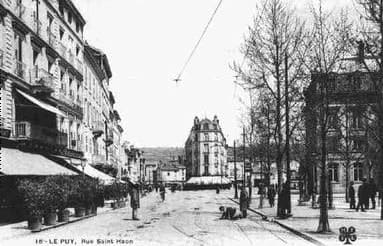 A picturesque stroll through the old town
The old town. — Exploring the old town—which is exceptionally steep and crisscrossed by terraced, stair-like alleys misleadingly called "streets"—is somewhat strenuous. However, undertaking this journey on foot is absolutely essential.
From Place du Breuil, you enter the old town via Rue Porte-Aiguière, which opens onto Place du Martouret. In the center stands the "Lime Tree of Victory," planted on July 14, 1919. To the left rises the 18th-century town hall, featuring a grand staircase and an ornate wrought-iron balcony dating from 1762.
Turning your back to the town hall, head up Rue Chaussade and take the first street on the left, Rue du Bessat. This is one of those quintessential alleys that aggressively scale the slopes of the Corneille rock. To your right along this street lies the high school, formerly a Jesuit college, whose chapel—begun in 1607—now serves as the church of Saint-François-Régis.
The church's façade boasts a Doric colonnade. Inside, the tribune is supported by curious false wooden ribbed vaults adorned with period decorative paintings (similar to the Jesuit chapel in Rodez). The high altar features a grand, elegant gilded wooden altarpiece framing a 1619 Crucifixion painted by local artist François Guy (Francisco Guido). The transepts house other beautiful altarpieces displaying two fine paintings: a "Nativity" and the "Apparition of the Virgin to St. Francis." Restored frescoes can also be admired in the choir.
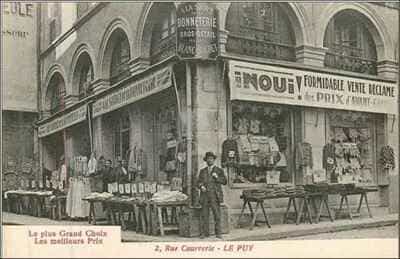
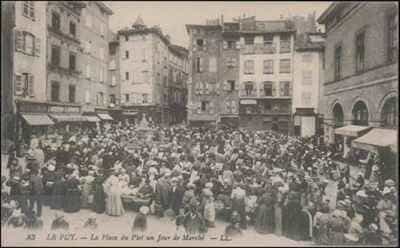
 Turning away from the church façade, proceed along Rue du Collège (house No. 22 dates from 1660, and No. 2 from the early 16th century) and cross back over Place du Martouret to enter Rue Courrerie, located to the right of the town hall (No. 8 exhibits a beautiful late Renaissance façade). This street ends at Place du Plot, which is centered around a large 18th-century fountain adorned with tritons, a layout reminiscent of medieval fountains.
Crossing the square, you enter Rue Pannessac, a street lined with fascinating historic houses: No. 18 and 22 from 1771; No. 33 from 1650; No. 42 from the late 16th century; No. 46 from the early 17th century; and No. 51 from 1576, considered one of the prettiest houses in Le Puy-en-Velay. At No. 57 is the birthplace of Professor Chantemesse (1851-1919), the brilliant inventor of the antityphoid vaccine.
Backtracking slightly on Rue Pannessac, take a left onto Rue du Chamarlenc. At No. 18 stands a peculiar house built in 1689, famously known as the "House of the Cornards." It features two comical sculpted masks (the "cornards" held the historical privilege of playing elaborate pranks on their fellow citizens). At the narrow end of Rue du Chamarlenc, take a left onto Rue Raphaël: No. 23 dates back to 1770, while No. 56 is a Renaissance-era structure.
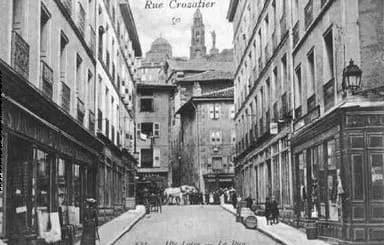 This path brings you to Place des Tables. Directly opposite, at the corner of Rue des Farges (No. 24, built in 1631), is a large gabled stone house featuring a 15th-century door that leads into a Gothic corridor and courtyard. Higher up, on the right, the square is graced by a 15th-century fountain. Next to it stands a beautiful Gothic-Renaissance house at the entrance of Rue Adhémar-de-Monteil (No. 18).
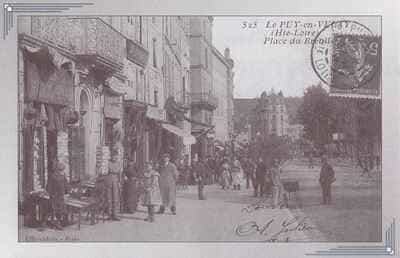
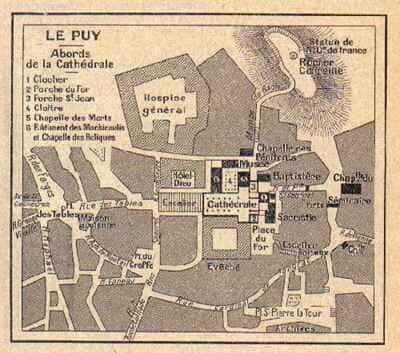
From this square, the picturesque Rue des Tables—dominated by the breathtakingly high façade of the cathedral—climbs so steeply that its sidewalks are carved into steps. During the summer, lace stalls line the street, and lace makers can be seen working directly on their doorsteps. Following this route brings you to the foot of the grand staircase that continues upward beneath the towering porch of the cathedral.
To the left of the staircase stands the Hôtel-Dieu, an ancient charitable foundation. It preserves a two-story Gothic building boasting a strikingly beautiful Flamboyant Gothic façade facing the stairs. The ground floor serves as a chapel and features two exquisite Romanesque portals (described below). On the first floor lies a vast, ribbed-vaulted hall dating from the late 12th century. Behind this structure, and partially obscured by it, the Mâchicoulis building can be seen.
To the left of the Hôtel-Dieu, Rue de Becdelièvre leads down to the General Hospice (1687), located across from a chapel built by Portai in 1752, which features a beautiful door sculpted by Vaneau. Downhill to the left lies the charming 18th-century Chapel of the Visitation. Conversely, walking uphill to the right leads to a ribbed-vaulted porch sheltering the two Romanesque portals of the Hôtel-Dieu. One of these portals is flanked by two curious capitals: one depicts a figure distributing bread to the poor, while the other shows four figures tending to a bedridden patient. Continuing up the picturesque alleyway passing beneath this porch will lead you directly to the Chapel of the Penitents at the base of the Corneille rock.