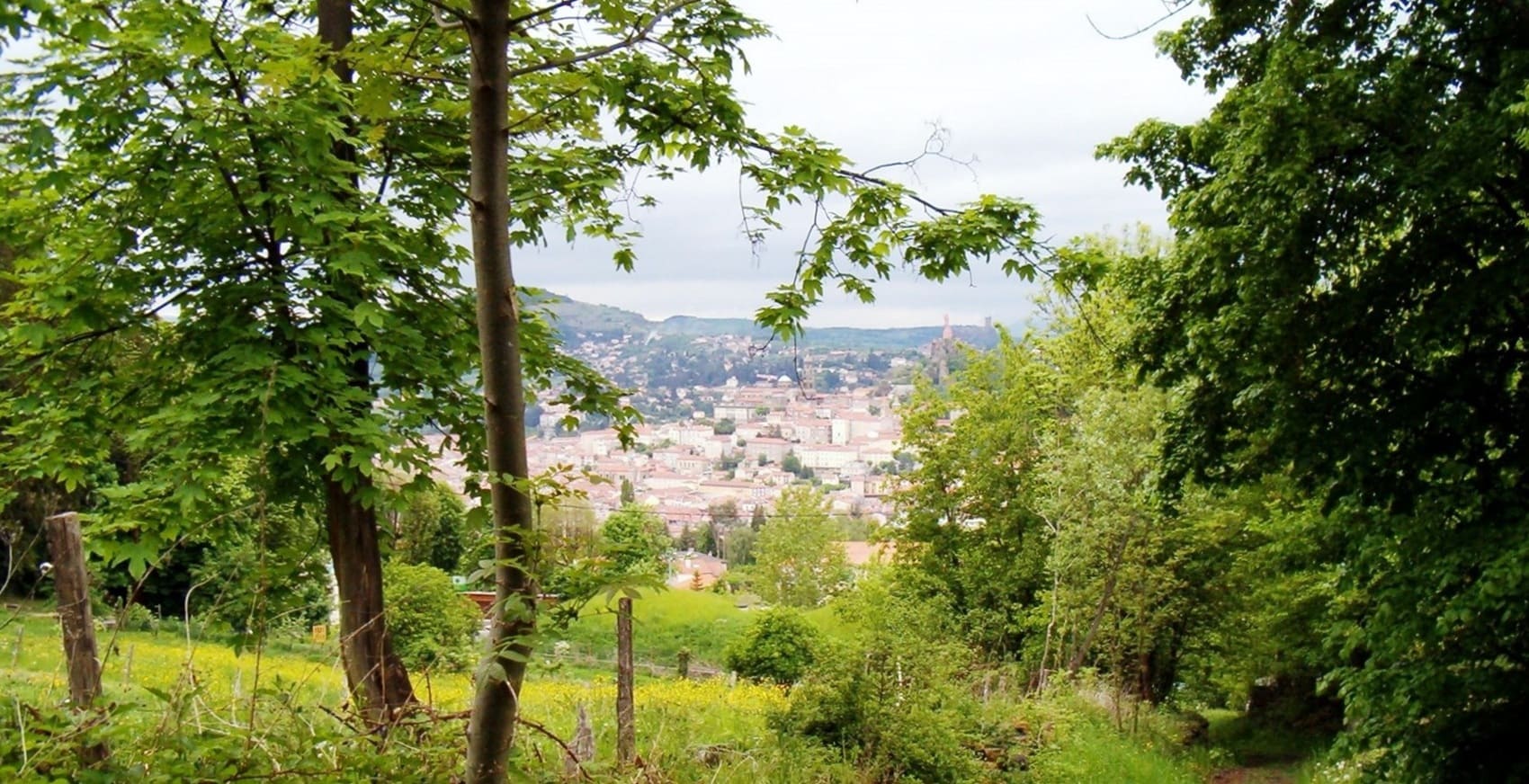
The Stevenson path, or GR®70, starts from Le Puy-en-Velay, a city famous for its religious heritage. This hike follows in the footsteps of the Scottish writer Robert Louis Stevenson and his donkey Modestine, who crossed the Cévennes in 1878. Starting from Haute-Loire, the route crosses varied landscapes, notably the vast plateaus of Velay and Gévaudan, offering a deep immersion into nature and local history. It then leads walkers through Lozère and finally into Gard, to Saint-Jean-du-Gard, over a distance of about 270 kilometers.
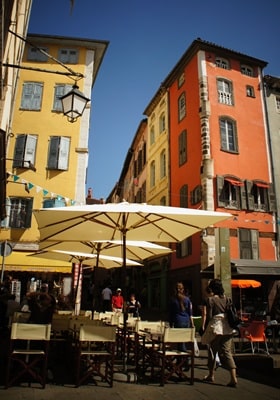 1st stage: From Puy-en-Velay to Le Monastier-sur-Gazeille
No weather miracle this morning; clouds and drizzle still shroud the hills. The undergrowth drips endlessly. In the waterlogged countryside, the flowers droop, overwhelmed, as if sympathizing with the distress of these poor hikers trudging through the muddy trails. Nevertheless, the crossing of Velay remains fascinating despite this penetrating humidity; all this grayness and the low clouds weighing on the landscape add to the wildness of the plateau. What an atmosphere!
Away from Montbonnet, in its rural solitude, the modest St-Roch chapel, dedicated to the patron saint of pilgrims, still bears witness to medieval faith and architecture. I take shelter there for a moment, for a meditative contemplation, joining all those travelers who, throughout the centuries, have pushed open the door of this haven of peace and reflection. The hamlets dot the path, gray stone islets isolated from the world. Pilgrims "with their scallop shells" pass through or brush past them, without seeing a living soul. A long rocky descent brings me to the gates of Puy-en-Velay just in time for a brief break in the weather. Until tomorrow, for the discovery of the old city. Already, the maze of large-pebbled streets creates a highly picturesque charm. Stage of 22 km.
 Before setting off to discover Puy-en-Velay, I need to solve a serious logistical problem: my shoes are betraying me. It's one thing that these "dry line" leather boots have occasionally soaked up water like sponges; the poor things have endured so much! But the right one is seriously injuring my instep; the wound is raw and it's no longer bearable. I did "break them in" properly before my departure. Never have I experienced such a problem in 20 years on the trail! It seems we are just not made for each other. So, I take the plunge and buy a new, relatively light pair, accepting the risks of breaking them in again. I will test them on the rough pavements of Puy-en-Velay and send the "disqualified" ones back home, along with my outdated topographical maps.
Three high-perched religious monuments dominate the city: Notre-Dame de France, the superb basilica, and the chapel of Aiguilhe. I must admit my aversion to this colossal, imperial statue of the Virgin, "cast from Russian cannons captured at Sebastopol." What a bizarre combination! The basilica is a remarkable Romanesque edifice, majestic, even grandiose, which one accesses by climbing a picturesque street lined with traditional lacemakers. But compared to these imposing constructions that echo a triumphant and dominant Catholicism, I prefer the nearby cloister, discreet and hidden. The St-Michel chapel of Aiguilhe, perched high on its volcanic crag at the top of 268 steps, also reveals a small marvel of Romanesque architecture; the elegant Arab style of the porch perfectly matches the oval interior colonnade. And suddenly, in the dim light, an ephemeral sunbeam colors the large gray slabs through the brilliance of the stained glass... I begin to hope for brighter tomorrows.
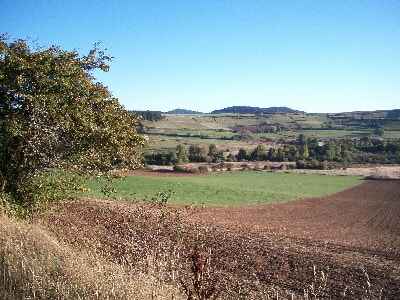 Crossing the Velay plateau
Out of seven days, five were filled with gray skies, rain, and thunderstorms... It wears down your morale. But you just have to believe and hold on! Today, a short stage brings me to Le Monastier-sur-Gazeille, where the "Stevenson Path" truly begins. This is also the start of the "St-François Régis Trail," marked in white and green (Jean-François Régis carried out missionary work in Velay-Vivarais during the 17th century and was chosen as the patron saint of lacemakers. The 193 km trail bearing his name leads from Le Puy to Lalouvesc in Ardèche).
I thus continue my crossing of the Velay plateau. The terrain is moderate, featuring two gentle climbs: first to climb out of the Puy-en-Velay basin—a good morning warm-up—and a couple of hours later, after crossing the Loire River at Coubon. The landscape is pleasant. Make no mistake, the weather does not yet grant me sunny skies, but I have seen worse. After enduring the Scottish showers, I have finally come to be satisfied with this intermittent drizzle. And when a fleeting clearing illuminates the Mézenc range to the East, the chiaroscuro in the infinitely gloomy sea of heavy clouds dramatizes the horizon of the volcanic chain. And it's true, "every cloud has a silver lining." Without this rain, I would have had a picnic on a grassy bank instead of seeking shelter in Archinaud, and I would have missed an unforgettable encounter. She was just returning from foraging for mushrooms. "No," she replied, "there's neither a bistro nor a bus stop in this hamlet." And just like that, she invited me into the old house she had bought back in her hometown. I resisted her stew, but I surrendered to the beautifully golden rice pudding. There was no rush during this short stage, and the weather didn’t exactly encourage lingering outside... So, we extended our conversations, sharing our mutual solitude.
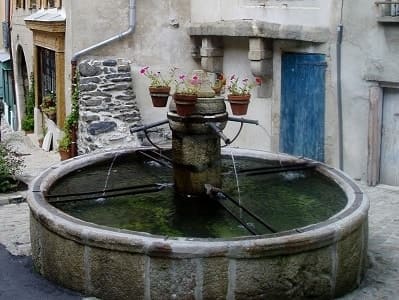 At L'Herm, to avoid the asphalt of a departmental road, I take a detour via Le Mont on a very nice bushy path, and carve myself a sturdy walking stick from a hazel tree thicket. Tonight, in Le Monastier-sur-Gazeille, I sleep at the former police station... which has been transformed into a comfortable hiker's guesthouse! Stage of 20 km.
The Stevenson Path truly begins in Le Monastier-sur-Gazeille. This sleepy little town deep in the Velay region owes much to the Scottish novelist. Without his adventurous journey, who would still visit it, despite its abbey and massive volcanic rock chapel? The town rightly owes him the commemorative plaque erected on the terrace overlooking the Gazeille valley—the very river Stevenson heard "chirping" before he fell asleep!
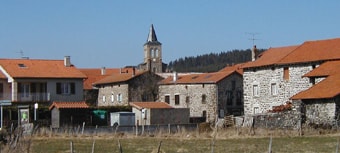
Today, the recent rains have amplified the decibels of its song. And it doesn’t seem to be clearing up overhead. Overhead? The expression is bold "with a sky so low..." as Jacques Brel would sing; and that heavy cloud cover is truly oppressive! Luckily, the morning drizzle doesn’t last forever... We learn to manage the grayness. In fact, it complements the volcanic desert quite well. Since yesterday, it’s true, the contrast is striking; not in the landscape, but on a human level. The heavy foot traffic on the first two stages of the Camino de Santiago and the bustling streets of Puy-en-Velay make me feel—and appreciate—the solitude of the vast plateau even more. Even passing through St-Martin-de-Fugères doesn’t change a thing this Pentecost morning: not a soul in the street, and the church is closed! Yet, I would have loved to discover what hides behind this monumental facade topped by a "comb" bell tower (bell-gables are typical of the Velay plateau. They consist of a single wall pierced with niches that house the bells. Although this volcanic region is not short of stones, this architectural peculiarity is more likely explained by the poverty of the communities cultivating these arid lands. Obviously, it is much more economical to build a single wall than the four walls of a traditional bell tower).
 From the wild Loire to the mysterious Gévaudan
Crossing the Loire at Goudet is a highlight of this stage. This is not yet the languid river that spreads widely through the Valley of Kings between Orléans and Tours. Here, the Loire rolls its swift waters between the high cliffs of wild gorges. The ruins of Château Beaufort, perched on a rocky outcrop, complete this very Hugo-esque scenery. I extend the magic by taking an unmarked detour—purely for the pleasure of it. After Goudet, the official route imposed too much asphalt leading up to Ussel, while a bucolic valley beckoned just off the beaten path. It is the eternal divide between walkers and motorists. At the bar in Goudet, patrons recommended the departmental road to spare me the steepness and muddy streams of the trail. Could these hurried motorists ever understand that a hiker enjoys the journey far more than merely reaching the end of the stage?
 Robert Louis Stevenson says nothing else, and expresses it much more beautifully, in his Travels with a Donkey in the Cévennes: "For my part, I travel not to go anywhere, but to go. I travel for travel's sake. The great affair is to move; to feel the needs and hitches of our life more nearly; to come down off this feather-bed of civilisation, and find the globe granite underfoot and strewn with cutting flints..." What a joy it is to wander through the charming Fouragettes valley between Cros Pouget and Ussel, and further still, at the gates of Le Bouchet-St-Nicolas, to be awestruck by an immense blanket of daffodils dotted with the bright yellow of buttercups! Stage of 24 km.
Is it enough just to have faith? The weather forecast finally promises a lasting improvement... but Le Bouchet-St-Nicolas is shrouded in thick fog. No matter, I bet on the sun and pull my shorts from the depths of my backpack. The guidebook describes this final stage across the Velay as relatively monotonous. What a mistake! Up to Landos, it’s true, the crossing of the plateau is flat and almost straight; but what profound solitude and tranquility in the crisp, misty morning air. I even catch sight of a fox returning to its den, prey in its jaws. How quickly it fled upon discovering my presence!
Past Landos, the miracle happens: the long-awaited sun finally appears! Just in time to enhance the vast landscape and the wide horizon that the trail's balcony unfolds towards Lake Naussac and the heights of Gévaudan. It is a riot of colors and scents, a floral wonderland. The broom bushes now share the spotlight with the swaying carpets of daffodils; there are also clusters of buttercups, forget-me-nots, cornflowers... My botanical knowledge is far too limited to name every piece of this multicolored bloom. This spring day, which almost feels like summer, finally allows for a leisurely stroll along the path leading to Pradelles. In the sunlit village, I gladly linger in the Foirail square, sipping a frothy beer... while hurried motorists wrap up their Pentecost weekend, forming long lines as they drive back north. As a happy hiker, I keep walking south to the rhythm of my solitary steps.
The GR®70 leaves Pradelles through an old neighborhood proud of its heroic past and offers yet another beautiful rural stretch. It is delightful to conclude this spring stage with a long descent to the banks of the Allier River, which I had not seen for several days. It is also a joyful reunion, in the heart of old Langogne, with the Romanesque architecture of its church, the harmonious stone vaulting, and the rich sculptures of its capitals. Right next to it, the monumental covered market (with its massive colonnade and slate roof) testifies to a wealthy commercial past. Stage of 25 km.
 On the Lozère paths towards Ardèche
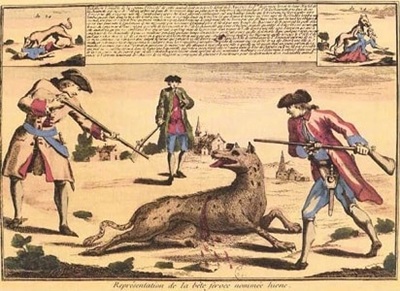
The petty annoyances of a farmer, who went so far as to demand a toll for crossing his land, forced a rerouting of the GR®70. The new route doesn’t thrill me, however, and I still attempt to reach St-Flour-de-Mercoire along the left bank of the Langouyrou stream. I end up paying the price in the Goat Ravine (Ravin des Chèvres), struggling to untangle a path through a maze of cattle tracks. And to think that today I am entering Gévaudan, the land of the Beast! This famous and mysterious creature, devourer of women and children, terrorized the countryside for three years in the 18th century, leading Stevenson to dub it "the Napoleon Bonaparte of wolves"! The region, however, needs no monster to give it a wild atmosphere; after the wide open horizons of the Velay plateau and the vast panoramas towards the Mézenc and the Margeride, Gévaudan closes in with its mystery of deep coniferous and birch forests, and rocky heaths that look almost like bogs.
After L'Herm, the hamlets of Sagne-Rousse, Fouzillac, and Fouzillic hardly break the solitude of my wandering; there is not a single soul to be seen while passing through these sparse settlements. Is the forest more alive? Here, I leisurely watch young deer frolicking until the most alert among them lets out a hoarse bark, triggering their flight. Only Cheylard-L'Évêque feels like an oasis in the hollow of its valley, surrounded by bright broom and the singing of streams. I would have loved to extend my lunch break at the friendly bistro on the small square... But a sign announces an additional 4 km on a route that is already quite winding. The mapped course for this stage is indeed particularly tortuous. The novelist must have been in a very playful mood. I am not complaining, though. Walking through the immense La Gardille forest makes for a deeply peaceful afternoon, crowned by a final idyllic stop on the shores of a small, unnamed lake nestled between the Auradou and Abïauradou hills.
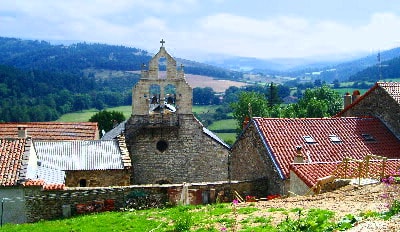 As I descend towards Luc, I am reunited with the Allier once again. The village stretches along the valley slope, beneath the ruins of its castle and an imposing statue of the Virgin Mary, which Stevenson dismissively reduced to "fifty quintals of Madonna"! Stage of 27 km.
Last night, a storm rumbled over the Tanargue heights; this morning, the sky is washed clean and promises a radiant walk... off the GR®70. Indeed, between Luc and La Bastide-Puylaurent, my planned stop for the night, the guidebook indicates a mere 7 km, with the trail mostly following the valley along roads D906 and D154... I have developed a certain fondness for the Allier, but not enough to swallow asphalt and sacrifice an escape into the nearby Ardèche mountains. This detour also allows me to visit the Abbey of Notre-Dame des Neiges, where the Scottish novelist once stayed. Thus, I remain entirely faithful to the spirit of his journey.
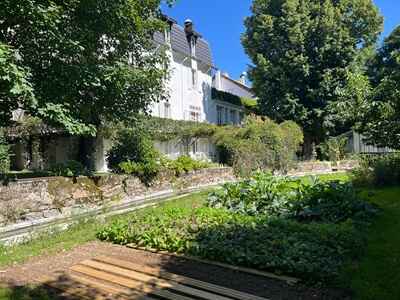 Relying solely on 1:100,000 and 1:25,000 scale IGN maps, I was determined to find a reliable route through the foothills of the Ardèche. I ended up discovering an incredible network of perfectly marked trails. (Since this hike, I have come across a relatively recent guidebook titled "From the Gorges of the Ardèche to the Margeride". It primarily focuses on the GR®4 route between the Rhône Valley and St-Flour. But it also details a whole series of satellite routes: GR®43, GR®44, GR®44A, GR®44B, GR®44C, and GR®44D. Nothing less! Not to mention regional trails like "The Tour of the Ardèche Mountain". A total of 208 pages of itineraries, practical advice, and captivating commentary... pure fuel for hikers' dreams).
The morning climb is quite demanding under a sun that is already beating down. But the scenery is well worth the effort. As is the pleasure of walking through the beech woods covering the Moure de Manibles. The Croix du Pal—a crossroads for the GR®7, the GR®72, and several local paths—is one of those places that heighten the senses: absolute solitude facing a grandiose landscape, looking out towards the summit of the Trois Seigneurs, the Borne gorges, and the Tanargue ridges. Everyday life suddenly seems so dull... The magic continues along the daffodil-lined banks of the Rieufrais river, leading to the Abbey of Notre-Dame des Neiges. We are only two visitors listening to the monks chanting the None prayers under the Gothic vaults. Just like in the temple of nature, it is a silence that invites meditation... Why rush back down to the valley? I leave the trail markers behind to take a detour over the summit of Felgère. From its ridge, I can see my immediate future: the Goulet mountain, and the horizon of Mont Lozère... beautiful days lie ahead. In La Bastide-Puylaurent, right on the banks of the Allier, sits L'Etoile Guesthouse; a former holiday hotel run by a Belgian-Greek host. It is a comforting stopover with a healthy, hearty meal, a long-awaited hot shower, and a good Belgian beer. Stage of 18 km. By Jean-Marie Maquet