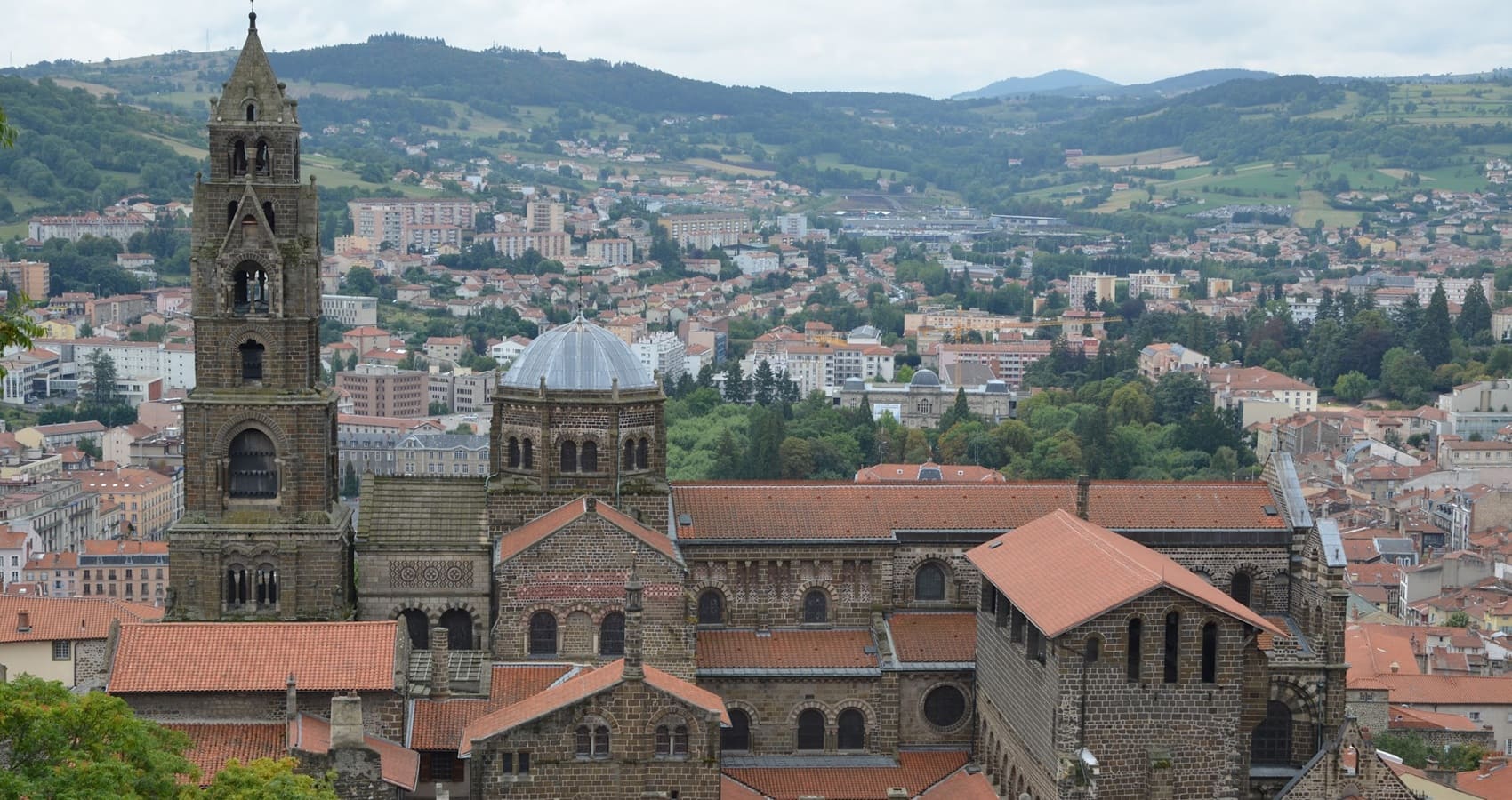
Le Puy-en-Velay, the prefecture of the Haute-Loire department in the Auvergne-Rhône-Alpes region, is a city with an exceptional historical and religious heritage, built upon ancient volcanic necks. Overlooked by the monumental statue of Notre-Dame de France and the Chapel of Saint-Michel d'Aiguilhe perched on its rocky peak, it offers breathtaking panoramas. It serves as an iconic starting point for the pilgrimage to Santiago de Compostela, marking the beginning of the Via Podiensis. The city is also famous for its bobbin lace, an ancestral and recognized craft, and for its green lentils (Lentille verte du Puy). Its historical center is filled with medieval alleys and colorful façades leading up to the Cathedral of Notre-Dame-du-Puy.
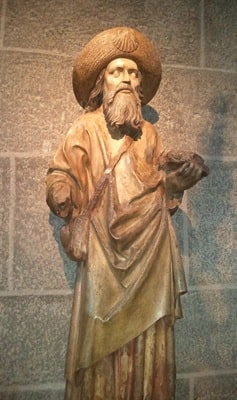 Heritage and Historical Importance
Le Puy-en-Velay is a city located in the Haute-Loire department, in the Auvergne-Rhône-Alpes region. It is a historic and tourist city, known for its architectural and religious heritage, as well as its significance on pilgrimage routes. Le Puy-en-Velay is famous for its Cathedral of Notre-Dame-du-Puy, an 11th-century Romanesque monument, which is listed as a UNESCO World Heritage Site. The city is also known for its Chapel of Saint-Michel d'Aiguilhe, a small church perched on a volcanic rock that offers breathtaking views of the city and the Loire Valley.
 Le Puy-en-Velay is also the starting point for several pilgrimage routes, including the Way of Saint James and the Stevenson Trail. The city hosts thousands of pilgrims each year in search of spirituality and cultural discovery. Finally, the city is also known for its production of lace, porcelain items, and green lentils from Puy, a locally grown variety of lentils appreciated for its flavor and quality.
Seat of the bishops of Velay and capital of the Velay country since the 6th century (Poridum Anicience). The pilgrimage to the Black Virgin brought fame and prosperity to the city from the early Middle Ages. Le Puy-en-Velay was initially part of the duchy of Guyenne, then came under the jurisdiction of the Count-Bishops, co-lords with the King of France, and remained loyal to the Crown as well as to the Catholic faith. The lace-making industry flourished particularly in the 16th century.
In the past, pilgrims gathered in the Place du Plot, each looking for companions to make the journey safer. From this square, in fact, several pilgrimage routes depart: Rue Pannessac towards Auvergne, Saint-Julien-de-Brioude or La Chaise-Dieu, Rue Saint-Jacques towards Compostela, and Rue Saint-Gilles or GR®700 Voie Régordane.
On Rue Saint-Gilles, there was a hospital of the same name known since 1227. This street opened into the rampart through the Porte de Saint-Gilles, so called, writes Etienne Médicis in the 16th century, because from this gate one exits the city of Le Puy-en-Velay to go to the ancient city of Saint-Gilles down in Languedoc. At the corner of Rue Saint-Gilles and Place du Plot, one can admire a statue of Saint Gilles by Madeleine Déchaux, placed on November 13, 1997. On the site of the Town Hall of Vals, there was a hospital in the 12th century, then a convent of Penance, an Augustinian monastery, and finally, until fairly recently, a Jesuit novitiate.
 In the Place du Breuil, at the center of the city, we notice the Crozatier fountain (famous founder, 1794-1855). The city statue dominates the monument. The waterways of the department are represented in human form: the Loire, the Allier, the Borne, and the Dolaizon. The Haute-Loire Prefecture, the Palais de Justice, and the Theater surround the Place. By Rue Porte-Aiguière, we arrive at the Place du Martouret, which was the site of capital executions in past centuries and during the Revolution.
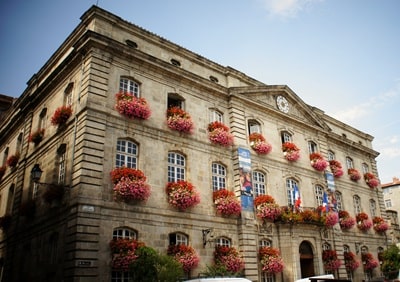
The Town Hall, rebuilt in 1766, has retained its classical façade. The interior, destroyed by a fire in 1964, has been entirely restored in a functional manner. 100 meters away, on the East side, you can see the Church of the College, the first monument in "Jesuit" style built in France. It houses gilded wooden altarpieces and magnificent 17th-century paintings (by Guy François). In Rue Saint-Pierre, above the Old Hall, is the National Library containing precious documents.
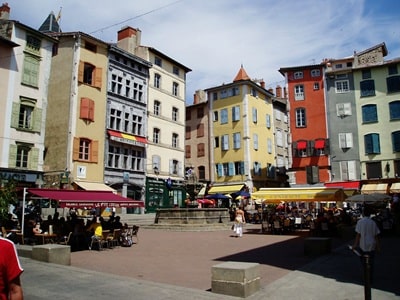
Nearby, we discover the Place du Plot with a beautiful fountain called "La Bidoire" from the 12th century. In the 16th century, wrongdoers were exposed at the pillory (an animated market is held there today on Saturday mornings). Rue Pannessac, to the northwest of the square, was the main artery of the old town. Beautiful façades of houses bearing numbers 29, 33, 42, 46, and 51 are to be noted. In the alley of Chamarlenc, number 16 was the "Cornards" house, recalled by macarons with inscriptions. Following the street, we arrive at Rue Raphaël (façades no. 48 and 56). This street opens to the west on Place des Tables, adorned with the beautiful "Choriste" fountain (15th century) as well as a Renaissance façade.
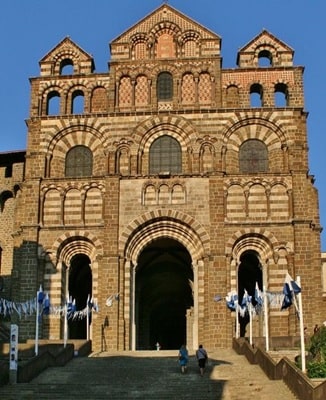 The Cathedral of Notre-Dame-du-Puy
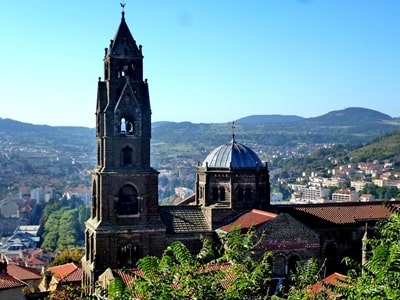
The Cathedral of Le Puy-en-Velay, officially known as the Cathedral of Notre-Dame-de-France, is a masterpiece of architecture. Listed as a UNESCO World Heritage site, this cathedral is a major pilgrimage site and an essential symbol of the city.
Built on the foundations of an ancient 4th-century church, the current cathedral was erected between the 11th and 12th centuries. It was dedicated to the Virgin Mary and played a crucial role in the journey of pilgrims to Santiago de Compostela. Over the years, the cathedral has undergone several transformations and embellishments, particularly inside with the addition of chapels and majestic decorations.
The architecture of the cathedral is a splendid blend of Romanesque and Gothic styles. The façade is adorned with sculptures representing biblical scenes and figures of saints. The portal is particularly impressive with its richly decorated tympanums. The bell tower, octagonal in shape, rises to over 80 meters in height and is an iconic element of the city's silhouette. Inside, you can admire ribbed vaults, side chapels, and remarkable sculptures. The stained glass windows add a colorful and warm light to the space.
The Cathedral of Le Puy-en-Velay is an international pilgrimage site. Every year, thousands of pilgrims come to pray and seek grace. The cathedral also houses relics, such as that of Saint Philomena, which attract many faithful in search of spirituality.
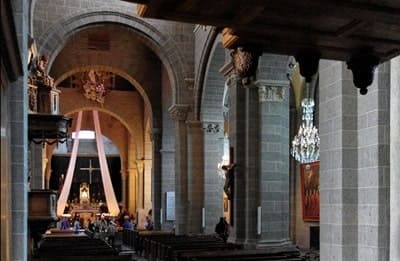
 From Rue des Tables, one discovers the impressive western façade of the monument. By climbing the 134 steps directly, one enters under the grand porch created by constructing four bays of the nave on pillars (the church floor is located below the three large stained-glass windows). Two 12th-century cedar doors and 13th-century Byzantine frescoes deserve your full attention. The Stone of Fevers is the origin of the pilgrimage since the end of the 4th century. At this location, you turn right and enter the basilica through the south aisle. The Romano-Arabo-Byzantine architecture is remarkable there, as are the three original parts: the north transept with its frescoes, the bays of the central nave, and the Porch of the For.
Built in the 11th and 12th centuries and classified as a historic monument, the cloister of the cathedral constitutes one of the most beautiful Romanesque ensembles in Europe. The semi-circular arches are surmounted by a mosaic of white, red, and black diamonds. The meeting room of the chapter of the cathedral is adorned with a Byzantine-inspired fresco representing the Crucifixion (13th century).
 Although restored in the 19th century, the cloister presents a remarkable series of historiated capitals from the 12th century (representation of the four evangelists, race of centaurs, an abbot and an abbess disputing the crozier...). Housed in the former Hall of the States of Velay, the Treasure of religious art gathers ex-votos, embroidered cloaks of the Black Virgin of Le Puy-en-Velay, a 15th-century parchment, as well as 17th-century sculptures by Pierre Vaneau.
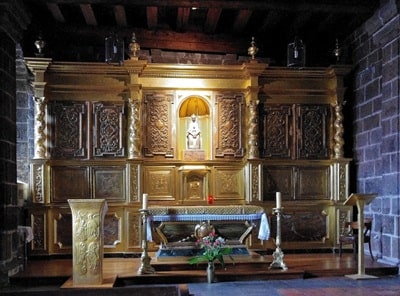
The current Black Virgin, which replaced the one burned during the Revolution, is displayed on the 18th-century High Altar. It is carried in procession every year on August 15, during the Feast of the Assumption. Also noteworthy inside: the grand organs, the pulpit, the Martyrdom of Saint Andrew (sculpture by Vaneau from the 17th century). In the north aisle: Painting of the vow of the Plague of 1630. Opposite the pulpit, there is a very beautiful Christ from the 14th century. In the south aisle: Vow of the Consuls (1653) and the frescoes of the North Transept. Under the Porch of the For, one observes the lintel of the small door with inscriptions recalling Scutaire, architect of the first church built around the year 430. The vaults with pierced arches (a true architectural jewel), the fluted columns, and the wonderful symbolic capitals complete the ensemble. From the square, one enjoys a very beautiful panorama of the city and the 56-meter-high bell tower.
At the sacristy, the Bible of Theodulf (around the year 800), a 15th-century Piéta and a 15th-century Head of Christ are preciously preserved, as well as reliquaries, 17th-century sculptures, chalices, and various ornaments. Under the bell tower, we find Gallo-Roman sculptures and canons' tombs. The Porch Saint-Jean (12th century) adjoins the Baptistery of the same name, dating back to the 10th century, where baptisms took place before the Revolution. The street that opens to the north gives access to Notre-Dame de France and the cloister. In the Building of Machicolations, one can admire a mural painting of the Liberal Arts. On the 1st floor, the Treasure of religious art houses numerous historical works of art.
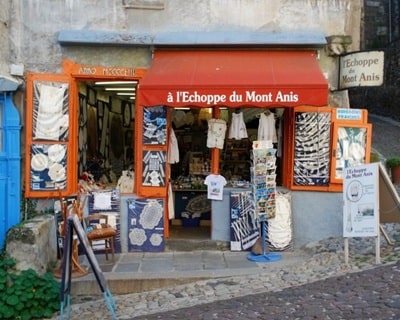 The Lace of Le Puy-en-Velay
The National Conservatory Workshop of Lace of Le Puy-en-Velay, created in 1976, is attached to the general administration of the National Furniture, under the supervision of the Ministry of Culture. A true local institution, this workshop perpetuates a centuries-old know-how intimately linked to the identity of the city.
The National Workshop is responsible for maintaining the complex techniques of bobbin lace: mapping, actual lace making, finishing, and assembly. It produces pieces of very high artistic quality on contemporary models: tablecloths, napkins, handkerchiefs, doilies, sheets, etc. These prestigious works directly enter the collections of the National Furniture. These unique pieces are presented to the public during exhibitions in the Workshop itself, or during prestigious exhibitions in France and abroad.
Created in 1974, the Teaching Center for Bobbin Lace pursues two essential missions: maintaining tradition and practice through teaching, and the meticulous safeguarding of the lace heritage. Over the years, the Center has acquired international outreach, and its correspondence courses, followed worldwide, make it an absolute reference in lace training. Its exhibition rooms allow the public to discover a remarkable collection of ancient and contemporary laces, regional, national, and international, as well as a rich exhibition of lace equipment, looms, and bobbins from different countries.
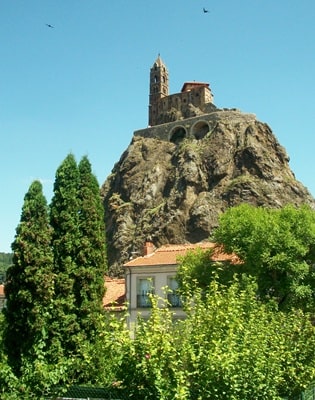 The Rock Saint-Michel d'Aiguilhe
One of the most astonishing volcanic sites in France, the Rock (with a vertiginous height of 82 m) and the Chapel of Saint-Michel d'Aiguilhe constitute an exceptional geological and architectural ensemble. A true technical and human feat, the chapel built in 962 came into being thanks to the bishop of Le Puy-en-Velay, Gothescalk, who decided on its construction upon his return from a pilgrimage to Santiago de Compostela.
 Discovered in 1955 during altar restoration work, the Treasure of Saint-Michel consists of venerable relics (Christ, fabrics, ivory box) dating back to the very origins of the construction. It is preciously preserved in the chapel. Saint-Michel d'Aiguilhe is a notable and striking example of Romanesque architecture, with its stone vaults and thick walls, erected at the site of an ancient sanctuary dedicated to Mercury. It is dedicated to Archangel Michael, the patron saint of knights and symbol of protection.
The plan of the chapel perfectly matches the irregular shape of the summit of the volcanic rock and is characterized by a single nave, a semi-circular apse, and an elegant bulbous bell tower. The use of polychrome volcanic stone for its construction gives it a unique appearance, harmoniously and organically integrated into the surrounding landscape.
To reach the chapel, visitors must take a steep path of 268 steps carved directly into the rock, offering breathtaking views of the valley, the cathedral, and the city of Le Puy-en-Velay. This physical journey is both a challenge and a deeply enriching experience. Inside, the chapel presents very beautiful ancient frescoes and sculptures testifying to the religious art of the Romanesque era. The olympic calm and serenity of the place make it a space particularly conducive to meditation and prayer.
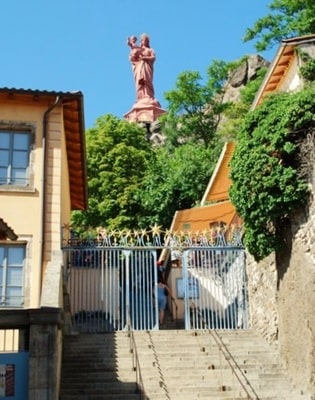 The Rocher Corneille and the Crozatier Museum
In the heart of the historic sector of Le Puy-en-Velay, just a few minutes' walk from the City Center, the monumental Statue of Notre-Dame de France constitutes a true technical feat. Erected in 1860, it was cast with the metal of 213 Russian cannons captured during the siege of Sevastopol during the Crimean War and offered to the city by Napoleon III. The work of sculptor Jean-Marie Bonnassieux, it measures 22.70 meters high with its pedestal and weighs 835 tons. It represents the Virgin Mary carrying the child Jesus, blessing the city. The statue was inaugurated to express the fervent faith of the inhabitants of Velay and remains a symbol of protection today. Each year, religious ceremonies and cultural events are organized in honor of Notre-Dame de France at the foot of this belvedere.
The Rocher Corneille on which it rests is an ancient citadel and the highest point of the Ponot basin. This impressive basaltic monolith, rising to nearly 750 meters of altitude, is the direct result of the erosion of ancient lava flows of the volcanic region of Velay. The rock offers a unique 360-degree panorama (equipped with an orientation table) on the red roofs of the city, the cathedral, and the rolling landscapes with bluish horizons.
Returning down towards the city, located in the Henri Vinay Garden, a true green haven in the heart of Le Puy-en-Velay, the vast building of the Crozatier Museum (inaugurated in 1868) houses very diversified collections.
The importance and encyclopedic character of its galleries form an exceptional cultural ensemble. Fine arts (paintings, sculptures), regional ethnology, Le Puy lace, paleontology, mineralogy, natural sciences, mechanics, and local history stand side by side. The discovery of these various rooms constitutes a true treasure hunt for visitors. The museum notably possesses a very beautiful collection of 19th-century works, including canvases by artists such as François Marius Granet and Emmanuel Lansyer.
 The Verveine du Velay
The Verveine du Velay has been, since 1859, an undeniable emblem of the gastronomic heritage of Auvergne and Haute-Loire. The famous Pagès Distillery, strong of its heritage, opens its doors to the public and invites you to enter its universe imbued with tradition, history, and authenticity.
During visits, one discovers the manufacturing secrets of this famous liqueur elaborated from a closely guarded recipe, comprising a complex blend of 32 plants, herbs, and spices, including the flagship ingredient: verbena cultivated directly on the Velay mountains.
This liqueur is the fruit of exceptional artisanal know-how dating back to the early 19th century. The monks of the region, very skilled in the exploitation of medicinal plants, were among the first to elaborate infusions based on verbena, a plant highly renowned for its digestive and soothing virtues. The recipe was then refined to become the complex liqueur we know today.
The manufacturing method, remaining strictly artisanal, includes several crucial steps: the maceration of plants in alcohol, distillation in magnificent copper stills, then prolonged aging in oak barrels. The Verveine du Velay is visually distinguished by its bright green color (although a yellow version also exists) and on the nose by its fresh and intensely lemony aroma.
In the mouth, it offers a perfectly balanced sweetness, marrying notes of aromatic herbs and citrus. Traditionally tasted as a digestif after a good Auvergnat meal, it is also increasingly sought after in the creation of contemporary cocktails.
 Fortresses of Saint-Vidal and Polignac
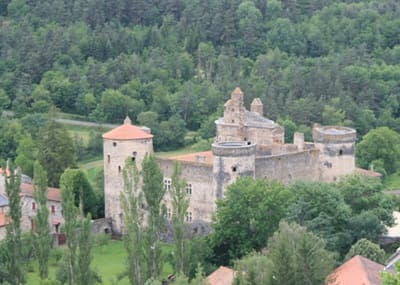
Just 12 kilometers from Le Puy-en-Velay stands the Château de Saint-Vidal, an imposing medieval fortress classified as a historic monument. Ancestral fief of the powerful family de la Tour de Saint-Vidal, this building was first a fortified house in the 13th century, before being considerably enlarged in the 14th and 15th centuries. In the 16th century, Antoine II de la Tour de Saint-Vidal (governor of Velay and Gévaudan) radically transformed the castle to adapt it to the modern artillery of the time, adding an imposing keep to the three existing towers and erecting a first defense enclosure.
During the troubled periods of the Hundred Years' War and especially during the violent Wars of Religion, the Château de Saint-Vidal constituted a major defensive bastion, surviving the tumults of French history. The castle retains from its feudal origin superb vaulted cellars and a vast ogival kitchen equipped with immense fireplaces. Its decorative elements (Renaissance windows, sculpted stone portal, French ceilings, and ogive-vaulted gallery bordering an inner courtyard) harmoniously contrast with its raw military architecture, visible by its numerous arrow slits, gunports, and machicolations.
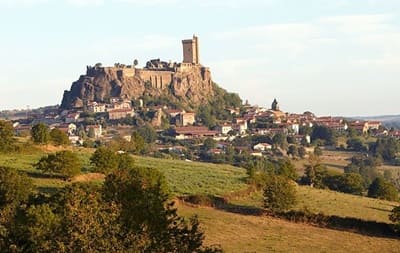 Not far from there, the Fortress of Polignac imposes itself majestically in the landscape. Founded in the 11th century by the Polignac family, a high nobility lineage that played a crucial role in regional and national history, it was initially designed as an unassailable ultimate defense point. This medieval residence, endowed with its walkway and a unique defensive system, proudly stands on an immense volcanic basalt platform (a dyke) that serves as its natural pedestal.
Cradle of the illustrious House of Polignac, the eventful history of the fortress merges with that of Velay and the Kings of France since the early Middle Ages. From the top of the large square keep erected in the 14th century (32 meters high), the panorama over the Puy basin and the surrounding massifs is exceptional and vertiginous. A beautiful Romanesque chapel dedicated to Saint George is also found inside the fortified enclosure, adding a strong spiritual dimension to this military site.
The Polignac family, intimately linked to these fortresses, is an illustrious lineage whose members were allied to the kings of France, distinguishing themselves in numerous military campaigns and complex diplomatic affairs, notably by firmly supporting the Catholic cause during the Wars of Religion. Through their strategic alliances, their cultural and intellectual patronage, the Polignacs have left an indelible imprint on the political, religious, and artistic heritage of the Haute-Loire.
 The Sanctuary of Saint Joseph de Bon Espoir
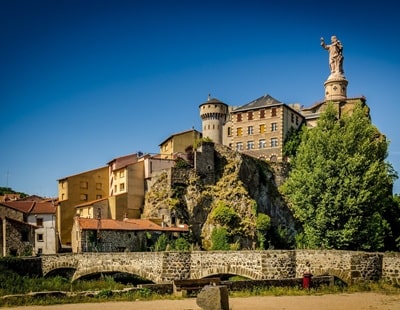
The Sanctuary of Saint Joseph de Bon Espoir, located in Espaly-Saint-Marcel in direct edge of Le Puy-en-Velay, is a place of pilgrimage and recollection particularly appreciated by locals and visitors. This majestic sanctuary is dedicated to Saint Joseph, patron saint of workers, fathers, and families, and embodies a deep spiritual dimension anchored in the urban landscape of the agglomeration.
The sanctuary is dominated by a colossal statue of Saint Joseph (22.40 meters in height), built in reinforced concrete, a bold work by Brother André Besqueut. Its realization, which durably marked the silhouette of Espaly, was officially approved by Pope Pius X. Its solemn inauguration and blessing took place on April 11, 1910.
This sanctuary was founded in the 20th century to meet the growing need for places of prayer and spirituality linked to the industrial and working-class development of the time, honoring the values of labor and protection attributed to the Saint. Over the decades, the sanctuary has developed, affirming itself as an important spiritual center of the Velay region.
The building and the adjacent cave-chapel present a singular architecture, both modern and welcoming. The ensemble is bordered by manicured gardens and terraced green spaces that favor meditation, silent contemplation, and calm, away from urban agitation. Inside the chapels, frescoes, mosaics, and sculptures retrace the life of the Holy Family, creating a serene atmosphere ideal for prayer.
Today, the Sanctuary of Saint Joseph de Bon Espoir maintains dynamic religious activity, regularly organizing masses, patronal celebrations (notably on March 19), and spiritual retreats that gather hundreds of faithful coming from the entire department and the Auvergne-Rhône-Alpes region.