 Immersing in the Bird King Festival
"Hurry up, change, we are going to rehearse..." A "court jester" gesticulating like a hundred nervous devils speaks to us. Multicolored, laden with bells and dressed in a strange patchwork cloak, he grabs the reins of Noée and ties her with her companions, several donkeys of different sizes and colors... "What group are you in?" Our astonishment and silence intrigue him. "Aren't you participating in the festivities?" A priori, all festivities please us, but neither the donkey nor her handlers received an invitation. Behind the friendly "jester," a real camp of performers is set up. Bonfires, long wooden tables, tin dishes, and jugs everywhere... Young warriors are practicing with flails and crossbows. A brief question from us is met with a long response from the intriguing braggart.
 The old town of Le Puy is preparing for the Renaissance festivities. All the inhabitants are involved. We encounter bears—both real and fake—magicians, bourgeois, gallant ladies, and bawds. Gendarmes direct traffic to allow the men-at-arms to pass. Fireworks and feasting are planned for several days. It’s the festival of the Bird King, which will designate the best archer in the city. You must kill the papegai, the parrot in Old French.
For a week, the performers joust and feast. Even the mayor dresses up! Not wanting to disappoint our interlocutor, we admit our humble status as passing vagabonds... A good sport, he offers to take care of Noée—and our backpacks—and give her some old bread while we eat. In passing, he offers us a glass of hippocras, a warm wine spiced with cinnamon and cloves. "Served in winter and often for dessert." Cheers...
Thus, every year, the city enjoys going back in time. A nice gesture, it's for History's sake. On every rampart, there are cardboard crenellations and soldiers in armor. Improvised drawbridges rise at every corner, plastic cannons threaten, under the watch of halberdiers as "stiff" as the town's steeples. They have fun with the fake, forget their worries, and toast at the slightest occasion... Once, the festival of the Bird King was invented to prevent young people from frequenting taverns too ardently. While they raised their crossbows, they drank less. Today, it’s the exact opposite. No sooner is the arrow shot at the fake bird than everyone rushes to the bar for fresh mugs. It’s a mock Renaissance that unfolds, good-naturedly, far from the tensions and violence of the past. In the old days, there was no fair without a knife wound.
 Inns, Fervor, and Pilgrimage to Compostela
At the inn, it was customary to fill the guest's glass to the brim. Upon sitting down, you would slip the long, pointed Laguiole knife under the table for easy access. You had to be ready to stick it in the other man's ribs if the conversation got heated. Yet, the armed drinkers belonged to the brotherhood of penitents! They wore the cross and, for the slightest reason, would fall to their knees in genuflection. When Saint François Régis, patron saint of lace-makers, sought to evangelize them, it was often under a rain of blows that he had to accomplish his holy task. In the same spirit, as an attentive observer, the fine Auvergnat storyteller Henri Pourrat knew how to wield his pen. The following anecdote is reminiscent of one told by Lucifugus Merklen about a cuckold and a defective gutter: "We tell the tale of a peasant hidden in the bushes, gun in hand, on a Sunday morning. He is waiting for a neighbor with whom he has a bone to pick. However, time passes. And suddenly, hearing the three chimes from the village bell tower, he bursts out: ‘Ah, the pig! He’s going to make me miss mass.’”
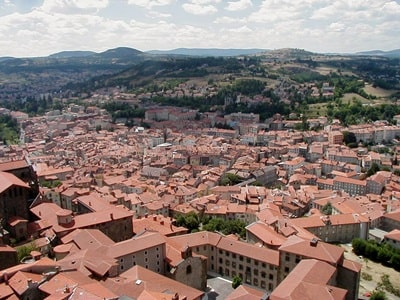 The populations of yesteryear, with their wild and delightful walls, possessed a sense of the divine and of accuracy. The peasantry and the country folk resemble old wood engravings with the ink still fresh. When noon rings from the chimes, we discover the tavern of the "described" time, taking care to look under the table for any hidden rapier or stiletto. Overheard in L'Âme des Poètes, the café where we have taken refuge: "You know, we only do nonsense on earth, what else?" And then: "This city is a mixture of priests, stuffy bourgeois, peasants who have come to the city, and fools."
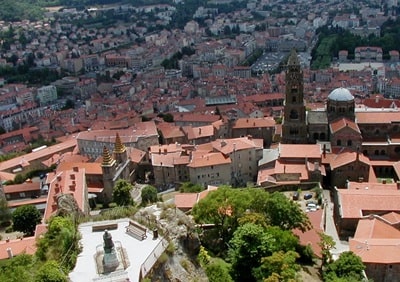
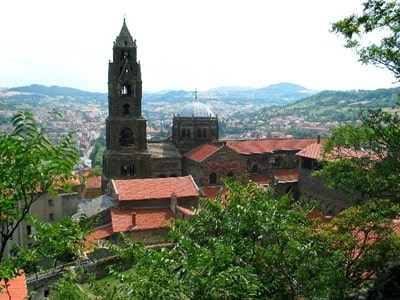
The Velay is the very kingdom of robber barons and passing pilgrims, of pious women bent over their lace-making cushions, and of fierce old men returning from the market, singing, shouting, taking up the whole road; of little green lentils and jewels enriched with garnet, of the drabness of the ravine and the splendor of the mountains. After a glass of warm wine accompanied by ginger and peppered tuna, saffron rice, and a rabbit stew, we diligently visit the Romanesque cathedral—where Bishop Le Breton and the Black Virgin, pride of the city, rest. A maze and a remarkable building. A bas-relief represents a donkey capering like a rabbit. Around us, people are actively praying in silence. Should we remind ourselves of the Byzantine, Eastern spirit of the cathedral? Should we recall that, along with Paris, Arles, and Vézelay, the cathedral is a starting point for the pilgrimage that leads to Santiago de Compostela—six hundred kilometers to Roncesvalles and seven hundred and fifty from the Spanish border to Santiago de Compostela? Further on, Mr. and Mrs. Tourist—she in Bermuda shorts with a pilgrim's staff, he in a purple tracksuit with a camera—bustle at the foot of the church of Saint-Michel-d'Aiguilhe. The camera is on its tripod. He activates the self-timer and enthusiastically joins his partner, who takes up quite a bit of space in the photo. The timed operation is repeated three times. In the background and from a low angle, the chapel of Saint-Michel remains unshakeable.
 The Upper Town and the Art of Lace-Making
At the top of the volcanic and tourist peak, a beggar, also dressed in a purple tracksuit—does the religious attraction encourage individuals to adorn themselves in cardinal colors?—asks for his share of the pie. We assess the climb at several hundred steps.
Begging and mountaineering, the brave man deserves his alms.
In the upper town, the lace-makers are at their posts, methodically placed in the winding streets and picturesque alleys. Along with the famous green lentil, they are the other somewhat outdated pride of Le Puy. Almost a controlled appellation of origin. They are most often seen on postcards, sometimes on the doorsteps of the shops, finishing the doilies that will pile up like a stack of pancakes. Above the lace-makers, the ritual sign seems to force your hand or your wallet: "No imported lace here." Even if the lace were imported or mechanized, one can always pretend. The genuine old shops of yesteryear are permanently closed. Despite its architectural qualities, its alleys, and its ochre or pink walls of fine craftsmanship, the city leading to Spain fails to fully unveil its identity.
Religious and rainy, the city mixes piety and mystery, the sacred and sorcery. Faith and tourism too, which are in no way incompatible. The streets and historical facades retain a freshness that the Bastille Opera could envy. Yet, the locals feel compelled to add more plaster and stucco. Beware of decorum. This city that believes in miracles, or believes it does, is it the lava from the volcanic plateaus that has thus "Pompeii-ed" it?
 Macabre Legends and Cemetery Anecdotes
Henri-Pourrat Street descends towards the cemetery. To our left, the old town with its tourist-religious trinkets, snow globes and Black Virgins, candles and posters of patron saints. To our right, uphill, the cemetery and the devotees recalled by the Almighty. It’s just a matter of stepping over an alleyway to move from worship—and its collection plate—to eternity. Better than a place name. In the middle of the cemetery, a young student unpacks mortuary anecdotes. She teaches the studious and mesmerized tourists that the penitents of Saugues come to Le Puy on Good Friday. There, they invade the restaurants to feast on frog legs specially prepared for them. The connection with the holy water fonts? Tourists comment, but the guide reforms the ranks... When she recites "The Gypsy and the Leukemic," one would think it was a new fable by La Fontaine. Everyone quickens their pace and lends an ear... With a haughty forehead, pale and serious face, the guide gets into character before delivering her embellishments. Around her, the group has tightened. Shh, it’s starting...
A few decades ago, a gypsy fell in love with a young girl from Le Puy. Alas, he learns that his beloved is suffering from leukemia. Our man is not easily deterred. He knows that love is a matter of magic and keeps a grimoire from his grandmother—a pale copy of the Grand Albert—to awaken the dead. Visible only at solstices and on a stormy night, the guide specifies. The young woman is weakening; her veins turn bluer with each passing day. She becomes diaphanous like a shroud, preparing for her final journey... Meanwhile, our good gypsy takes the opportunity to revise his tricks and formulas. Alas, the beloved breathes her last! The gypsy follows the funeral, identifies the tomb where the deceased is to rest, and patiently endures. On the evening specified in the magic book—storm, solstice, and all the required ingredients—he returns to the cemetery, picks the lock of the chapel door, and descends into the vault where four coffins are piled. Armed with a lantern, he spots the one he believes to be his beloved’s bed. In the silence of the crypt, he forces the wood open—horrible creaking sound from the guide. Just as he slips his forearm into the coffin, a decomposed and laughing corpse appears to him...
 In fright, he releases the lid. His hand, crushed by the weight, breaks several ribs of the deceased in passing. So there is our gypsy with a hand stuck in the ribcage of the one whose heart he coveted. The lantern shatters on the floor. Terrified and blind in the dark, the coward cannot extract his arm from the macabre box. This time, he understands... The grim reaper is giving him a nudge. He struggles, screams at the top of his lungs, and in the same breath curses his grandmother and love itself... The guide falls silent... Once the dramatic effect has passed, she continues in a confidential tone.
A gravedigger, finding the vault door open the next morning, found the gypsy lying on the ground. Almost lifeless... At that moment, it must be said, the guide won the round. The group is staggering. The narrator catches her breath and declares, grave and solemn, that the unfortunate man has been speaking incoherently for thirty years in the psychiatric hospital where he is interned. It is even said that on certain misty nights in the cemetery...
The skeptical tourists generously pull out their purses and coins. Relieved or anxious, everyone pays their fee, quickly steps away from the sinister chapel, and leaves the cemetery in silence after a last glance at the cursed vault. Henri Pourrat would have been flattered to learn that his name marked the alley near a cemetery and that horrible stories were told there, seeming to leap straight out of his own tales. Just like in a magic book, the tourists have vanished. No more passersby, no inhabitants, no one. By the way, what do you call the inhabitants of Le Puy? Puysatiers?
The Corneille Rock and the City's Identity
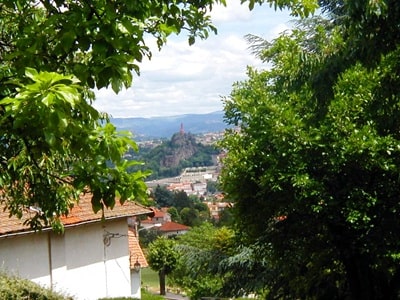
Leaving the city and the richest archbishopric in France—so we were assured—you can glimpse the Corneille rock, which acts as a counterpart to the Aiguilhe. Here again, the hypocrisy of History has cast its lot on the peak. At its summit, a heavy Virgin and Child has been erected, cast from the bronze of more than two hundred cannons recovered from Sevastopol. The whole Sulpician ensemble reminds us that wars, whether imperial or not, can serve to attract pilgrims. It’s as tall as a lighthouse, except it’s not a lighthouse and it’s much less beautiful. Discovering his first solid house, the late clown Achille Zavatta exclaimed: “This shack is nice, but it lacks wheels!” That’s a bit of the impression Le Puy-en-Velay gives me. Studious and pious, steadfast and solid. Orderly. A large notary's house where, quite rare for notaries, they offer you mulled wine.
by Eric Poindron. Excerpt from "Belles étoiles" With Stevenson in the Cévennes, Gulliver collection, directed by Michel Le Bris, Flammarion.