


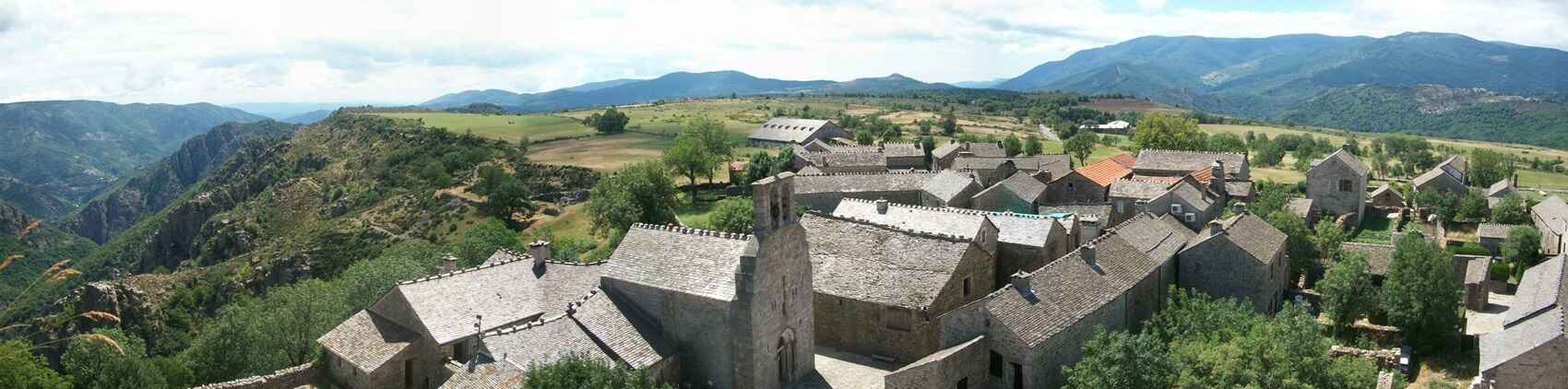

The population of the village, a hamlet in the municipality of Prévenchères, has varied greatly over the centuries. There were 111 inhabitants in 1789, 158 in 1846, 84 in 1936, and only 12 in 1980. The school, which still welcomed 35 students in 1930, had to close its doors in 1963 with only three children remaining. By comparison, in 1880, two schools were open in La Garde: a public school and a private one.
Today, about fifteen inhabitants live there year-round, most of whom are young retirees or artisans. During the summer, including the guests staying at the Auberge Régordane, the population grows to around a hundred people.

Since 1972, numerous buildings have been restored—or are in the process of being restored—by families rooted there for generations, or by new owners captivated by the beauty of the site.
For a long time, the sweet chestnut was one of the main resources of the village. The lands were cultivated right up to the banks of the Chassezac. Chestnut trees were also planted in the most sheltered parts of the plateau, as well as on the slopes facing Pourcharesses. On the steep slopes of the gorges, there are still chestnut groves arranged on terraces called "accols," supported by dry stone walls built by the elders. These accols were ingeniously irrigated by channels bringing water from the Chassezac.
Each family owned one or more chestnut dryers, called "clèdes," located on the slopes of the gorges or in the heart of the village. As the population declined, the most distant and least mechanizable plots were gradually abandoned.
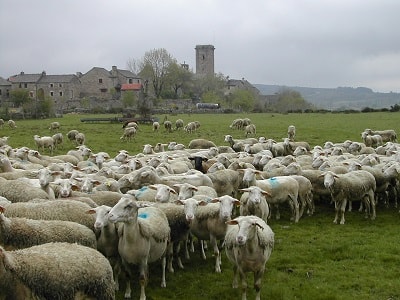
Livestock farming remains another major resource of La Garde-Guérin today. Between 1950 and 1960, there were 1,000 sheep, 50 cows, 100 goats, one or two pigs, and poultry in each house (about twenty households in total). This is not to mention the draft animals, usually a mule, sometimes a horse or a donkey. A communal shepherd tended the flock and was fed in turn by the owners, in proportion to the number of animals or "days" they had in the summer pasture.
As early as the 14th century, a fair was held in La Garde-Guérin on Saint Michael's Day, September 29. The last edition took place in September 1938. This event was primarily intended for the "hiring of shepherds." On that day, local shepherds found work, as did chestnut gatherers and laborers hired to clean the orchards. The elders remember these fairs as great festive events. The Pré de la Foire swarmed with merchants and traveling showmen who, due to the slow transportation of the time, arrived in the village several days in advance and stayed with the locals.
The villagers lived in near-autarky. The vegetable garden provided fresh produce, and the meat consumed came from their own pigs and poultry. Potatoes, a staple food alongside chestnuts, were cultivated in the fields. Bread was baked in the communal village oven, with each family taking their turn—a tradition that continued until 1966. It was a rustic bread made from local cereals (wheat and rye), harvested locally and brought to the mill.
This organization explains how the inhabitants managed, not without difficulty, to feed often very large families (from 6 to 16 children). Outside purchases were limited to coffee, wine, and oil for salad, while lard served as cooking fat. Today, the local economy relies almost exclusively on sheep farming and rye cultivation, the latter now intended for animal feed. It is a fragile economy that two dedicated farmers maintain with determination, ensuring the village's survival throughout the year.
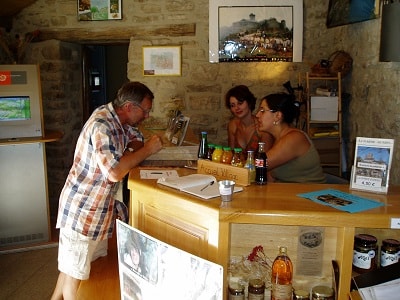
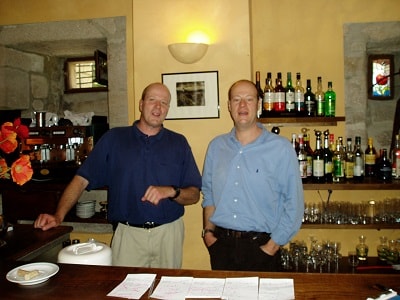
For about twenty years, a hotel and restaurant, the Auberge Régordane, has successfully welcomed locals and travelers during the summer season. You can also discover an exhibition of painting, engraving, and textile creation—a play of shapes and colors—at the workshop in the old village school, run by Mr. and Mrs. Thibeaux.
Heir to a prestigious heritage, La Garde-Guérin welcomes thousands of visitors each year, always impressed by the beauty and grandeur of the site. May this village continue to live and amaze those who stop in this historic place! Due to its geology, the drinking water supply has long been problematic: the thin surface layer of Triassic sandstone did not allow for a sufficient water reserve in contact with the underlying granite bedrock.
Within the walls of La Garde-Guérin, the wells were therefore frequently polluted, especially in summer. During the dry season or in the event of a siege, the castle's cistern, dug deep into the solid rock, took over. Rainwater, a precious resource in the Middle Ages, was subject to a right that the lords granted for a fee. Outside the ramparts, the fountains were of paramount importance due to their flow and water quality, until a water supply network was built in 1938.
From the 12th century, amidst the steep and wild landscapes of Occitania, the fortified village of La Garde-Guérin stood proudly above the Chassezac gorges. This strategic outpost controlled the Chemin de Régordane (the GR®700 trail), an essential communication route linking the Massif Central to the Mediterranean. One can easily imagine the banks of the Chassezac, the imposing stone ramparts, and the shepherds going about their daily tasks.
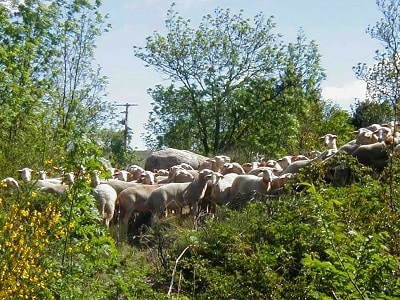 These shepherds, both men and women, were recurring figures in local history. They watched over their flocks of sheep, guiding the animals along the rocky and verdant paths. Their days were marked by the tinkling of bells and the soft bleating of lambs.
The Chemin de Régordane was much more than a simple pastoral route: it was the vital link between Auvergne, Velay, Languedoc, and the Mediterranean coast. The shepherds of La Garde-Guérin played a crucial role in the safety of travelers. As true guardians of the Régordane, they protected caravans loaded with precious goods, rich fabrics, and exotic spices.
Each of them was linked to a "parérie," a portion of the fortress and the road that they carefully maintained. In return, these men collected tolls, fees for the "cartalage" (grain measurement), and even for the passage of foreign flocks. These shepherd-knights, called the Pariers, swore an oath to the Bishop of Mende and formed a formidable economic and military community.
The castrum of La Garde constituted their impregnable border post. They kept watch day and night, scanning the horizon for the slightest threat. Their names echoed in the winds of the Chassezac: the Gaucelmes, the Hérails, the Bertrands, and the Gaules. Each clan assumed its share of responsibility to preserve the fiefdom.
Thus, in the heart of the Middle Ages, the inhabitants of La Garde-Guérin forged links between the mountains and the sea, between the stars and their flocks. Their stories intertwined with those of merchants, pilgrims, and troubadours. When the sun disappeared behind the ramparts, they gathered around the hearth to share their legends and hopes. Today, the stones of the village still carry the echo of their footsteps, and these guardians of the past watch over our memories like stars in the Cévennes night.