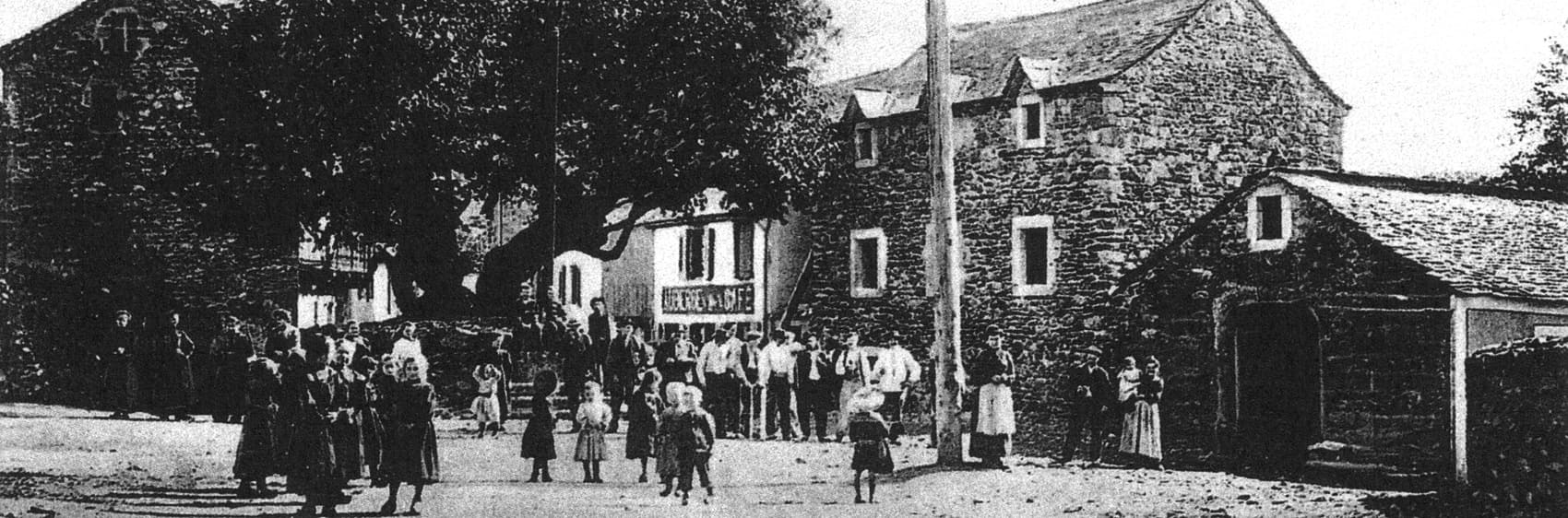
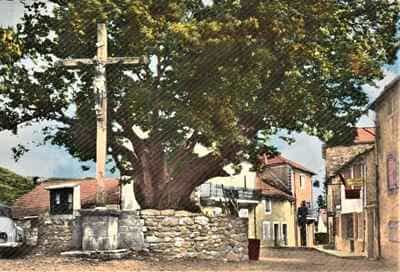
 Holiday residence in Prévenchères at the time
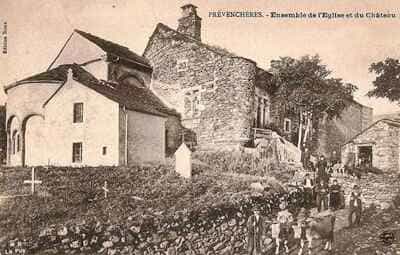
Prévenchères in the early 20th century, a small Cévennes village in Lozère, retained its rural and mountainous character. The economy was primarily focused on subsistence agriculture, sheep farming, and chestnut cultivation, the "bread of the Cévennes," which played a crucial role in the local diet. Geographic isolation limited exchanges and technological progress, preserving ancestral traditions and ways of life. Social life was marked by the seasons and parish festivities, with the community being tightly knit and reliant on mutual support in the face of the harsh climate. The few roads and mule paths were the only means of communication.
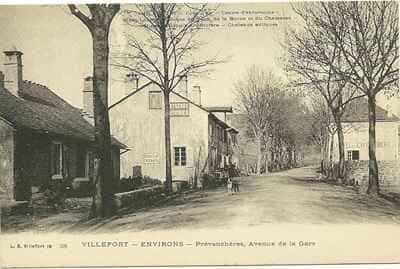
The village of Prévenchères lies at 840 meters above sea level. It is a moderate elevation that is highly suitable for children. The climate is a bit windy, but not humid. The summer season lasts longer here than deeper within the Massif Central, and this small village was beginning to become somewhat frequented during the summer. Even more than its altitude, it owed this growing popularity to convenient transportation and its proximity to the Bas-Languedoc region.
There were no buses, but the express services stopped at the small station on the Nîmes to Langogne line. The vacationers were almost entirely locals from the areas around Nîmes and Alès, with some from Montpellier, Avignon, and the Bouches-du-Rhône. Most were from the middle class. Often, mothers would settle in for a month with their children. The husbands would come to join them every Saturday, spend Sunday with the family, and then return to their work.
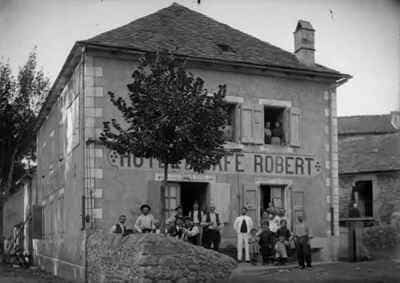 The health cure at Prévenchères
In 1900, there were barely a dozen holidaymakers. The main of the two hotels, built in 1898, had only 8 rooms and was hardly frequented except by passing travelers. It has 29 today. In these hotels, about 90 vacationers stay each year for three weeks or a month. 9 rental houses, almost all rebuilt since the war, each featuring two apartments, house about 80 people for part of the summer. The accommodations were expensive: 300 francs per room for the season. A holiday camp, a Catholic institution set up by a priest from Montpellier, hosts 150 children and youths from the Montpellier, Béziers, and Orange parishes. It has developed mainly since the war. Finally, the villagers or neighboring hamlets often welcomed relatives who came to stay with them during the summer.
 This summer season was a significant source of income for the commune. A five-room house yielded 1,500 francs. The farmers sold milk, butter, cheese, vegetables, and poultry. The hotels employed local staff. Vacationers would leave an estimated sum of 100,000 francs during the season (1936 prices). Of this amount, more than half represented a net profit for the local economy.
Situated between Villefort and La Bastide, which are more fashionable and well-known, Prévenchères could hardly achieve a large-scale development in this regard. But if there had been a little more initiative, the vacationers would have been more numerous. Provisions were difficult to source. The butcher from La Bastide only came twice a week, and there were no vegetable sellers. One had to run to the locals to obtain them. There was no doctor either; in case of illness, one had to telegraph La Bastide or Villefort. Comfort was minimal.
The electricity produced in the village barely lit the homes. There was no garage, only one gas station, and no entertainment, not even a cinema. However, the banks of the Chassezac River are green in places, and fishermen go there to catch trout. Prévenchères could especially become, even more than it is, a destination for children. A small, quiet corner at 800 meters, where one can breathe and play freely, is what best suits our children from the plains who are exhausted by the heat in July and August.
 Agriculture and peasant diet
In the village of Prévenchères, a baker had settled. But he only made wheat bread for part of the population and for the summer visitors. All the peasants of the village kneaded their dough and came to bake their rye bread in the baker’s oven once a week, on Wednesdays. However, flour supplies were almost always insufficient, so on Sundays, or on feast days, one or two times per week, bread was bought directly from the baker.
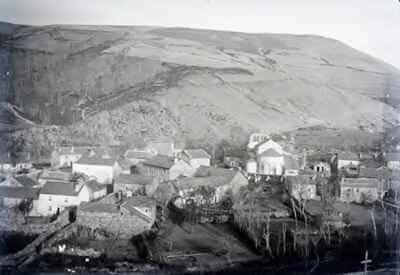 After rye, the main crop was potatoes, though they were still not enough to feed a family. Each owner had a garden. Some meadows provided hay for the winter, and these meadows were sprinkled with apple trees, plum trees, and a few peach trees. They were sometimes bordered by walnut trees.
The crops provided the family’s food. Large tracts of land could only be used for sheep grazing. The rock often outcrops, many slopes are unstable, the plateaus are dry, and the bottoms of the valleys are sometimes too humid. Cultivable lands were very limited. Thus, cultivation remained here, as it once was for all of France, a sheer necessity for feeding people.
Fields marked as "arable land" on the old cadastre are now fallow. Broom shrubs have grown; they are cut to fuel the baker's oven. Only rye can grow in these clayey soils. Farmers barely sowed enough to harvest food for the year and seeds for the next sowing. Each owner sowed 1 to 3 hectares of rye. Agricultural statistics from 1918 show that only 4 out of 76 owners sowed more than 3 hectares, with a maximum of 5.
One hectare required about 10 to 12 double decalitres of seed. Each double decalitre yielded 4 or 5 times that amount, at most 8. This was barely enough to feed a family of five in a country where bread was heavily consumed.
The threat of wolves in the region
The need to defend against wolves may have been one of the reasons for the tight grouping of each village. Wolves were numerous in the region in the past. In 1806, a wolf carried off a five-year-old child near Villefort, and three days later, a little girl near Génolhac. It was written in 1815: "For the past five years, wolves have devoured more than 60 children in the communes bordering the Villefort canton." On January 18, 1823, a farmer traveling from Prévenchères to La Bastide was accompanied for three hours by a wolf. To combat these predators, bounties were paid to those who killed them: in 1815, it was 54 francs for a pregnant she-wolf, 36 francs for a male wolf, 45 francs for a non-pregnant she-wolf, 18 francs for a young wolf, and 9 francs for a cub.