


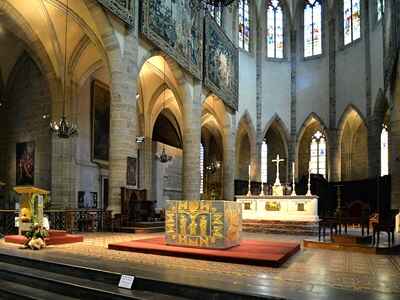
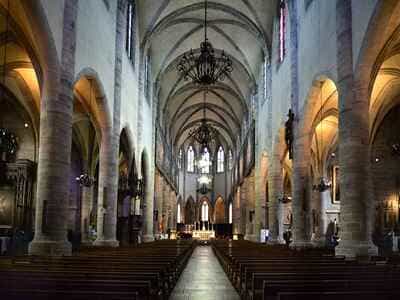
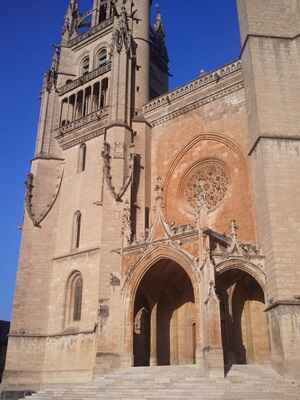
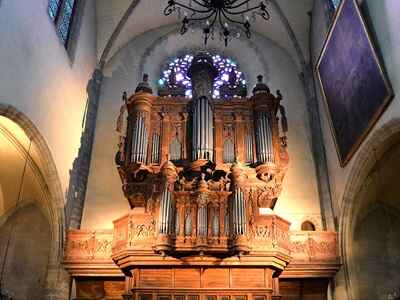
Located in the heart of Mende in Lozère, the Cathedral of Notre-Dame-et-Saint-Privat is a major religious building whose history dates back to the 14th century. Its construction was initiated under the influence of Pope Urban V, a native of the region, who wanted to endow his hometown with a monument worthy of the name. Originally built in a pure southern Gothic style, it suffered the ravages of the Wars of Religion in the 16th century and was partially destroyed by the Protestant troops of Merle. Magnificently rebuilt afterwards, it has retained remarkable architectural elements from its prestigious past, such as its western facade flanked by two asymmetrical towers: the imposing "Bell Tower" and the more modest "Clock Tower". The interior notably houses an old Romanesque crypt as well as splendid organs. A true jewel classified as a Historical Monument, the cathedral bears witness to the architectural and spiritual richness of the region, standing out as an essential stop for any visitor to Gévaudan.
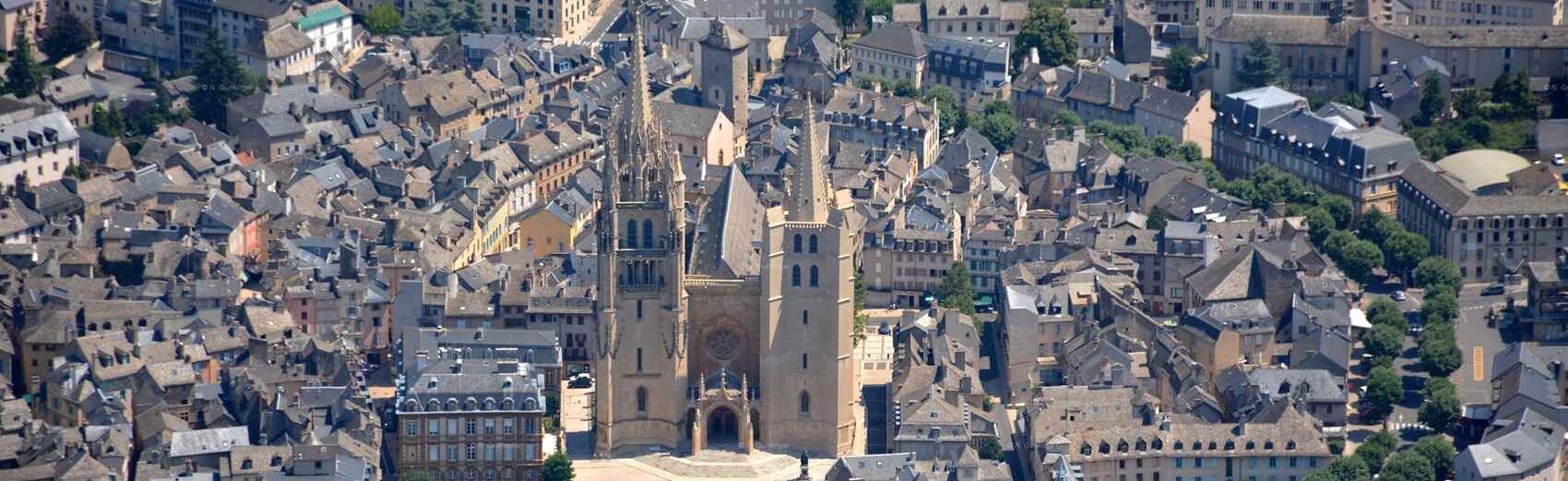
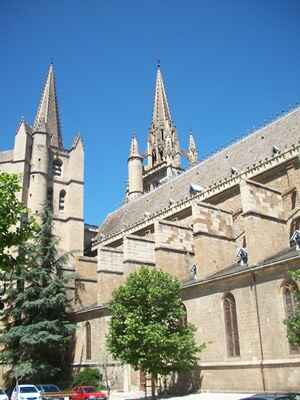
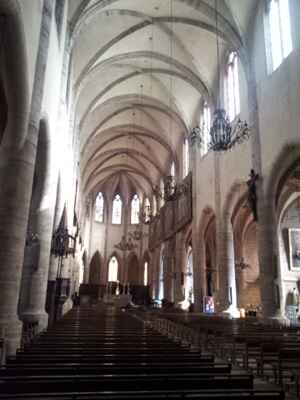
Dedicated to the memory of Saint Privat, the first bishop of Gévaudan martyred by the Barbarians, the Cathedral of Notre-Dame-et-Saint-Privat boasts a thousand-year history. Erected on the site of three previous churches built over the saint's tomb at the foot of Mount Mimat, it was beautified by Pope Urban V before suffering the sackings of the Huguenots. Elevated to the rank of minor basilica in 1874, it still attracts pilgrims today who come to venerate its 12th-century Black Madonna. The building also houses priceless treasures, such as sumptuous organs, fine woodwork, Aubusson tapestries, a majestic high altar and, above all, the original clapper of the "Non-Pareille," once considered the largest bell in the Christian world.
Mende, the historical capital of Gévaudan, has always devoted a fervent cult to its patron saint. In the 3rd century, under the threat of the Alamanni led by Chrocus, the terrified inhabitants took refuge in a fortress while their bishop, Privat, retreated to the surrounding heights. Captured and atrociously tortured, he refused to deny his faith. He died a martyr, miraculously prompting the withdrawal of the invaders. Having become one of the greatest saints of Gaul, it was on his tomb that the very first church of Mende was built, most probably on the site of the current cathedral. Archaeological excavations have indeed brought to light the remains of a Carolingian sanctuary, supplanted in the 10th century by a pre-Romanesque edifice ravaged by fire around 1100. A third church, significantly larger, was then erected under the aegis of Aldebert II de Peyre, bishop from 1109 to 1123.
In the Middle Ages, the cathedral formed the nerve center of a city encircled by powerful seigneurial residences. The current Place Urbain-V formerly housed the Castel-Frag, the fortress of the Counts of Barcelona. To the east, the castle of the Canilhacs majestically dominated the apse, while those of the Cabrières and the Dolans stood respectively on the current Place Chaptal and on the opposite flank. The religious edifice thus rose in the center of a fortified town protected by more than two kilometers of ramparts. It was in this imposing setting that in 1163, the cathedral welcomed Pope Alexander III, on his way to the Council of Tours, escorted by the builder-bishop Aldebert III du Tournel, the instigator of the urban fortifications.
A true Gothic jewel dominating the city with its high spire, the cathedral nevertheless experienced very dark hours before shining with a thousand lights. Its destiny changed thanks to Guillaume de Grimoard, a native son from the Gévaudan nobility. A scholar, deeply pious and enamored with justice, he first embraced monastic life and a teaching career before being elected sovereign pontiff under the name of Urban V. A man of great vision, he dreamed of reforming the Church and pacifying Europe. In 1364, he formed the ambitious plan to completely rebuild the cathedral of Mende, then dilapidated. Having obtained from the King of France the levying of an exceptional tax on the households of Gévaudan, he entrusted the direction of this grandiose work to his friend Pierre d'Aigrefeuille, then bishop of the town.
While the construction site was in full swing, a devastating fire ravaged a large part of the building. From Rome, Urban V refused to yield to discouragement. He released new funds for the diocese and replaced Pierre d'Aigrefeuille with three vicars specially mandated to allocate all the revenues to the reconstruction. Faced with this disaster, he declared with unshakeable faith: "Praise be to God, who has allowed this trial and at the same time gives me the means to overcome it. We will rebuild it and we will do more good there than the devil has done harm." He sought the expertise of Pierre Morel, an illustrious Majorcan master builder who had officiated at La Chaise-Dieu. The elevation resumed in the east, gradually replacing the dilapidated Romanesque structure. Unfortunately, the passing of Urban V in 1370, combined with the torments of the Hundred Years' War, brought the construction site to an abrupt halt.
For sixty long years, the cathedral remained unfinished: a truncated nave overhanging the tomb of Saint Privat and a barely outlined choir nevertheless housed the priceless gifts of Urban V. The pope had endowed it with notable relics, including a thorn from the Holy Crown and the head of Saint Blaise enclosed in a sumptuous silver reliquary. This fabulous treasure also included a solid gold Virgin crowned with pearls, two golden angels supported by six metal lions, as well as a panoply of sacred objects of the greatest preciousness.
 In addition to these masterpieces of goldsmithing, the pontifical legacy included numerous liturgical ornaments and more than thirty majestic carpets, formally inventoried in 1380. However, cornered by persistent financial difficulties, the chapter considered alienating part of this treasure to relaunch the work on the cathedral. Judging this sacred gift totally inalienable, Cardinal Anglic de Grimoard, brother of Urban V, traveled personally to Mende to block what he considered a sacrilege. In 1392, King Charles VI came to support this pontifical prohibition by wielding the threat of severe punishments against the canons who dared to evade it.
It was necessary to wait until 1452 for the canons to finally resume the unfinished dream of the builder-pope. They launched the construction of elegant radiating chapels circling the choir, intended to illuminate it with a thousand sparkles. The first stone was solemnly laid on September 7 by Provost Guilhabert de Cénaret. Fifteen years later, in 1467, the choir was officially consecrated by Bishop Guy de La Panouse. The following year, his nephew and successor, Antoine de La Panouse, crowned the work by ordering sumptuous stained glass windows from the famous Toulouse master glassmaker Guillaume Papillon. These windows, recounting the life of Christ, the Virgin, and the saints, remain authentic masterpieces of Gothic art. The vast choir was thus definitively completed around 1470.
One of the architectural singularities of the cathedral undeniably lies in its two asymmetrical bell towers. The high left tower symbolizes episcopal power, while the smaller one, on the right, embodies that of the canons, reflecting in a petrified manner the lively rivalry that opposed them. In 1508, Bishop François de La Rovère—a relative of Pope Julius II, the instigator of St. Peter's Basilica in Rome—decided to finance from his own funds the construction of a bell tower of monumental proportions. Stung to the quick, the canons replied by launching the construction of their own tower, more modest but just as refined. These two elevations, initially planned above the pentagonal chapels of the apse, finally had to be erected on the facade, at the level of the episcopal buildings, due to the instability of the soil. The construction of the large bell tower, started in August 1508, and that of the small one, begun the following year, were completed simultaneously in 1512. The large bell tower culminates at 84 meters, dominating with all its superbness the 65 meters of the small one.
 Eager to endow his tower with a voice commensurate with his ambition, François de La Rovère placed an order for the most colossal bell in Christendom at the time: the highly celebrated "Non-Pareille". Cast in Lyon and provided with a heavy hammer forged in the Gard, this campanological marvel displayed a titanic weight of 12.5 tons for 3.25 meters in diameter and 33 centimeters in thickness. Its transport to Mende, completed in 1516, constituted a real technical and human feat. Hoisted into the large bell tower, it majestically set the rhythm for the hours and major celebrations, its bronze voice resounding, it is said, more than 16 kilometers away.
However, the Wars of Religion would soon plunge the building into turmoil. Following the assassination of the Protestant Baron Astorg de Peyre during the St. Bartholomew's Day massacre in 1572, his widow implored the help of the fearsome Huguenot leader Matthieu Merle. On Christmas night 1579, taking advantage of the fervor of the faithful gathered for Mass, Merle's troops invested Mende. Settling in the episcopal palace, he transformed the cathedral into a real military bastion. Under his orders, the building suffered systematic pillaging and destruction: statues pulverized, altars smashed, organs dismantled, relics scattered. He pitilessly melted the bells—including the mythical Non-Pareille, cast into the Lot river—and the stoups to forge his artillery. After subduing the surrounding towns, Merle left Mende in 1581, not without having delivered the majestic cathedral to the flames.
 Under the energetic impulse of Bishop Adam de Heurtelou, the cathedral rose from its ashes between 1599 and 1605. Although it was faithfully rebuilt on its original plan, it lost a large part of its abundant Gothic decoration. Opened for worship in 1605, it was not solemnly consecrated until 1620, by Bishop Charles de Rousseau. On this occasion, it was adorned with brand new stained glass windows and a majestic rose window, which unfortunately did not survive the destructive fury of the French Revolution in 1793.
The year 1605 was also the scene of a dark news item within these sacred walls. During an assembly gathering the high nobility of Gévaudan, a violent quarrel broke out between Armand de Polignac, Baron of Randon, and Philibert, Baron of Apchier and former head of the local Catholic forces. The tragedy unfolded a few days later, on January 18: in the middle of Sunday service, Philibert was cold-bloodedly assassinated by Annet de Polignac, Baron of Villefort and Armand's own brother, blooding the flagstones of the cathedral with an inextinguishable resentment.
At the dawn of the 18th century, the cathedral benefited from the largesse of Bishop François-Placide de Baudry de Piencourt. In 1692, he endowed the sanctuary with superb Aubusson tapestries illustrating scenes from the New Testament. A great builder and a figure of profound charity, Mgr de Piencourt also financed the reconstruction of the general hospital of Mende, an institution to which he generously bequeathed his entire fortune upon his death.
The pangs of nature also failed to spare the building. In 1732, lightning violently struck one of the four pinnacles flanking the large bell tower, then it was the turn of its high spire to be struck by lightning in 1784. In both cases, local fervor allowed for the prompt repair of these dismal outrages.
 During the troubles of the Revolution, the small bell tower narrowly escaped its conversion into a civil prison. The idea gained ground, however, and it was under the Napoleonic era, at the beginning of the 19th century, that the tower briefly served as a dungeon. Among its illustrious captives were the sub-prefect of Florac as well as, for a duration of a few hours, Marshal Soult himself.
The 19th century breathed a wind of renewal over the cathedral, marked by the consecration of a splendid white marble high altar in 1825. Integrated as early as 1840 into the very first list of Historical Monuments requiring urgent care, the original roof in local slate was replaced by zinc. Faced with the rapid degradation of this modern material, a complete overhaul had to be carried out around 1880. Under the episcopate of Mgr Julien Costes, the building was also enriched with a new south portal, finely sculpted and surmounted by the bishop's coat of arms, opening majestically onto the current Place Chaptal.
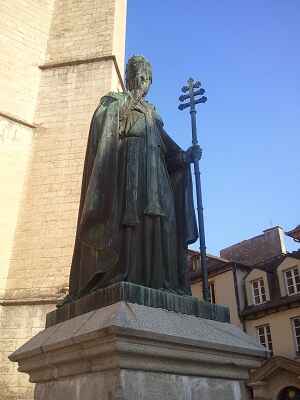
In June 1874, a decree from Pope Pius IX consecrated the historical and spiritual greatness of the premises by elevating the cathedral to the privileged rank of minor basilica. This honor hailed both the founding role of Urban V and the prestige linked to Pope Julius II. The esplanade, henceforth named Place Urbain-V, welcomed an imposing statue of the Gévaudan pontiff, a work of the sculptor Dumont. Subsequently moved in front of the small bell tower, it watches over the faithful and visitors today. In parallel, the radiating chapels of the choir, once bruised by the Huguenots, finally recovered the intact elegance of their ribbed vaults.
At the twilight of the century, the famous architect Charles Laisné, assisted by the talented master glassmaker Émile Hirsch, restored its original brilliance to all the stained glass windows and the large rose window. The entrance porch, built on the site of the former bell ringer's house, opened the facade more widely onto the square. This ceaseless work of preservation and embellishment found its ultimate consecration in 1906, with the definitive classification of the basilica-cathedral as a Historical Monument.