


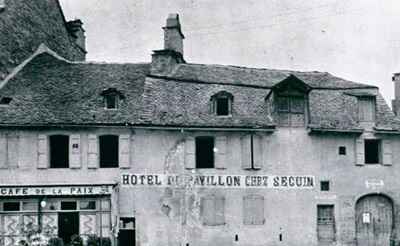
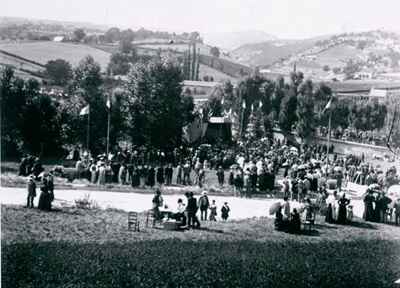
At the beginning of the 20th century, tourism in Mende was primarily focused on discovering the Lozère region and its rugged, natural landscapes. Often viewed as a stopover rather than a major destination, the city attracted visitors eager to explore the vast expanses of the Cévennes and Aubrac. At the time, accommodation infrastructure remained modest, consisting mainly of small hotels and family-run guesthouses. Although the arrival of the railway had greatly facilitated access, the journey was still quite long. The target audience was often a bourgeois elite in search of fresh air and thermal treatments, despite the fact that the city itself lacked any notable thermal springs. Leisure activities largely centered around bucolic walks in the surrounding countryside and visits to local historical monuments, including the majestic cathedral. It was a discreet and peaceful form of tourism, far removed from the crowds of large seaside resorts, perfectly suited for those valuing the authenticity and tranquility of this rural prefecture.
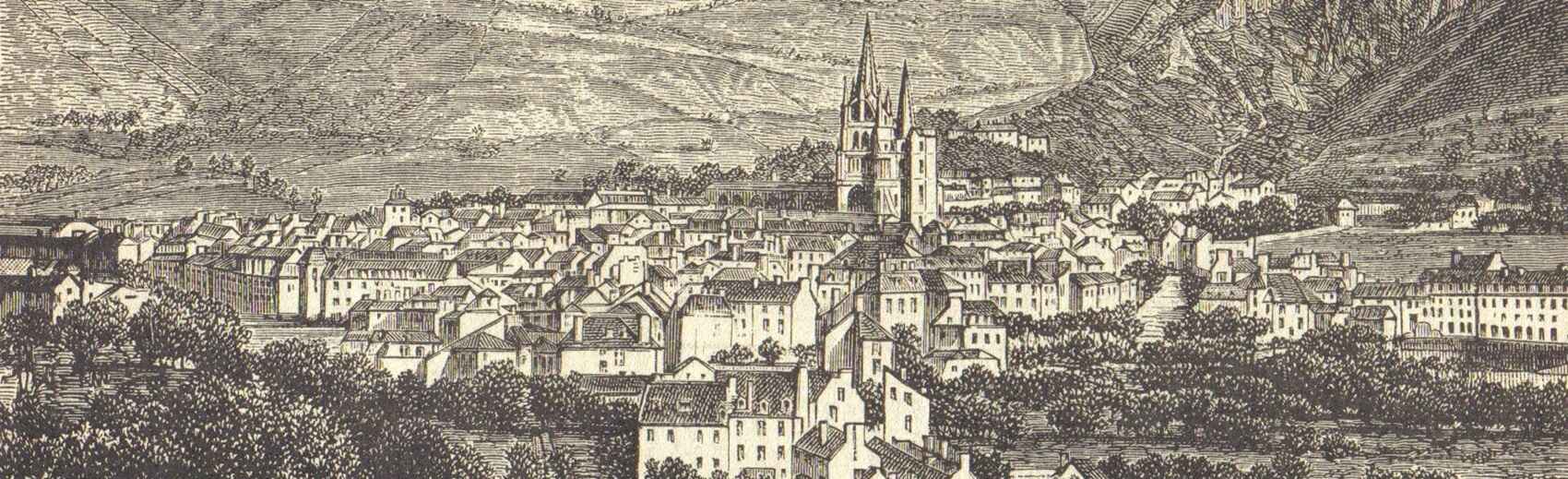
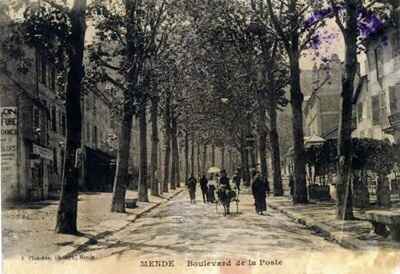
Place de Gaulle serves as the beating heart of the city, a true crossroads where the main thoroughfares of Mende converge. Whether arriving from the train station or from Saint-Flour, visitors reach this square by crossing the peaceful waters of the Lot river over the Berlière bridge, and then strolling down the Piencourt alley. This path offers a lovely shaded walk under old poplar trees, which were planted in 1707 on the initiative of the bishop who gave the alley its name.
Standing solemnly on this historic square is the monument dedicated to the Lozériens who died during the 1870-1871 war, serving as a poignant reminder of the region's tragic past. The town hall, constructed during the reign of Louis XVI, boasts a simple yet remarkably harmonious architectural style. Inside, it features a magnificent staircase, superb Aubusson tapestries proudly adorning the council room, and a rich library containing over 13,000 volumes, among which are many carefully preserved incunabula.
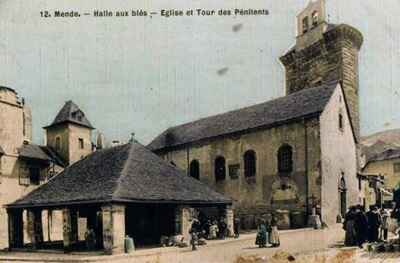
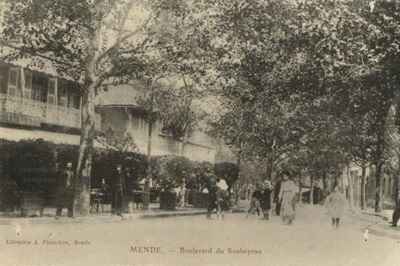
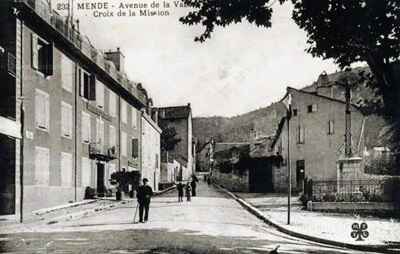
From Place de Gaulle, a circular boulevard lined with large plane trees extends around the city, tracing the path of the old city moats. It begins to the southwest with Boulevard du Soubeyran, which is now home to the main cafés and the central post office. Right at the entrance of this boulevard stands the Pénitents Tower. This semi-cylindrical structure is the sole remaining vestige of the defensive wall erected in 1165 by Bishop Aldebert du Tournel. Nestled at the foot of this protective tower is the chapel of the Pénitents, built in 1657. The chapel houses a Black Virgin, an ancient and venerated copy of the famous Notre-Dame-du-Puy. In the adjoining cloister, curious visitors can admire the insignias of the Pénitents' brotherhoods, along with a beautifully carved wooden eagle lectern dating from the late 17th century.
Just steps away, Place au Blé opens the doors to the old town, a picturesque maze that has managed to retain all the charm of its glorious past. The old, well-preserved houses reveal fascinating architectural details, while some of the narrow streets seem frozen in an archaic era. Rue du Fournet, which runs along the left side of the square, frequently surprises strollers with its intricately carved 17th-century doors and small oratories sheltering statues crafted in the 15th century.
Boulevard du Soubeyran seamlessly continues into Boulevard Henri-Bourrillon, naturally guiding pedestrians toward Place Urbain V, which is dominated by the majestic facade of the cathedral. In the center of this expansive square, a bronze statue sculpted by Dumont pays a vibrant tribute to Pope Urbain V, undoubtedly the most illustrious son of Lozère (born Guillaume de Grimoard in 1309 at the castle of Grizac, near Pont-de-Montvert). To the left of the cathedral stands the prefecture, a modern building whose architectural style is freely inspired by the Louis XIII era. The construction of Saint-Pierre Cathedral was initiated in 1369 directly by Pope Urbain V, but it was not completed until the 15th century following a 60-year interruption. In 1579, it was ruthlessly destroyed by explosives set by Protestant troops, miraculously sparing only the facade, the towers, and the choir. Its reconstruction took place from 1599 to 1620 with remarkable faithfulness to the original design, although the overall structure exudes an undeniable austerity.
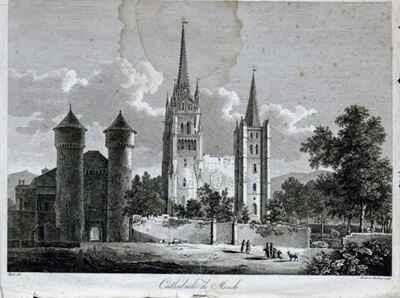
The facade, adorned with an elegant rose window, is flanked by two beautiful towers erected between 1508 and 1521 by Bishop François de la Rovère. An observant eye can spot the bishop's initials and coat of arms engraved in several places within the masonry. The grand bell tower on the left, highly elegant and reaching a height of 84 meters, is decorated with sturdy buttresses and a delicate Renaissance-inspired gallery. Its tall spire reaches boldly towards the sky, accompanied by graceful little pinnacles. The tower on the right is simpler in its design, standing at 65 meters high and terminating with a modest crocket spire. Visitors are advised to contact the sacristan to gain the privilege of exploring the secrets of the grand bell tower, entering the sacristy, or discovering the mysterious underground crypts.
The nave, deliberately simple and devoid of a transept or triforium, is flanked by wide aisles that house a series of side chapels. An ambulatory surrounds the choir, though interestingly, it only provides access to two radiating chapels. The choir itself features stunning wooden stalls carved in 1692, with panels that emotionally depict significant scenes from the life of Christ. Overlooking the imposing main altar, the miraculous statue of the Black Virgin—whose benevolent presence is documented as early as the 13th century—is accompanied by precious relics and beautiful carved wooden candelabra from the 17th century. At the back of the choir, a painting of the Assumption—a luminous 18th-century copy inspired by a work of the painter Murillo—sits majestically above eight Aubusson tapestries woven in 1706, elegantly depicting the mysteries of the Virgin.
The pulpit, while of more recent design, strictly adheres to a Gothic inspiration and is the meticulous work of the talented local sculptor, Pagès from Mende. Opposite the pulpit, the Louis XIII style episcopal stall and a beautifully carved wooden Christ from the 17th century perfectly complete this deeply spiritual setting. The splendid woodwork encasing the great organs, dated precisely to 1653, is also highly admired by visitors. Resting behind the facade is an ancient tombstone from the 15th century, guarding the gigantic clapper of the Marie-Thérèse bell, more famously known as the "Non-Pareille". Cast in 1517, this bronze marvel was tragically destroyed by Captain Merle in 1579. The bell once boasted a colossal weight of 460 quintals, and its iron clapper still impresses with its extraordinary dimensions: 2.35 meters in height and 1.10 meters in circumference at its widest point.
In the dim light of the side chapels, one can discover ancient liturgical piscinas from the 15th century, along with several carved wooden altars typical of the Louis XIV era. The baptismal chapel on the left is adorned with rich Renaissance woodwork, whose delicate panels illustrate key episodes from the Old Testament. The sacristy houses an elegant Renaissance-style door, a life-size wooden Christ dating from the 17th century, a modern crozier crafted in gilded silver, and an exceptional liturgical ornament composed of five luxurious pieces of brocaded silk from the 17th century.
Close to the clapper of the Non-Pareille, a beautiful flamboyant-style portal invites visitors to ascend the grand bell tower, an experience highly recommended. After climbing 241 time-worn steps to the Clock gallery (located on the fourth level), the explorer is rewarded with a breathtaking panorama over the vaulted roofs and picturesque dormer windows of the old town. Beneath the cathedral, nestled at the foot of the grand bell tower, lie mysterious crypts. The crypt sheltering the venerable relics of Saint Privat, which was only unearthed in 1905, dates back to the 12th century. The southern portal of the cathedral, a true masterpiece of flamboyant decoration, opens onto Place Chaptal, which is pleasantly refreshed by a fountain. Moving past the courthouse, pedestrians will find Rue de la Banque (the old road to Rodez) on the left, and Rue d’Aigues-Passes on the right. By walking up Rue de la Banque and then taking Avenue du Musée to the left, visitors reach the fascinating museum managed by the Society of Letters, Sciences, and Arts of Lozère.
This museum reveals incredible collections to curious minds, such as the famous Bronze Age treasure discovered in Carnac, near La Malène, on the vast causse Méjean. Visitors can admire early Christian cippi unearthed in Ispagnac, precious Gallo-Roman artifacts, locally minted coins, and remarkable stone fragments—including beautiful 14th-century bas-reliefs salvaged from an ancient cathedral tomb. Large 16th-century cartouches, finely carved with the coat of arms of Bishop François de la Rovère, are also on display, alongside various works of art, minerals, specimens of endemic local birds, and a delicate collection of traditional lace. Strolling down the picturesque Rue d’Aigues-Passes, which is bordered by venerable old houses, one's gaze is inevitably drawn to an ancient Gothic door fitted with elegant Renaissance panels. At the end of this street, taking a left onto Rue Notre-Dame—formerly known as Rue de the Juiverie and the main artery of the historical center—allows you to view an imposing Gothic building that once served as a synagogue. Just a short distance away lies a discreet oratory sheltering a Black Virgin positioned directly above a fountain adorned with modern paintings.
A bit further on, marking the entrance to Rue du Collège, stands a large 16th-century cross. Rue du Chastel, which serves as a natural extension of Rue Notre-Dame, preserves on its left side the final remnants of the fortified gate that gave the street its name, and on its right, an ancient stone cross weathered by time. The street peacefully leads into Place du Chastel, where the monument erected in memory of the respected Senator Théophile Roussel is situated.
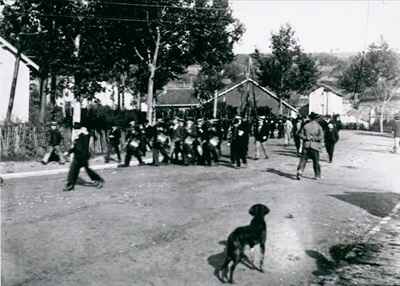
From Place du Chastel, walking under the foliage of the Paul-Doumer alley and then down a small street to the left brings you to the charming 14th-century Notre-Dame de Peyrenc bridge. This architectural gem peacefully spans the clear waters of the Lot; after crossing it to better appreciate its arches, the visitor can return to the old town by taking Rue du Collège to the left. On the right opens the discreet Rue de l’Epine, where at number 11 lie the romantic ruins of the 17th-century Hôtel de Ressouche, featuring a monumental door dated 1665 and a majestic ceremonial staircase. The urban journey concludes via Rue Droite, gently guiding the stroller back to the starting point at Place de Gaulle, while passing the very charming Calguière fountain on the left.
The surroundings of Mende offer wonderful excursion opportunities, starting with the Hermitage of Saint-Privat, nestled at an altitude of 890 meters. To get there, you must leave the boulevard ring at Le Foiral and take the Saint-Privat path, which winds up the mountain slope in tight switchbacks. The trail respectfully passes the oratory of Saint-Ilpide, erected over graves excavated in 1805 and 1913, offering along the way an absolutely breathtaking panorama of the valley below. This spiritual journey is punctuated by the fourteen stations of a picturesque Way of the Cross, guiding pilgrims to the Hermitage. This sanctuary, largely carved directly into the rock, was once the retreat of the illustrious holy bishop. Next to the small chapel, a curious resting place carved out of the rock never fails to intrigue walkers.
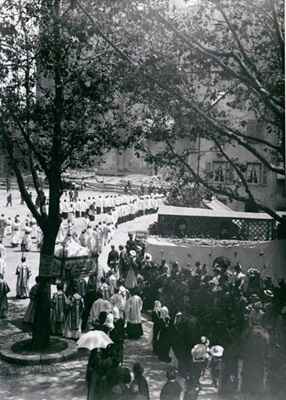
From this sacred hermitage, one can gaze upon the monumental cross that watches over Mende and warmly illuminates the night. The panoramic view of the episcopal city and its lush green surroundings is simply magnificent; observers can admire the cathedral standing proudly amidst the landscape. The most adventurous hikers will gladly continue their ascent to the famous Croix de Mimat (1,070 meters in altitude). To do this, take an old forest path off to the right just before the hermitage, crossing through dense, dark plantations of Austrian black pines before reaching the edge of the causse de Mende. Reaching the summit in August, walkers are dazzled by the vibrant and fragrant spectacle of vast, blooming lavender fields. The impressive 360-degree panorama encompasses the deep gorge of the Tarn valley, the arid expanses of the Mende and Sauveterre causses, the massive bulk of Mont Lozère, the Roc plateau, the rounded peaks of the Margeride, and, in the hazy distance, the foothills of Aubrac.
Exploration of the region can continue onto the small causse of Mende, gently stretching south of the hermitage, or towards the causse of Changefège. To reach the latter, travelers follow the picturesque road to Florac until they hit the old railroad bridge (about 3 km), then turn right onto a rugged cart path that climbs up to the hamlet of Changefège (5 km). There, tucked around the corner of a meadow, a magnificent prehistoric dolmen awaits the curiosity of visitors.
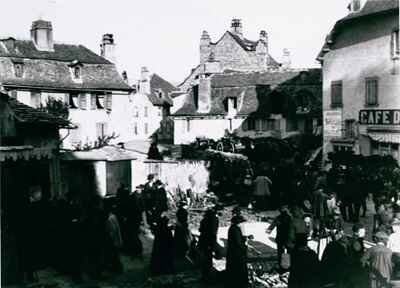
The excursion often extends towards Lanuéjols and Bagnols-les-Bains. Leaving Mende via the Florac road, you quickly reach Rouffiac before turning off Route N. 107 to take Route C. 41 to the left. This charming road ascends the bucolic Nize valley, weaving between the small causse of Balduc on the right—whose silhouette resembles an immense petrified reef—and the imposing cliff of the causse de Mende on the left. After passing through Brenoux and admiring the silhouette of Château du Boy, an elegant 18th-century building, you arrive in Lanuéjols (857 meters). At the entrance to the village, on the right, stand the remarkable remains of a 3rd-century Roman monument affectionately dubbed "lou maselet" by the locals. It is a square edifice measuring 5.35 meters on each side, punctuated with niches 1.30 meters deep. An inscription carved on the door's lintel reveals that it was a mausoleum dedicated to the memory of the children of Bassianus and his wife, Regala.
The area surrounding this monument has yielded numerous fascinating Gallo-Roman artifacts to archaeologists. Lanuéjols also takes pride in its very beautiful Romanesque church. Lovers of old stones can continue their journey to the ruined Château de la Prade and the Hermitage of Saint-Génies, where a remarkably pure spring emerges. Past Lanuéjols, the road climbs in spectacular hairpin bends up to the Masseguin or Loubière pass (1,185 meters) before descending towards the peaceful spa resort of Bagnols-les-Bains. This itinerary makes up part of the grand Mont Lozère circuit, a tourist loop connecting Lanuéjols, Bagnols-les-Bains, Villefort, Le Bleymard, and Mende. Finally, the road inevitably leads to the geological wonders of the south: the breathtaking Tarn Gorges—offering spectacular landscapes all the way to Le Rozier—and the unmissable Aven Armand near Meyrueis, a fantastic underground cave filled with extraordinary stalactites and stalagmites.