


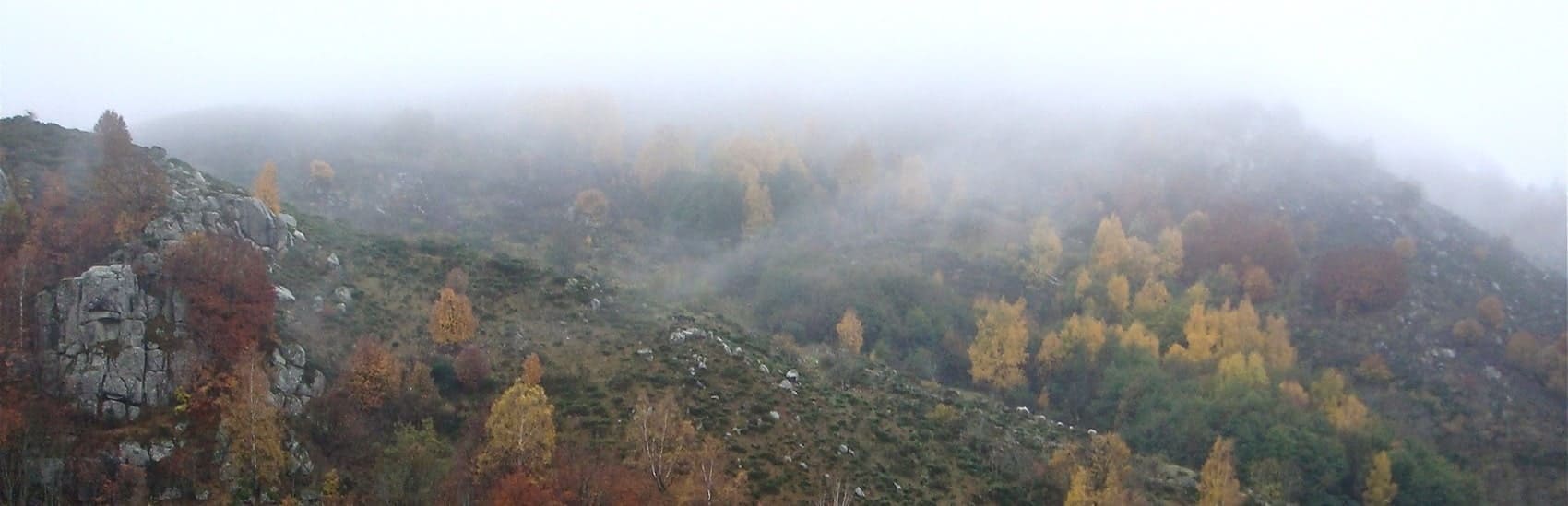
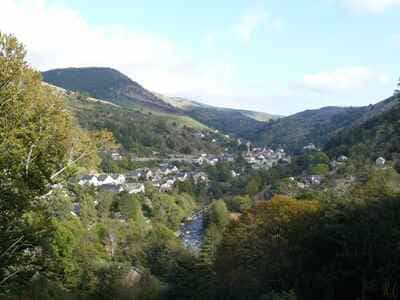
Just before reaching Le Pont-de-Montvert, the rock walls overlooking the road along the Tarn shimmer with a thousand lights. Huge cascades of ice have frozen there, sculpted by runoff water and the polar cold of recent days. Like an immutable ritual, I allow myself a brief stop here.
It was my brother, Tarn, who introduced me to Le Pont-de-Montvert over forty years ago. How had he discovered this remote corner of Lozère? The memory escapes me. He roamed the roads tirelessly and loved to drive. We fished together in the region for many long years, then Tarn got married. He moved to the Southwest, to the foot of those Pyrenees to which he had grown so powerfully attached and where death finally caught him by surprise. He must have been five or six years old when he joined our family, leaving behind his native Vietnam and his most painful memories. Tarn grew up by our side, as best he could. He often watched me prepare for my outings, and his eyes would light up with a singular brilliance when I unpacked my little gear: pliers, hooks, spools of line, feathers, and floats.
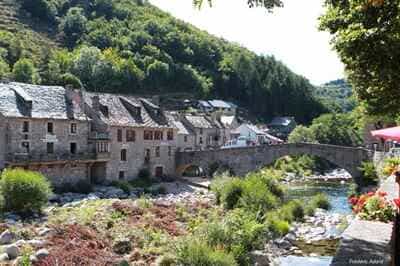
One day, he eagerly insisted on accompanying me to the water's edge. Meticulous care, ingenuity, and patience were among his innate qualities: he thus became an extraordinary fisherman. However, he also harbored an inexhaustible competitive spirit, so our camaraderie was never quite what I had hoped it would be. Yet, his love for fishing and nature was of rare depth, and I remember with vivid emotion our long conversations on the banks of the Tarn.
Since that memorable Pentecost weekend in 1973 when I first set foot in Le Pont-de-Montvert, I have often reflected on this visceral, almost irrational attachment that binds me to this rugged fragment of land that is the south of Lozère. Could I have settled there permanently? I don't know. Higher up, towards Mende, the Lot Valley, Aubrac, or Margeride, most certainly. But the geography of the Cévennes conceals a formidable, wild soul. Jean Carrière describes this harshness with admirable precision in L’Épervier de Maheux. And yet, I deeply love this region: the Cévennes are first and foremost the Cévenols, provided one knows how to listen to them. While the landscape exerts an undeniable power over the human soul, its logic is not always obvious. For instance, the Provençal Alps are grandiose and flooded with light, but their villages can sometimes seem unwelcoming. Conversely, the Cévennes offer rugged and austere terrains, yet their inhabitants bear witness to incomparable goodness and human warmth.
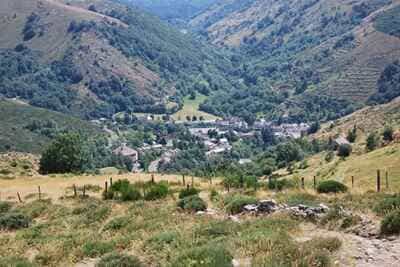
I remember a warm evening towards the end of the eighties, in a rural gîte nestled on the banks of the Rieumalet. Pink flames danced softly on the embers, illuminating our serene faces. The atmosphere was filled with knowing smiles. At one point in the evening, our thoughts converged on the memory of Paul, whom some of us knew well. I had met him one June evening, two or three years earlier, as we were both returning from a fishing trip. At first glance, there was nothing more austere—but paradoxically nothing more eminently likable—than this tall, taciturn Parisian: slender, standing a meter eighty tall, and endowed with a singularly deep voice.
Seated at the Café du Commerce, we drank beer while shelling pistachios. I was immediately struck by the accuracy of the words Paul chose to express the revelation that the wildness of these Celtic moors had been for him, fascinated by the violence of their torrents contrasting with the peaceful gentleness of their streams. That was five or six years ago. He came straight from Paris, where he practiced a liberal profession whose exact nature escapes me today. A passionate fly fisherman, he yearned to tackle the Tarn and the Lot, which he rightly considered to be among the most sumptuous trout rivers in Europe. I later understood that he was also seeking, through the silence of these landscapes, to soothe the painful memory of a woman.
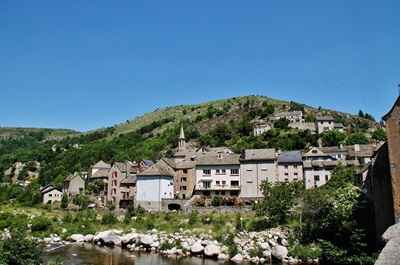
Thus he arrived one fine April morning and, to everyone's astonishment, settled down permanently without ever casting a backward glance at the capital. He experienced there everything a romantic spirit could fantasize about, even spending a few nights under the starry Cévenol sky. He then took up quarters in a stopover gîte, surviving on modest savings, a few clothes packed in a worn old suitcase, and his battered Peugeot. Deep down, he had finally found his refuge.
To make a living, he valiantly took on a series of odd jobs: he restored old dry stone walls, tended flocks on the ridges, repaired temperamental engines, and even gave valuable fly-fishing lessons. Eventually, he passed a modest exam to become a departmental road worker and rented a small house right in the heart of the village. This radical change of life was more than enough to forge his legend in the valley. However, it was truly his exceptional talents and fishing instincts that established his fame, and I know what I am talking about.
I hold at least two imperishable memories of our epic expeditions on the Tarn. The first dates back to a May evening: I had followed him into that dizzying gorge, downstream from La Malène, where the river sometimes crashes furiously against three-meter-high granite blocks. An inky storm threatened over Mount Finiels, and the sky had suddenly darkened. Around six o'clock, on the small winding road overlooking the gorges, cars already had to drive with their headlights on. The spectacle was fascinating: you had to see this boy boldly advance into the overpowering current of the torrent, the churning foam up to his waist. He swayed, stumbled, but never averted his gaze from the precise whirlpool where the trout was rising to snatch insects on the surface. Then, once the fish was solidly hooked, he would retreat with calculated slowness toward the protective bank to reel it in. This maneuver is extremely delicate; incidentally, Norman Maclean in his famous book, just like Robert Redford in his magnificent film adaptation, transcribed it with heartbreaking accuracy.
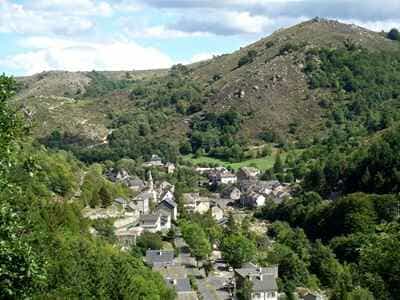
Another time, toward the end of summer it seems to me, we had decided to try the famous "evening rise" (coup du soir) near Bédouès. With fingers still purplish from picking blueberries, we had meticulously prepared our lines and selected our flies. I hesitated a bit: the water level was alarmingly low, and its absolute clarity forgave no clumsiness. For fly fishing, Paul exclusively used natural honey-colored silk lines, which he procured, I believe, from Dubos on the Île Saint-Louis. Once a year, at the close of the season, he cleaned them with infinite precaution in lukewarm, very slightly soapy water. He then patiently let them dry on the back of a chair before greasing them with the rigor recommended by the best specialized manuals.
Seized by a sudden wanderlust, he requested a year of unpaid leave from his administration and flew to England. Over there, I don't know what seasonal jobs allowed him to earn a comfortable living, but it was in that misty land that he met Nathalie, whom he ended up marrying. Upon returning to the Cévennes, they purchased a charming building leaning against the temple and bordered by climbing roses. Inside, they managed to recreate a prodigiously warm British atmosphere, made up of delicately faded tapestries, shelves bowing under the weight of books and records, charming mismatched old furniture, antique engravings, fascinating geographical maps, watercolors, and animal sketches.
One day, Paul gifted me a precious copy of a small volume—his own fishing notebooks—that he had self-published. It was fifty pages imbued with sincere poetry, sprinkled with "snow veils," "morning frost," "gentle sun," and "dark fogs." I had read these lines in my own way, and I probably should have refrained from the slightly too sentimental comment I gave him, which earned me the amused suspicion of my friends for a while. Today, when the detours of my wanderings bring me back to this region, and even if I am desperately short of time to visit them, I always stop for a brief moment by a meadow or a stream. Just to listen to the breath of the wind in the tops of the fir trees, and to contemplate the light which, majestically, stretches its arms over the silent moor. By Patrick Heurley. In time and place: Autumn Fog.