


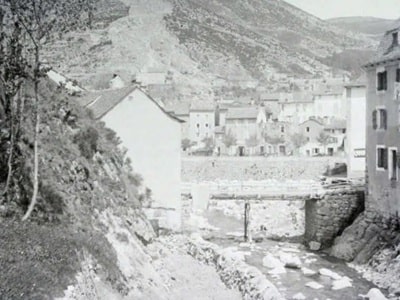
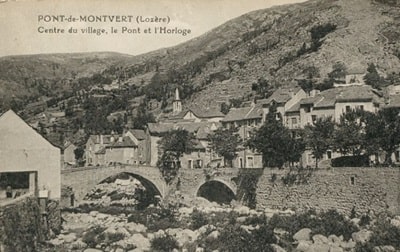
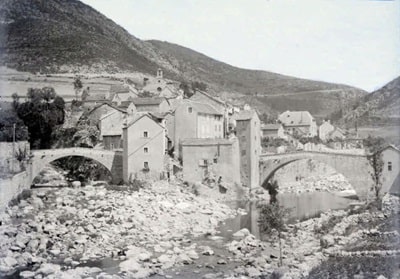
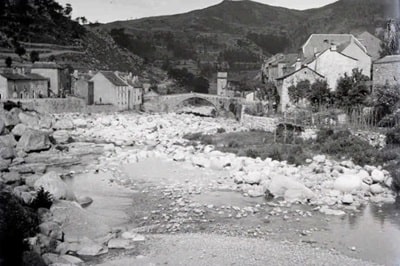
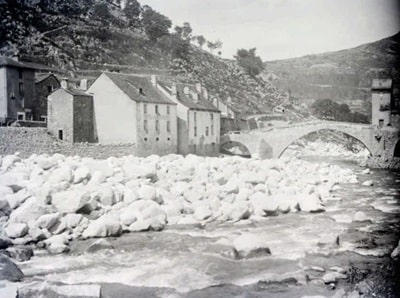
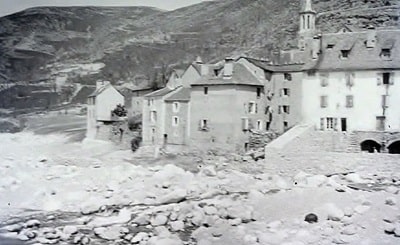
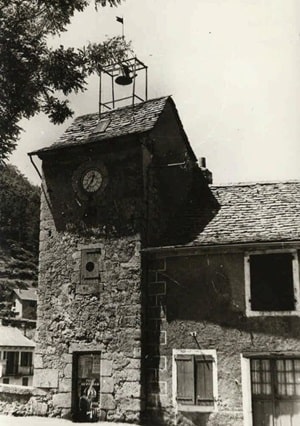
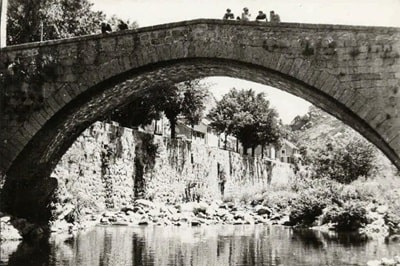
At the end of the 19th century, the tourist appeal of Le Pont-de-Montvert was primarily tied to its status as the gateway to Mount Lozère and the wild beauty of its Cévennes landscape. The arrival of Robert Louis Stevenson in 1878, accompanied by his donkey Modestine, deeply marked the village, although the full impact of his travel narrative would only be felt later. Visitors during this period were mainly travelers seeking authenticity and rest, far from the hustle and bustle of big cities. Many were already passionate hikers, sensitive to nature and interested in the tragic history of the religious wars. The village then offered the essentials: a simple inn for lodging and dining, as well as direct contact with the local Protestant culture and the stories of the Camisards. The famous medieval bridge and the Tarn River were already the main visual points of interest for these early tourists.
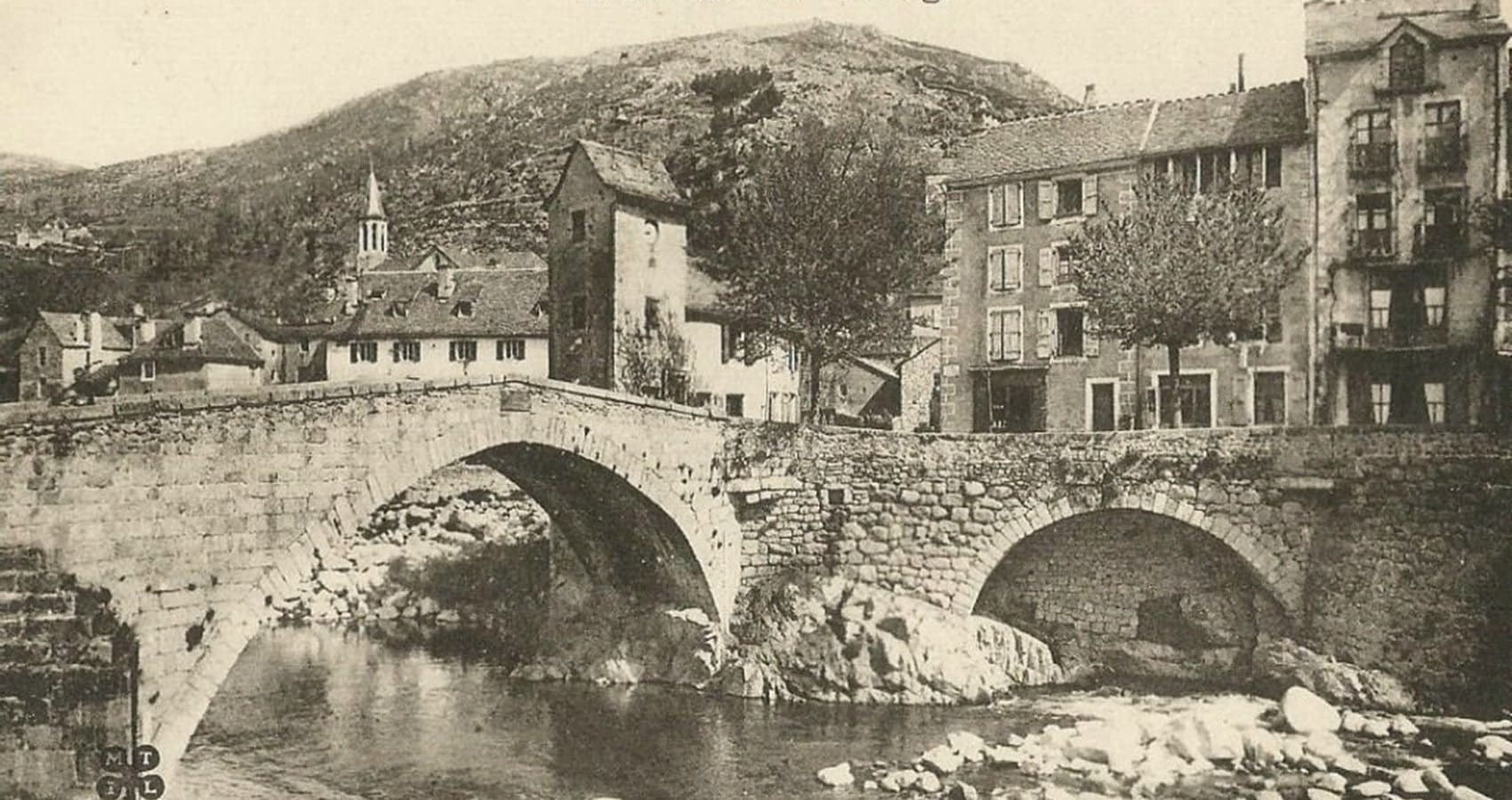
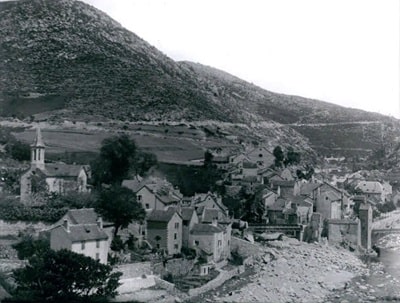 Le Pont-de-Montvert (882 m above sea level; bus connections to Florac, Génolhac, and Mende; Hotel de la Truite Enchantée, 12 rooms, tel. 3), with its 607 inhabitants, spans both banks of the Tarn River at the mouth of the Martinet (left bank) and Rieumalet (right bank) valleys. With a vast reforestation area of 1,284 hectares, it was one of the most ardent centers of Protestantism in the Cévennes. It was here that the famous Camisard uprising began on July 24, 1702, sparked by the murder of the Archpriest of Chayla.
The village is majestically dominated to the north by Mount Lozère. Five kilometers to the southwest lies Grizac, a hamlet featuring an old castle now converted into a farm, where Pope Urban V (1309-1370) was born. The route from Le Pont-de-Montvert to Le Bleymard, 23 km to the north, passes through Finiels (at 6.5 km), where it joins the road to Mount Lozère, and continues to the Col de Montmirat via the hamlet of Runes.
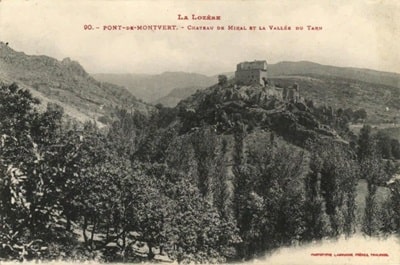
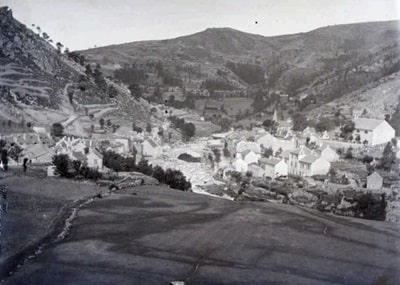 From Le Pont-de-Montvert to Florac, the Tarn valley is still deeply carved into ancient rocks. You pass Le Viala, a hamlet where the road to the Col de Montmirat branches off to the right. The highly scenic N. 598 road descends the Tarn valley at a great height above the sheer cliffs of the right bank. You pass in front of the Château de Miral, perched proudly on a promontory to the left. In Cocurès, a beautiful view of the cliffs of the Méjean causse opens up. As the valley widens, the road descends to cross the Tarn, leaving on the left Bédouès, which boasts a 14th-century church founded by Pope Urban V. On the right stands the Château d'Arigès. At the confluence of the Tarn and the Tarnon (535 m), the route reaches the N. 107 road, which you follow to the left, heading up the Tarnon valley, crossing this river just before reaching Florac (at 48.5 km).
At the exit of Génolhac, the N. 106 road crosses the Homol and leaves the road to Florac on the right. Beyond the hamlet of Belle-Poêle, the road descends windingly toward the left bank of the Luech, which you cross upon entering Chamborigaud (300 m; railway station), a former mining town that exploited coal. One kilometer to the east, you can admire the beautiful curved viaduct of the Nîmes railway line, towering 60 meters above the Luech. Leaving the road to Bessèges, which plunges into the wild gorge of the Luech, on the left, the N. 106 road then climbs in switchbacks over the ridge separating the Cèze basin from that of the Gardon. There lies La Tavernole, connected to Sainte-Cécile-d'Andorge by a picturesque, winding 10 km road.
The journey continues to Portes (578 m), dominated by its beautiful 14th- and 17th-century castle, solidly perched at the highest point of the road, which from then on descends in large curves. At an intersection, the road to La Grand-Combe (6 km) branches off to the right via the Col de Malpertus (390 m). After crossing Le Pradel (391 m), the continuously uneven road slips between the hills, descending through the scrubland while overlooking the Gardon valley on the right, finally opening into the Alès plain. To the right, you can spot the forges and blast furnaces of Tamaris.
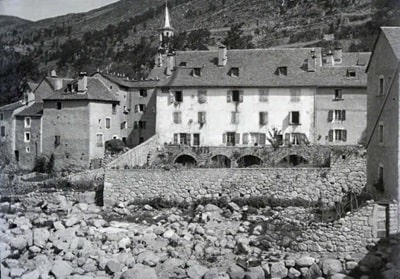 Just before reaching Le Pont-de-Montvert, the rocky walls overlooking the road along the Tarn glisten brilliantly. Huge ice cascades have frozen there, sculpted by runoff water and the polar cold of recent days. Like an immutable ritual, I make a brief stop here.
It was my brother, Tarn, who introduced me to Le Pont-de-Montvert over forty years ago. How had he discovered this remote corner of Lozère himself? The memory escapes me. Indefatigable, he wandered the roads and loved to drive. We fished together in the region for years, and then Tanh got married. He moved to the southwest, to the foot of those Pyrenees to which he had become so deeply attached and where death eventually took him. He must have been five or six years old when he entered our family, leaving behind his native Vietnam and his most painful memories.
 Tanh grew up with us, as best he could. He often watched me prepare for my outings, and his eyes lit up with a singular gleam when I unpacked my little equipment: pliers, hooks, spools of line, feathers, and floats. One day, he strongly insisted on accompanying me to the water's edge. Meticulous, ingenious, and blessed with inexhaustible patience, he quickly became an extraordinary fisherman. But, driven by an unquenchable spirit of competition, our complicity never quite reached the fullness I would have liked. Yet, his love for fishing and nature remained profoundly deep, and I remember with emotion our long conversations by the Tarn.
Ever since that Pentecost weekend in 1973 when I first set foot in Le Pont-de-Montvert, I have often reflected on my absurd, almost irrational attachment to this rugged piece of land in southern Lozère. Could I have lived there permanently? I don't know. Further up, towards Mende, the Lot valley, the Aubrac, or the Margeride, most certainly. But the geography of the Cévennes holds a terrifying and wild soul. In L'Épervier de Maheux, Jean Carrière describes this harshness with admirable accuracy. And yet I deeply love this land: the Cévennes are primarily the Cévenols, provided you know how to listen to them. The power of a landscape and its influence on a population's soul do not always follow logical slopes: the airy splendor of the Provençal Alps, for example, is at odds with the harshness of their villages, whereas the roughness and, let’s be honest, the ugliness of certain Cévennes landscapes have in no way altered the kindness of their people.
 I remember a warm evening towards the end of the eighties, in a rural inn nestled on the banks of the Rieumalet. Pink flames danced softly on the embers, lighting up our serene faces in an atmosphere of knowing smiles. At one point during the evening, our thoughts converged on the memory of Paul, whom some of us knew well. I had met him one June evening, two or three years earlier, as we were both returning from a fishing trip. At first glance, there was nothing more austere—but paradoxically nothing more eminently congenial—than this tall, quiet Parisian, thin as a rail, standing five foot eleven, and endowed with a remarkably deep voice.
At the Café du Commerce, we drank beer while shelling pistachios. I was immediately struck by the precision of the words Paul chose to describe the revelation that the wildness of these Celtic moors had been for him. He was fascinated by the violence of their torrents contrasting with the peaceful gentleness of their streams. That was five or six years ago. He had come straight from Paris, where he practiced a liberal profession whose exact nature escapes me today. As a passionate fly fisherman, he yearned to tackle the Tarn and the Lot, which he rightly considered to be among the most magnificent trout rivers in Europe.
 I later learned that, in the silence of these landscapes, he was also seeking to heal from the painful memory of a woman. He arrived one beautiful April morning and, to everyone’s astonishment, unpacked his bags for good, without ever casting a glance back toward the capital. He lived out everything a romantic mind might fantasize about, even spending a few nights under the stars in the Cévennes. He then took up quarters in a stopover lodge, surviving on modest savings, a few clothes packed in a worn-out old suitcase, and his battered Peugeot.
But he had finally found his haven. To make a living, he bravely took on odd jobs: he restored old dry-stone fence walls, tended animals on the ridges, maintained cars, and even gave valuable fly-fishing lessons. Finally, he successfully passed a modest exam to become a departmental road worker and rented a small house in the heart of the village. This radical lifestyle change was more than enough to forge his legend in the region. However, it was truly his exceptional talents as a fisherman that made him famous. And I know what I’m talking about.
In Time and Places: Autumn Mist by Patrick Heurley.
 "I would like to have a guide who could take me to Le Pont-de-Montvert, and leave at once," said Toinon.
"Go to Le Pont-de-Montvert, madam! But don’t you know that the heretics in the west..."
"I know everything that’s said, but it doesn’t matter; I want to leave right now for Le Pont-de-Montvert and find a guide. Do you know one?"
Thomas Rayne turned his cap in every direction, scratched his ear, and finally said:
"We are so afraid of the fanatics, madam, since they have gathered armed, that for neither gold nor silver will you find anyone willing to step out of the city."
"But the postilion who brought me... can’t he take me to Le Pont-de-Montvert?"
"The postilion! Leave here! And here comes the night! Ah! madam, it’s clear you are a stranger. Even if you covered their saddles with gold coins, they wouldn’t move an inch, the postilions! And the heretics! Don’t you know that the sight of a carriage attracts them like honey attracts flies!"
"What cowardice!" Toinon exclaimed angrily, stamping her foot; "to not find a single man of heart and resolution!"
"If madam would wait until the day after tomorrow, a convoy of muleteers from Nîmes is due to arrive, heading to the Rouergue; they should pass very close to Le Pont-de-Montvert. If they dare, despite the rumors, to venture into the west, then you can follow them."
"But one hour, one minute late, is of fatal consequence for me! I will give, I tell you, twenty, thirty louis, if necessary... but find me a guide, for heaven's sake, a guide!"
 After thinking for a while, the innkeeper slapped his forehead and exclaimed:
"Perhaps the poor young black-clad woman, who also says she is in a hurry to get to the west, will agree to accompany you, madam."
"Who is this woman?"
"A poor girl dressed in mourning, who travels on foot. She arrived about an hour ago; she is resting now, but she wants to set off again at sunset, despite what anyone may have told her. By Saint Thomas, my patron saint! She seems to fear neither God, nor devil, nor fanatic, nor prophet... What a girl! Jesus-God! A steel corslet would suit her better than a delicate collar!"
"And where is she going?"
"To Saint-Andéol-de-Clerguemot; it’s two leagues from Le Pont-de-Montvert. You see, madam, that if she wants to take you where you need to go, it won’t take her much out of her way."
"And where is this young girl? Can I see her? Send her to me," said Toinon quickly; "I will pay her whatever she wants, if she agrees to serve as my guide."
Thomas Rayne shook his head.
"This poor young girl seems prouder than the wife of a count, madam. Seeing that she was traveling on foot and believing her to be destitute, when she wanted to pay me for the piece of bread, the glass of water, and the grilled eggplants she modestly ate, I told her: Keep your money, my good girl, Thomas Rayne did not put up the sign of the Pastoral Cross for nothing. Say a prayer for me, and I will be well repaid for my alms."
 "But, God in heaven! At that mention of prayer and alms, the young girl shot me a look so furious, along with her silver coin, that in the future I would rather ask my guests for double the fare than merely offer them the generosity of a glass of water! She is proud; so much the better; she might understand you. She is in the small room next to the wine press," said Thomas Rayne. "The corridor is dark; if madam wants to follow me, I will guide her."
Toinon followed the innkeeper. After crossing a courtyard, she arrived in a fairly long corridor. Not caring to be around the young girl he had inadvertently offended, Thomas stopped and quietly said to Psyche, pointing to an ajar door:
"Here is her room, madam."
And he disappeared. Toinon, too preoccupied with her resolution to feel intimidated, gently pushed the door open and entered.
 Doubtless exhausted from the journey, the young girl was sleeping. She was so beautiful, despite the poverty of her clothing; her beauty had such an energetic and grand character that Toinon stood for a moment, stunned in admiration. This small, dark room was lit by a bull's-eye window, placed quite high up, which filtered a vivid and rare light onto the straw bed where the young girl rested, dressed in a long dress made of coarse black cloth; a hooded cloak of the same fabric, called a “gaulle” in Lower Languedoc, lay on a chair beside her, along with her iron-tipped staff, a leather knapsack, and her dusty sandals.
The noble profile of the young girl stood out in the light against the shadows of the alcove: she seemed to be a model for one of the ardent and dark figures of Murillo or Zurbarán. She had a broad forehead, a straight and somewhat long nose, full, uplifted lips, a prominent chin, and an eyebrow almost as straight as the ebony brow that framed it. Her hair, a blue-black with lustrous highlights, slightly uncurled by the moisture of the water in which the young girl had likely bathed her face, fell in natural curls around a neck of antique purity. The fresh down of youth softened her sun-kissed complexion. Although she was pale, the lively brown of her skin indicated strength and health.
 She was tall, and her broad shoulders, as well as her strong hips, further emphasized her slender and graceful figure. The sleeves of her dress, pushed up during her sleep, revealed her bare, round, and muscular arms: one hung almost to the floor, while the other supported her head. Her hands and beautiful feet, although slightly tanned, showed by the elegance of their shapes that she did not usually engage in long fatigue or hard labor.
Toinon examined this wild beauty in silence, with a curiosity mixed with fear; suddenly the young girl moved, and her face, instead of remaining in profile, turned to face her. From this new angle, the expression of her face seemed to Psyche dark, violent, almost threatening. The young girl was dreaming, a bitter and painful smile flickering across her lips. She furrowed her black brows, shaking her head on the pillow two or three times; then, still lost in her dream, she murmured in a low and broken voice, these disjointed words:
"Jean... no, I am not guilty... Cavalier, I swear it... my father... dead... the Marquis de Florac... infamous... oh! infamous... infamous!"
She pronounced these last words with such increasing energy, with so much exaltation, that when she said the word “infamous” for the third time, she jolted awake. Toinon had never seen this young girl, but upon hearing those words about the infamous Marquis de Florac, Psyche was convinced by a hidden revelation—a true marvel of love—that there was some fatal secret between this woman and Tancrède.
Toinon had listened to Larose's account with rapt attention and consuming anxiety; the slightest details of this narrative had etched themselves in her mind, and the name of Cavalier, one of the rebel leaders, especially lingered in her memory as that of one of Mr. de Florac’s most dangerous enemies. Now, this young girl had also uttered those words in her sleep: Cavalier, I swear it... What mysterious connection could exist between these three characters: the young girl, Cavalier, and Tancrède?
 Psyche did not yet grasp this secret. But at the painful blow that had just echoed in her heart, at the fervor of her hatred, her jealousy, her piercing curiosity, and her instinctive terror, she felt at that moment that Isabeau (for that was her name) must be the most deadly enemy of Tancrède. In light of these fears, Toinon had to do everything possible to persuade Isabeau to serve as her guide, hoping to spy on her during the journey and to divert from Tancrède the misfortunes she feared for him.
Isabeau, seeing a stranger near her bed upon waking, stood up abruptly. She appeared even taller to Toinon when standing than when lying down.
"What do you want?" Isabeau said harshly, frowning her ebony brows and fixing on Psyche a dark, profound gaze like the night.
"To talk to you," Toinon replied resolutely, her large, bright gray eyes not lowering before Isabeau's dark glance.
These two women, so different by nature, examined each other in silence: one proud, tall, and strong, the other small, supple, and nervous. It was as if a lioness was ready to roar at a snake. After this first moment, involuntarily given to the expression of a suppressed, deep-seated hatred, Toinon reflected that it was a matter of cunning and not violence with this woman, and that it was not by defying her that she would convince her to serve as a guide.
 Psyche therefore called upon all her resources, all the hypocrisies of her art; as a practiced actress, she timidly lowered her beautiful eyes, which quickly extinguished their spark of passing anger in a tear of angelic sadness; her childlike mouth shaped the most touching, naive smile, her two small hands rose in supplication, she sank halfway to her knees and said in a soft, trembling voice:
"Forgive me, miss, but alas! I come to ask you for a great favor."
"I am alone, I am poor, I cannot help anyone," Isabeau replied curtly.
"If you would deign to consent, you could do everything for me, miss," said Psyche, falling to her knees.
"I am Protestant," said Isabeau, stepping back a pace, believing this declaration would cut the conversation short.
"And so am I!" said Toinon in a low voice, making a mysterious sign.
Psyche had risked this lie without foreseeing the consequences, but she was only thinking of the present moment, and her mind, exalted by the difficulty of her situation, suggested to her a rather plausible fable right then and there.
"You are of the Reformed religion?" Isabeau resumed in a less harsh voice, fixing a penetrating gaze on Toinon.
"Alas yes, my mother and my sisters are prisoners at Le Pont-de-Montvert. I have just arrived from Paris to join them, but the postilion who brought me refuses to travel any further, fearing the rebels, as they say. No one wants to serve as my guide. The innkeeper told me you were heading toward Le Pont-de-Montvert. Out of pity, let me accompany you. If you have a mother, sisters, or a father, miss, you will understand all that I suffer, all that I desire!"
And Psyche, weeping, embraced Isabeau's knees.
"Get up, get up," said Isabeau with a tender look; then she added: "I have no sister, I have no mother, I have no father; but you are of our religion, and I must do for you all that I would do for my own sister."
Then, after a moment of silence, she said to Toinon:
"One can tell by your accent that you are not from this country..."
La Revue de Paris 1928