


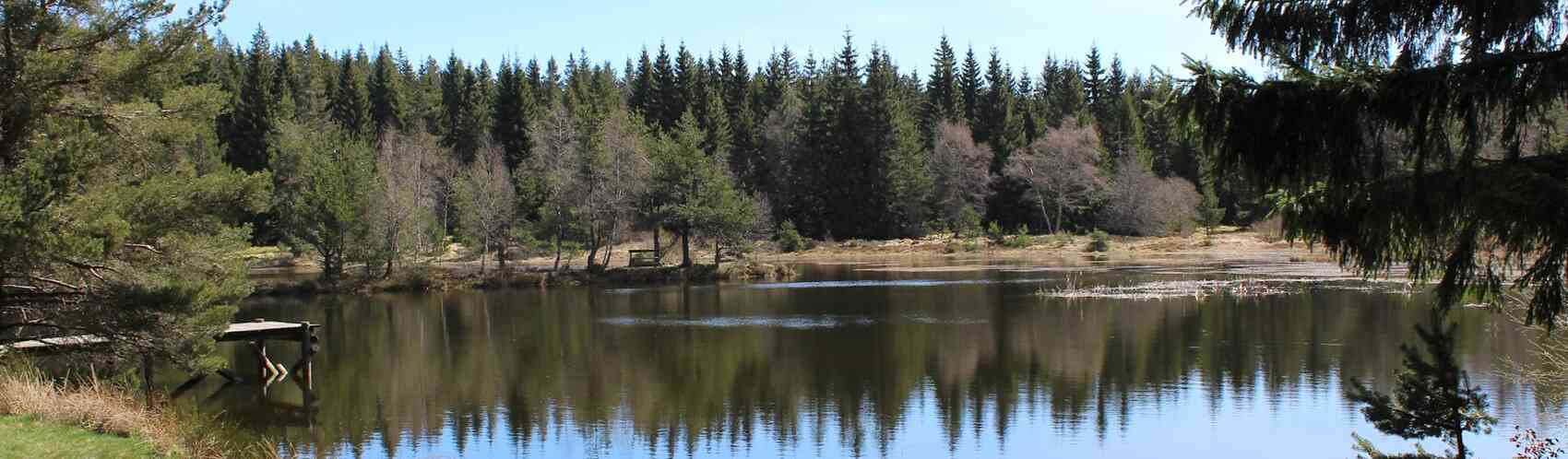
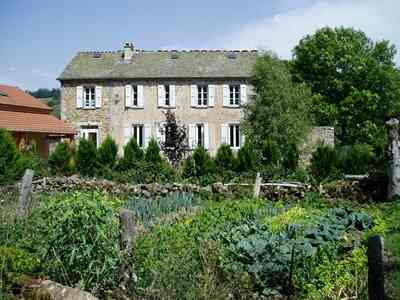
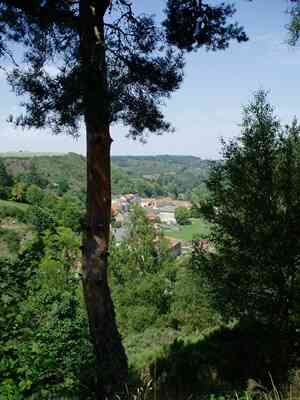
"To be completely frank, Cheylard hardly warranted such extensive searching. A few haphazard streets trailing out of the village, no clearly defined roads, just a series of small squares piled high with logs and bundles, a couple of crosses bearing inscriptions, and a chapel dedicated to Our Lady of All Graces perched atop a hill. All of this was nestled beside a murmuring river in the recess of an arid valley. What was I expecting to see there? I wondered to myself. Yet, the locality possessed its own unique charm. Inside the tiny, fragile church, I found a plaque commemorating Cheylard's donations from the previous year, hanging proudly like a banner.
It appeared that, in 1877, the inhabitants had contributed forty-eight francs and ten centimes toward 'the work of the Propagation of the Faith.' I couldn't help but hope that a fraction of that money would find its way to my homeland. Here was Cheylard, painfully scraping together small change for the souls of Edinburgh still engulfed in darkness, while Balquhidder and Dumrossness lamented that Rome ignored them entirely. Thus, much to the angels' jubilation, we send Evangelists against each other, like schoolboys quarreling in the snow.
The local inn was remarkably devoid of any pretensions. All the furnishings of a comfortably well-off family were gathered right in the kitchen: the beds, the crib, the clothes, the dish drainer, the flour bin, and a framed photograph of the parish priest.
Five children were present. Shortly after my arrival, one of them was busy with his morning prayers at the bottom of the stairs, while a sixth child was soon to be born. These good people welcomed me with open arms. They took a keen interest in my misadventures, especially since the woods where I had slept actually belonged to them.
They considered the man from Fouzilhac to be a monster of wickedness, and earnestly advised me to sue him 'because you could have perished.' The good landlady was quite alarmed to see me down a pint of unskimmed milk in one go. 'You could hurt yourself,' she warned. 'At least let me boil it for you.' After starting my morning with that exquisite drink, and since she had a multitude of chores to attend to, I was allowed—or rather, required—to prepare my own bowl of chocolate.
My shoes and gaiters were hung up to dry. Seeing me attempting to write my journal on my knees, the eldest daughter brought over a folding table and set it up for me in a corner by the fireplace. It was there that I wrote, drank my chocolate, and eventually ate an omelet before setting off. The table was covered with a generous layer of dust, as I was informed it was only used during the winter. Whenever I looked up, I had a clear view of the sky through the chimney opening, framed by dark piles of soot and blue smoke. And every time a handful of twigs was thrown onto the fire, my legs were practically roasted by the flames.
The husband had begun his working life as a muleteer, and when it came time to load Modestine, he demonstrated a wealth of practical experience. 'You should modify this packing,' he advised. 'It should be split into two parts; then you could carry double the weight.' I explained to him that I had no desire whatsoever to increase the weight and that, for no donkey ever born, would I dream of cutting my sleeping bag in half. 'But that,' the innkeeper insisted, 'is what causes fatigue during the walk. Look.' Alas! Modestine's two front legs were rubbed raw, showing only bare flesh inside, and blood was dripping from her tail.
I had been told upon my departure—and I had been quite inclined to believe it—that within a few days, I would come to love Modestine like a dog. Three days had now passed, we had shared several misadventures, yet my heart remained as cold as ice toward my beast of burden. She was certainly pleasant to look at, but she had also displayed a fundamental stupidity—redeemed, to be fair, by her patience, but severely aggravated by inappropriate and distressing bouts of sentimental lightheartedness. I must admit that this discovery constituted yet another grievance against her. What on earth was a donkey good for if she couldn't even carry a sleeping bag and a few small accessories?
I could see the moral of the fable rapidly approaching: the moment when I would have to carry Modestine myself. Aesop was truly a man who understood the world. I assure you that I set off again with a heart heavy with worry for my short stage of the day. And it wasn't just serious concerns about Modestine weighing me down—there was something far more painful to bear.
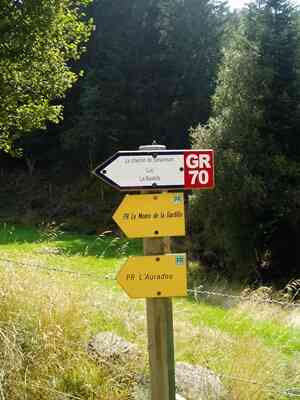
First of all, the wind blew with such relentless force that I was forced to hold the pack steady with one hand the entire way from Cheylard to Luc. Secondly, my route crossed through one of the most desolate and miserable regions in the world. It was somehow even more barren than the Scottish Highlands, in an even worse state:
cold, arid, hideous, poor in wood, poor in heather, poor in life. A single road and a few sparse fences broke up the uniform immensity, the path's layout marked only by standing stones to serve as landmarks in times of heavy snow." Excerpt from "Travels with a Donkey in the Cévennes" by Robert Louis Stevenson.
In this classic book, the author recounts his epic journey through the Cévennes, a rugged mountainous region in southern France. The story begins when Stevenson, eager to leave urban life behind and reconnect with nature, decides to embark on a hike with a donkey named Modestine. This choice of an unexpected, stubborn companion adds a distinct touch of humor and tenderness to his adventure. Throughout his journey, Stevenson not only describes the magnificent, sweeping landscapes of the Cévennes but also his memorable encounters with the local inhabitants. His writing is deeply poetic and richly detailed, allowing the reader to fully immerse themselves in the unique atmosphere of each place. He also touches upon timeless themes such as solitude, wandering, and the eternal quest for self. Through the ups and downs of his journey—sometimes grueling but often enchanting—Stevenson evokes a profound sense of freedom and escape, standing in sharp contrast to the anxieties of modern life. In short, it is a narrative that is both introspective and vibrant, where the author masterfully explores both the physical landscape and his own mind.