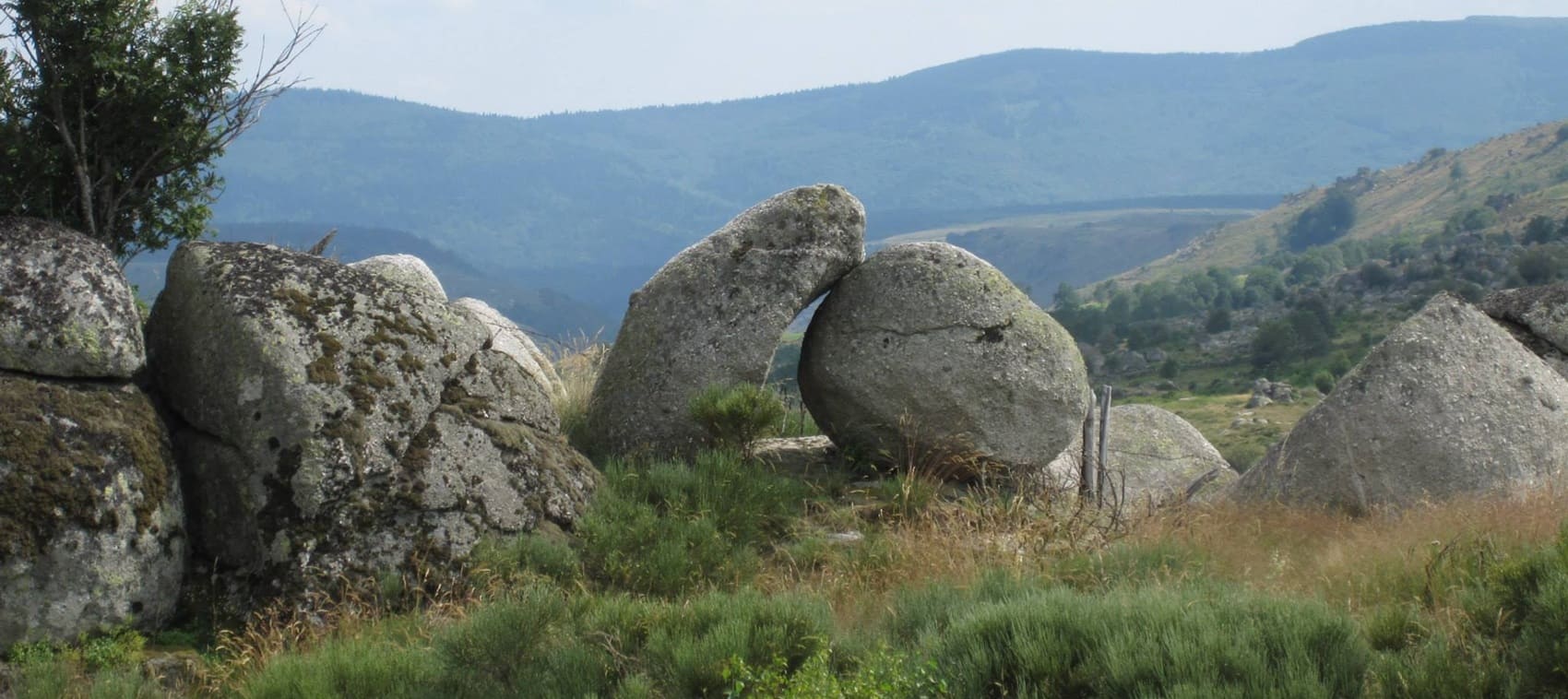
 Welcome to La Bastide-Puylaurent: A timeless haven
 The ideal starting point for this adventure is found in La Bastide-Puylaurent, a small village perched at an altitude of 1,024 meters on the watershed line. It is here that the L'Étoile guesthouse, an imposing building from the 1920s, immediately imposes its singular hospitality and old-fashioned charm.
Philippe, the master of the house and an authentic globetrotter, redefines the art of hosting with a disarming simplicity and rare human warmth. Around a generous large table where the languages of hikers from all over Europe intertwine, crusty homemade bread accompanies a warm wine from the southern Cévennes that loosens tongues after the effort.
In this vast estate overlooking the clear and singing waters of the Allier river, each spacious and bright room offers a peaceful retreat lulled by the murmur of the river. In the hands of your host rests a thick binder, a true bible of local trails resulting from decades of exploration, promising tailor-made escapes at the crossroads of Ardèche, Haute-Loire, and Lozère.
Barely five hundred meters from the village, the edge of the forest opens up, releasing the heady scent of damp earth, humus, and fresh porcini mushrooms. It is a preserved environment, an absolute tranquility sometimes pierced by the silent flight of a graceful deer or the heavy trotting of a wild boar in the thickets.
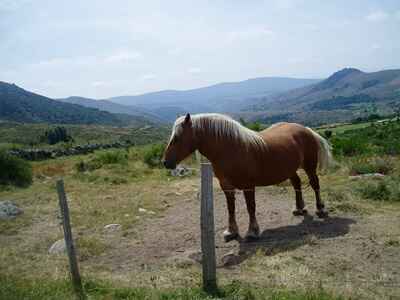 On the Stevenson Trail: Deep forests and immense skies
The adventure truly begins on the historical footsteps of the Scottish writer Robert Louis Stevenson and his donkey Modestine, following the legendary Stevenson Trail (GR®70). The route first sets off on the gentle slopes of the Moure de la Gardille, brushing past the nascent and mysterious sources of the Allier, before plunging towards the verdant Chassezac valley in Chasseradès.
The passage under the dizzying freestone arches of the Mirandol viaduct marks the beginning of a harsh but magnificent ascent towards the Goulet mountain. You then cross the thick L'Estampe national forest, a sea of dark conifers that was once the old stronghold of Baron Guillaume Périer. The air there is crisp, heavy with the essence of pines and firs.
The trail then begins a long panoramic descent through the picturesque hamlet of Les Alpiers. Facing the horizon, the imposing Mont Lozère massif stands with all its granite mass above the Lot valley, crowned with fleeting clouds. These twenty-eight kilometers of effort, sometimes demanding on the calves, are richly rewarded by the raw beauty of a mosaic of landscapes alternating wild moorlands dotted with golden broom, purple heather fields, and vibrant green alpine pastures, before finding a restful break in Le Bleymard.
Mont Lozère and Le Pont-de-Montvert: At the sources of Camisard history
 The next day, the ascent towards the Mont Lozère resort via the Santel pass (with its 400 meters of positive elevation) prepares you for the mineral apotheosis of the hike: the summit of Finiels. At an altitude of 1,699 meters, amidst a chaos of granite blocks shaped by millennia, the wind sweeps across an exceptional 360-degree panorama where the Cévennes ridges undulate endlessly under the sky, like a frozen ocean. On a clear day, the gaze reaches as far as the Mediterranean Sea and the Alps. The descent then begins through scree and crystalline springs, leading directly to the bubbling heart of regional history, in Le Pont-de-Montvert. It was here, in this market town with solid granite houses crossed by the tumultuous waters of the Tarn, that the tragic spark of the Camisard war was ignited on July 24, 1702, with the assassination of the Abbot of Chayla by rebellious Protestants. The atmosphere still retains a strong, almost solemn identity today, this "subtile atmosphere" that Stevenson himself noted facing the temple, marking a sharp break with the villages across the Channel.
"One of the first things encountered at Pont-de-Montvert, if I remember correctly, was the Protestant temple. But this was only the harbinger of other novelties. A subtle atmosphere distinguishes a town in England from a town in France or even Scotland."
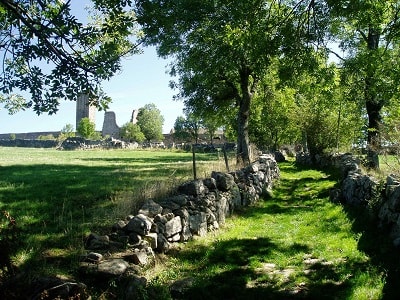 Towards Mas de la Barque and the Régordane Way: Wild lands and knights
The route then diverges from Stevenson's wake to join the GR®72 markers. Following the nascent and joyful course of the Haut Tarn from the isolated hamlets of Felgeroles and Le Merlet, witnesses of an ancestral peasant life, the path winds through damp meadows to the historic old stone bridge of the Tarn. A detour to the former Mas Camargue agricultural estate, with its typical traditional architecture of the region, is a must before reaching the cozy refuge of Mas de la Barque. The warm welcome of this guesthouse, a true haven in the middle of the summer pastures, inevitably invites a longer stay to climb Pic Cassini. From its 1,680-meter height, the view plunges spectacularly down to the wooded foothills of Mont Aigoual. The return, across the flat moorlands and the Commander's wood, allows observation of pastoral life: shepherds carefully preparing the fences for the imminent summer grazing, accompanied by the joyful yapping of their dogs and the distant tinkling of sheep bells.
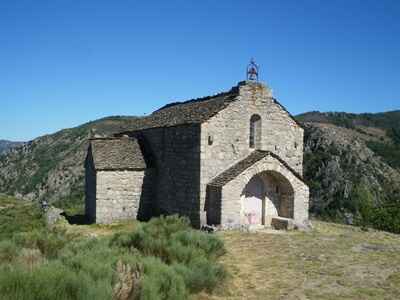 After a night sometimes rhythmic with Cévennes showers that revive the scents of the earth, the ridge track descends steeply through centuries-old chestnut forests towards Lake Villefort. The reborn sun illuminates the calm, deep blue waters held back by the large dam. Once back on the plateau, the fortified village of La Garde-Guérin proudly raises its medieval ramparts and watchtowers on the edge of the dizzying Chassezac gorges. This former lair of the "parier knights" majestically opens the way to the Albespeyre stage, offering breathtaking viewpoints over the granite cliffs plunging into the river.
The final stretch takes place on the large worn stone slabs, hollowed out by wagon ruts, of the legendary Régordane Way (GR®700). This major commercial and spiritual artery of the Middle Ages connected the Île-de-France to the Mediterranean. Beneath your steps resonates the imaginary echo of Frankish chivalry marching south, monks on pilgrimage to the Abbey of Saint-Gilles, and peddlers transporting wine, salt, and precious spices on mule back. By crossing the Rachas dam and the rocky, wind-swept heights of Le Thort, you once again cross the invisible watershed line at an altitude of 1,133 meters. The journey ends where it began, in La Bastide-Puylaurent. The body is weary but the spirit is invigorated, the head filled with the majestic flight of eagles soaring over the ridges, the furtive glimmer of brown trout under the wooden footbridges, and this unfailing certainty that unites all walkers: one always returns to the Cévennes.
"November 17: departed at dawn from La Bastide, dined in Villefort at the Logis des Trois Rois, spent 17 sols 6 deniers; snack and horse feed in Génolhac, 4 sols 6 deniers; supper and sleep in Le Pradel at the logis called Fornier, spent 19 sols 9 deniers."