


 Although riddled with deep and mysterious caves, the Cévennes and the Causses have not yielded an artistic legacy comparable to that of Périgord or the Pyrenees, for reasons that remain elusive to historians. However, the Bronze Age did leave behind some remarkable treasures, notably the hoard discovered on the Causse Méjean near Mas-Saint-Chély (now displayed at the Mende museum), and the treasure found at the Capucins climb in Puy-en-Velay (currently housed in the Lyon museum).
The Gallo-Roman era is best represented by the magnificent, well-preserved monuments of Nîmes, alongside countless objects unearthed in the surrounding region. Some of these artifacts are of purely Roman manufacture, while others were imported from Greece or Italy (visible at the Maison Carrée and the archaeological museum). The ancient acropolis of Ensérune, near Béziers, has also provided a vast array of remarkable vases imported from Greece, now gathered at the Mouret museum. Furthermore, the sigillated pottery workshops in Banassac (Lozère) and Graufesenque, near Millau, famously distributed their beautiful red-slip ceramics throughout the entire Languedoc region, with fine examples displayed in the museums of Mende and Rodez.
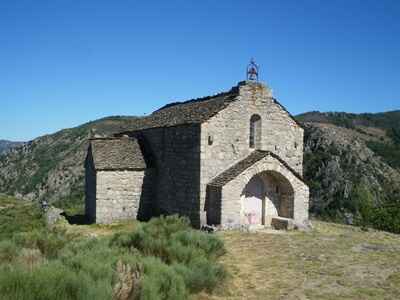
 Religious Architecture — Following the dark ages of the barbarian invasions and the early Middle Ages, the Carolingian Renaissance finally began to dawn. However, in the poor and rugged mountains of the Cévennes—much like on the coastlines constantly exposed to various degradations—this renaissance left far fewer traces than in other regions. Nevertheless, one can confidently attribute to the 10th century the baptistery of Mélas and the oldest section of the Saint-Michel d'Aiguilhe chapel in Puy-en-Velay. The 11th century gifted us the crypt of Cruas, the baptistery of Puy-en-Velay, the church of Quarante, the nave of Saint-Guilhem-le-Désert, and quite possibly the charming chapel of Notre-Dame de Vallée-Française.
The 12th century, particularly during its second half, witnessed the widespread diffusion of Romanesque art. Yet, due to a severe lack of local resources, its productions generally remained so austere and simplistic that they cannot easily be attributed to a specific architectural school. An apse, a single nave without side aisles, occasionally two false transepts covered with transverse vaults, and an unadorned, sculpture-free portal are the unchanging hallmarks of countless churches throughout southern France. The Auvergne school, though represented by a small number of buildings, was highly original and heavily influenced the churches of Chamalières, Saint-Paulien, and the grand Cathedral of Puy-en-Velay, which remains an exceptional masterpiece in many respects.
Bas-Languedoc, being richer, more densely populated, and endowed with large, prosperous cities, has bequeathed us far more considerable monuments. Churches featuring side aisles are far more frequent here: one can admire the grand churches in Béziers, Saint-Guilhem-le-Désert, Espondeilhan, and Quarante. The Rhône valley shares this richness with sites like Cruas and Bourg-Saint-Andéol. Surprisingly, however, some fairly large cathedrals in the area lack side aisles entirely (such as Agde and Maguelone). These monuments, constructed in a vibrant region where ideas circulated just as freely as people, clearly denote strict Mediterranean influences. One can observe Provençal touches and, further north, Carolingian influences—echoes of the imperial and Gallo-Roman past. The famous intricately carved portal of Saint-Gilles strongly resembles that of Arles, while the decoration of the apse at Saint-Jacques in Béziers belongs to a Provençal school that extended its reach all the way to Alet in the Aude valley. Meanwhile, the richly composed apses of Cruas, Bourg-Saint-Andéol, Quarante, and Saint-Guilhem-le-Désert belong to a Lombard artistic tradition that swept across Bas-Languedoc and ultimately conquered Catalonia.
In the Causses region, the large abbey churches are predominantly Benedictine or Cistercian constructions, such as those found in Nant and Sylvanès, as well as the Saint-Salvi collegiate church in Albi. The magnificent abbey of Conques-en-Rouergue stands as an exceptional building, closely resembling the grandeur of Saint-Sernin in Toulouse, Moissac, and Beaulieu. Just like Provence, Bas-Languedoc diligently preserves a multitude of small, charming rural Romanesque chapels scattered across its countryside.
 Throughout the Gothic period, the entirety of southern France remained deeply faithful to the Romanesque art style, which perfectly suited the local preference for austere simplicity. The ribbed vault did, however, make isolated appearances to solve specific structural problems toward the end of the 12th century—roughly fifty years after its debut in the Île-de-France region. It remains uncertain whether these early examples (such as the transepts of Maguelone and the porch of Saint-Guilhem-le-Désert) derived from Parisian or Champagne architectural influences.
A few great monuments do genuinely belong to the classical Gothic style of Northern France, including the cathedrals in Montpellier, Rodez, Mende, and Lodève. Yet, only the cathedral of Rodez is considered a truly flawless success; the others tend to suffer from a certain poverty in planning and a noticeable dryness in their execution. To the cathedral of Rodez, one must undoubtedly add the magnificent choir of the Narbonne cathedral, which faithfully reproduces the soaring designs of Limoges and Clermont-Ferrand.
 Most often, however, Gothic churches in this area belong to the distinct "Southern Gothic" style. This style is so remarkably uniform that its very designation spares us from having to repeatedly describe the structure of these edifices. They primarily consist of a vast, single nave flanked by side chapels tucked between the buttresses, leading to a polygonal apse that is both narrower and lower than the nave itself. There is no ambulatory, no transept, and no side aisles. Occasionally, the main apse is flanked by smaller absidioles that open directly into the nave, as seen in Saint-Vincent and Saint-Michel in Carcassonne, Frontignan, Saint-Sévère in Agde, and Cruzy.
The ultimate prototype of the Southern Gothic style is undeniably the fortress-like Cathedral of Albi, which was begun at the end of the 13th century. However, the architectural concept of a single nave without side aisles, flanked only by side chapels, had already been realized in the 12th century at the Cistercian abbey of Sylvanès in Rouergue—which was itself a direct reproduction of Fontenay Abbey in Burgundy. Regardless of the origin of this "formula," it truly flourished only in southern France. The esteemed historian Émile Mâle is likely correct when he attributes the overwhelming popularity of these wide, open naves to the exceptional acoustics and visibility they offered for preaching, particularly in a region where religious authorities were heavily focused on repressing the lingering remnants of the Albigensian heresy.
These churches are characterized not only by their unique structure but also by their distinct proportions: the height of the vault noticeably decreases in relation to its width, and these two dimensions often tend toward equality. This creates a complete and striking contrast to the dizzying, slender verticality of northern Gothic churches. Furthermore, even in the middle of the 14th century, the heavy broken barrel vault resting on transverse arches remained actively in use for naves, as seen in Cruzy and Frontignan.
 Among the monastic constructions of the Gothic period, the striking charterhouse of Villefranche-de-Rouergue deserves a very special mention for both its massive scale and its remarkable state of preservation. Just as it had stubbornly clung to the Romanesque style during the early Gothic period, Languedoc surprisingly preserved the Gothic style—or at least its essential structural principle, the ribbed vault—well into the 17th century (as seen in the cathedrals of Alès, Castres, and Uzès, the latter being the only one to feature side aisles, as well as the church of Lunel). There are, of course, classical churches analogous to those found in Northern France. Overall, though, churches from the classical era are relatively few in number, simply because southerners felt no compelling need to reconstruct a perfectly sound church merely to follow architectural fashion. Indeed, without the widespread destructions caused by Protestant forces in the 16th century, classical churches in the region would be even rarer.
However, classical architecture is magnificently and dignifiedly represented by the historic center of Montpellier. This vibrant city—populated by nobles, wealthy bourgeois, high-ranking officials, professors, and prestigious lawyers—was almost entirely rebuilt after the devastating siege of 1622, displaying a level of luxury uncommon for the region. It is a powerful and elegant architecture, born from the abstract and highly refined work of skilled designers, since the narrowness of the medieval streets and private courtyards prevents any sweeping overall view. In any case, the grand hôtels particuliers (private mansions) of Montpellier, which are much more distinctly French in style than those of Aix-en-Provence (which lean more Italian), constitute one of the most beautiful classical urban decors one can see in France, rivaled only by Bordeaux and Nancy. The town of Pézenas also offers a considerable number of similar, elegant mansions relative to the city's smaller size; however, having frequently fallen into the hands of humbler owners over the centuries, many are today unfortunately quite dilapidated and disfigured.
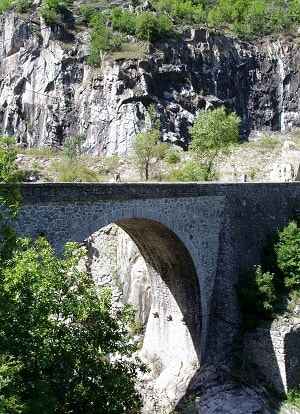 Public Architecture — This part of France has miraculously preserved a considerable number of ancient, often breathtakingly beautiful bridges. The most famous are the legendary Pont du Gard, an absolute masterpiece of Roman engineering, and the Pont Saint-Esprit, which eventually gave its name to the bustling town that formed at one of its ends. Since its partial destruction, the famed bridge in Avignon sadly no longer connects the city with the Languedoc bank.
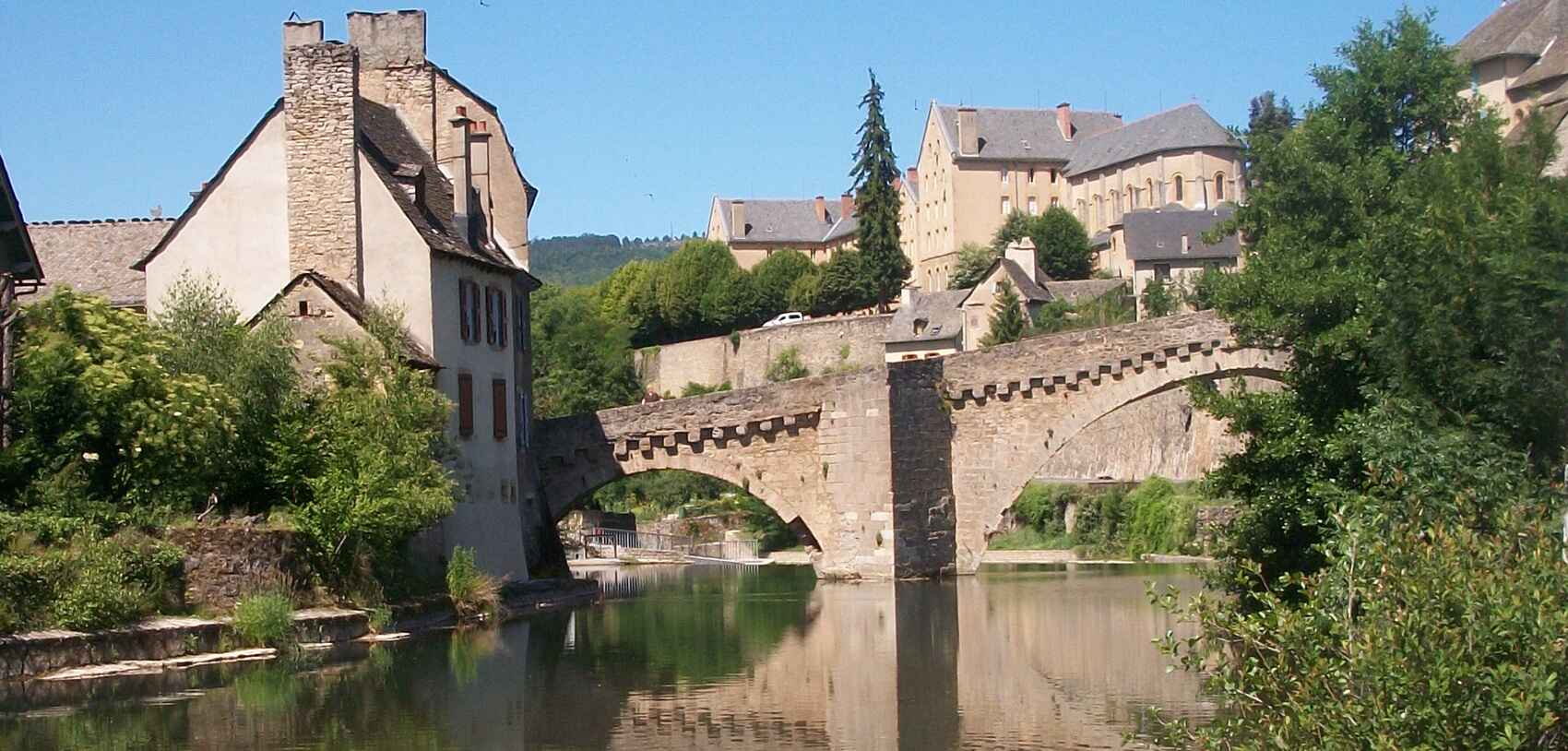
Another very beautiful Roman bridge can still be admired near Viviers. However, it is primarily Gothic stone bridges that one encounters most frequently in the region: in Béziers, Le Puy-en-Velay, Mende, Espalion, Estaing, Entraygues, Olargues, Camarès, and Quezac. Many of these structures, built incredibly high above the violent, unpredictable torrents they cross, feature a massive central arch and a very pronounced "humpbacked" profile. They possess a superb, rugged appearance and wonderfully complement the dramatic, wild landscapes where they were constructed. Countless smaller bridges of a similar style, seamlessly integrated into rural paths and built with slightly less refinement than those on the royal roads, date only from the classical period, an era when the sprawling road network initiated in the Middle Ages was finally completed.
In the 16th, 17th, and 18th centuries, several major cities, including Albi, Béziers, Nîmes, Alès, Le Puy-en-Velay, and Pézenas, erected highly imposing town halls. During the 18th century, Montpellier and Nîmes created two of the most spectacular and meticulously designed public gardens one can see in France. The former Jesuit colleges of Tournon, Montpellier, Albi, and Rodez have hardly changed their primary purpose and today proudly serve as national high schools. The college in Sorèze, originally of Benedictine origin, boasts a unique and fascinating history that has only added to its long-standing celebrity.
Public architecture in the region is also proudly represented by ancient covered market halls (halles), some of which are among the oldest in France, such as those in Revel, Anduze, and Langogne. The specific region described in this guide does not feature the same multitude of bastides (fortified new towns) founded in the 13th century that one finds in abundance throughout the Southwest. Consequently, one sees far fewer of these perfectly symmetrical old cities built on a grid plan, with a central square surrounded by stone arcades or "couverts," and the existing examples are slightly less typical. Nevertheless, such striking squares can still be explored in Revel, Uzès, and Millau. The Place Notre-Dame in Villefranche-de-Rouergue remains one of the most breathtaking of its kind, though it must be noted that geographically, we are much closer to Gascony here than elsewhere. Finally, the magnificent lower town of Carcassonne offers the largest, most ambitious, and arguably the most beautiful example of French urban planning surviving from the 13th century.
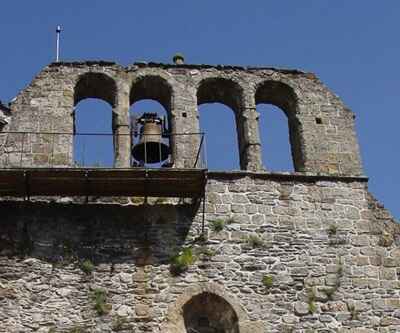
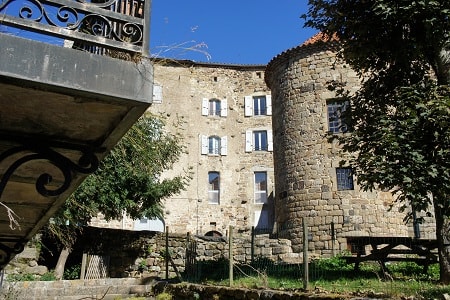 Military Architecture — Military architecture is both overwhelmingly abundant and intensely varied in this region. The Rhône valley, much like the Rhine, possessed its own imposing rival fortresses glaring at one another across the water. The rugged interiors of Vivarais, Velay, Gévaudan, and Rouergue, situated far from the main royal thoroughfares, were fortified less to repel foreign invaders and more to settle the bloody needs of endless local quarrels. In Bas-Languedoc, the bitter, violent memories of the Albigensian crusade and the brutal Protestant wars persist vividly in the heavy fortifications. Finally, the Mediterranean coast has always been, exactly like the Rhône in the Middle Ages, a vulnerable border that it was the absolute duty of the King of France to defend. Hence the incredible diversity of military monuments. Fortified churches are particularly numerous throughout Languedoc; often, they alone formed the sole line of defense for many small villages and served as impregnable citadels for towns already encircled by walls.
Countless towns and villages have managed to preserve at least a portion of their original defensive walls, which were most often erected in the chaotic 14th century. These stoic stone remains reveal the inherently harsh, unforgiving character of so many southern landscapes. Cordes in the Albigeois, La Couvertoirade in Rouergue, and the marshland fortress of Aigues-Mortes—not to mention the legendary walled city of Carcassonne—boast particularly fascinating and exceptionally well-preserved ramparts. To this list, one must certainly add the beautiful, towering fortified gates of Marvejols.
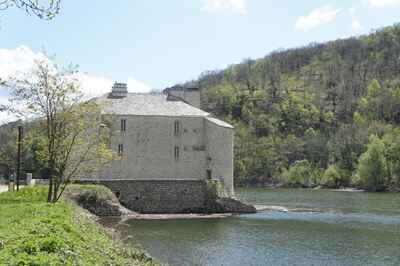 Many formidable castles sit directly adjacent to a town, such as those in La Voulte-sur-Rhône, Largentières, Beaucaire, Tournon, and Aubenas, or are planted right in the very heart of the city, like in Uzès and Yssingeaux. The impressive fortresses in Largentières and Yssingeaux were built by the powerful bishops of Viviers and Le Puy-en-Velay; similarly, the colossal episcopal castle of Albi remains one of the most stunning and intimidating brick fortresses in all of southern France.
However, in this rugged, mountainous country, there is scarcely a single well-placed, defensible peak that some minor local lord did not eventually choose as a retreat. These rough, weather-beaten buildings, now in varying states of ruin, fit much more organically into the surrounding, wild landscape than the soft, elegant châteaux of the Touraine. Polignac, Brissac, Cabrières, Crussol, Bournazel, Castelnau-de-Lévis, Castelbouc, Lacaze, Séverac, Estaing, Penne, and Bruniquel—these are sonorous, historical names that ring out like musket shots across the valleys. Many of these castles were expanded or refined in the 15th or 16th century, and these delicate additions should not be overlooked if one wishes to get a truly accurate and nuanced idea of Renaissance art in the region.
Finally, just as in the neighboring Auvergne, one can find isolated or adjoining fortified manor houses scattered throughout Velay, Gévaudan, and Vivarais. Here, as in the rest of the southern provinces, the evolution of these constructions significantly lagged behind the cutting-edge military architecture being developed in the North. This delay was primarily because the financial resources of the southern builders were far more limited, but also because the extreme steepness of the natural, rocky positions greatly simplified the defensive tasks of the engineers. For a long time, builders continued to construct highly vulnerable square towers at the entrance gorge, poorly protected outer gates, and perilously large lower windows.
A few royal fortresses, however, stand out as brilliant exceptions to this rule, most notably the impenetrable Tower of Constance in Aigues-Mortes and the magnificent cliffside castle of Najac. It is no coincidence that these were explicitly royal constructions, designed and built by masterful military engineers brought down from the North. Just like the kingdom's other vulnerable borders, the southern coast was heavily fortified and put into a state of absolute defense by Louis XIV and Louis XV, resulting in the construction of the forts of Sète and Cap d'Agde. Lastly, one should note as a dark historical curiosity the imposing citadels of Alès, Nîmes, and Montpellier, all built in the 17th century not to protect the cities from outside invaders, but specifically to keep their own rebellious Protestant populations firmly under royal control.