


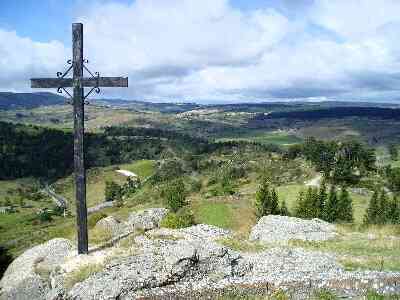
Long ago, a castle was apparently built at the top of the mountain where Châteauneuf would later rise. However, we remain completely ignorant of the exact periods during which these fortresses were constructed. We know little more about the origins of the town of Randon. It owed its high importance to the strong strategic position of the castle, which elevated it to the rank of the principal baronies in the country. There exists a charter from Raymond-Bérenger, Count of Barcelona, granted of his own accord—and ruler of part of Gévaudan through his wife Douce—dated April 1126. This document grants the castle of Randon (Castrum quod vocatur Rando) as a fief to the brothers Guarin and Odilon and to their descendants in perpetuity.
In the middle of the 12th century, Guillaume de Randon, likely their successor, was—along with other regional lords—a witness to the cession made by Pagane of all his goods to his brother Bernard-Atton, Count of Nîmes (1152). Under the episcopate of Guillaume de Peyre from 1187 to 1223, the Lords of Randon founded or richly endowed the monastery of Mercoire, situated in a forest in the mountains of Gévaudan, near the sources of the Allier.
This abbey, the only one in the diocese (Mende), received nuns from the Cistercian order. Bishop Guillaume de Peyre had violent disputes with Randon of Châteauneuf, whom he accused of committing acts of violence against the peasants, his vassals. The other lords of the region were hardly more humane. The prelate, wishing to set a firm example, invaded the domains of Randon of Châteauneuf, captured eighteen of his castles, and forced him to seek peace.
Around 1226, the town of Châteauneuf-de-Randon had Odilon Guarin as its lord, according to a monument from that time; he held his barony as a fief from the church of Mende or from the abbey of Saint-Gilles. Informed of the invasion plans of King Louis VIII of France, the Baron of Randon wrote to affirm his willingness to recognize the King as his sovereign and to receive royal troops in his strongholds should they take the road to Gévaudan.
From 1233 to 1243, the lords of Châteauneuf-de-Randon and Tournel fought against Pons V, Viscount of Polignac, over the barony of Ceissac, half of which they claimed as heirs of Guillemette de Polignac. Bernard de Montaigu, Bishop of Le Puy, ultimately restored peace between the opposing parties. This marks the first mention of an alliance between the Randons and the House of Polignac, an alliance into which they would soon completely merge. Before the end of the century, Guillaume, Lord of Randon, married Walburge, the eldest daughter of Hugues, Count of Rodez, and Ysabeau de Roquefeuil. His only daughter was married to Armand IV, Viscount of Polignac, who died in 1289. From this union were born two sons: Armand V, Viscount of Polignac, and Guillaume, the ancestor of a new branch of the lords of Randon.
The political prominence of the Lords of Randon was so widely recognized that, during the disputes between King Philip the Fair (Philippe le Bel) and Pope Boniface VIII, the act of appeal from the seneschal of Beaucaire was drawn up in the name of Guillaume de Randon (1303). It seems this lord had acquired the barony of Portes, since in 1321 he sold it to Raymond-Guillaume de Budes. Châteauneuf was one of the fortified places in Gévaudan that the free companies seized around 1361. It fell into the hands of one of their leaders, Séguin de Badefol, a Gascon knight who roamed the countryside at the head of three thousand looters. In the absence of the Constable of Fiennes, the King's lieutenant in Languedoc, Garin, Lord of Apchier and general captain in Gévaudan and Velay, levied a tax on the inhabitants of these two regions to maintain a body of troops and to ransom the fortresses of Châteauneuf and Baude from the mercenary leader.
In 1362, Marshal d'Audeneham, general captain of Languedoc, yielding to the demands of the Estates, personally laid siege to Salgues, one of the main hideouts of these rogue companies. He was valiantly assisted in this venture by Armand VI, Viscount of Polignac. This lord had initially borne the name Randonnet; he was the son of Guillaume de Randon, who had died in Paris upon his return from the wars in Flanders. Since Armand V had made him his heir, he united both the barony of Randon and the viscounty of Polignac in his hands.
Armand VI had violently disputed the succession of the Polignac domains with Arnaud, Lord of La Rouë, with great excesses committed on both sides (1357). To acknowledge his services during the siege of Salgues, Marshal d'Audeneham granted him letters of remission on March 23, 1362. It is recorded that Armand participated in this campaign with five hundred men-at-arms, both infantry and cavalry. The historian of the House of Polignac even claims that the Lord of Randon's contingent amounted to no less than one hundred and twenty men-at-arms and a thousand infantrymen—all his vassals, paid entirely at his own expense.
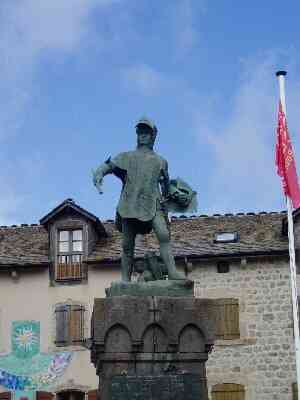
We now arrive at a famous era, not only in the annals of Gévaudan but in the history of France itself. The life of an illustrious captain who had filled the world with his name came to an end, like a fading meteor, at the foot of the walls of Châteauneuf-de-Randon in the late 14th century. This land thus received the solemn historical consecration that some privileged places on earth gain from the birth or death of great men.
In 1380, several mercenary companies—half English and half Gascon—encouraged by incursions from the troops of King Edward III of England, had taken up quarters in the castles along the borders of Languedoc, Auvergne, and Limousin. Among other strongholds, they occupied Châteauneuf-de-Randon. The communes of Languedoc sent deputies to King Charles V of France, pleading with him to send an experienced captain. They offered to cover the costs of the war through a tax of three gold francs per household and twelve deniers per pound of merchandise, in addition to collecting a double salt tax (gabelle).
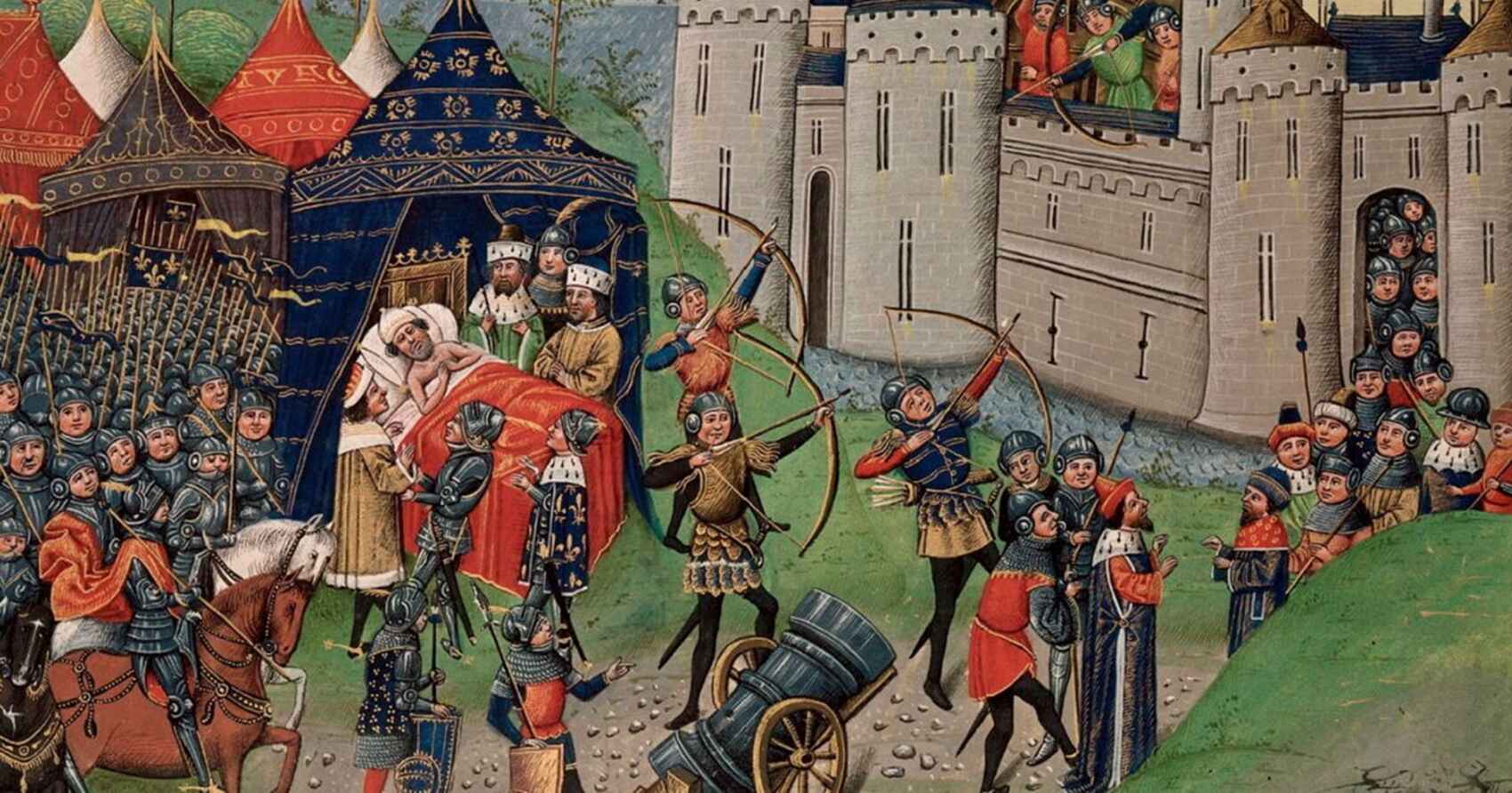
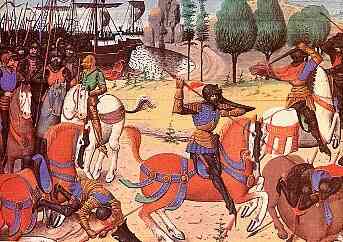
The King appointed Bertrand Du Guesclin to take command of the province. The Constable opened his Auvergne campaign in the early days of July 1380 by capturing the castle of Challier, an event attended by the Duke of Berry. Next, entering Languedoc through the Gévaudan mountain passes, he laid siege to Châteauneuf-de-Randon. Du Guesclin was surrounded by a brilliant retinue of knights, including Marshal Louis de Sancerre, Alain de Beaumont, Sir Olivier de Mauny, and several other renowned captains. However, contrary to the erroneous claims of the historian Villaret based on an old chronicle, his brother-in-arms Olivier de Clisson did not follow him into Languedoc. Several lords from Auvergne and Velay sent their vassals to bolster the Constable's forces. This great conqueror of castles had every reason to believe that the fortress of Châteauneuf-de-Randon would not halt his progress for long.
However, he was nearing the end of his glorious career, and it seemed as if the entire army had been gathered solely to witness his passing and honor his final moments. Du Guesclin was destined to die among the very men-at-arms he had nurtured and so often led to victory. He had frequently fed and paid them at his own expense with patriotic generosity, as if he had amassed his immense personal fortune merely to spend it in the service of the state. He pressed the siege of Châteauneuf-de-Randon hard, but the local governor, whose garrison was numerous and well-supplied with provisions and artillery, refused to surrender.
The call for an assault rang out across the French camp, and the soldiers rushed toward the castle, attacking fiercely. But the English captain, leading his men, stood firm and repeatedly repelled the attackers. Irritated by this stubborn resistance, Du Guesclin swore that 'he would never leave until he had the castle at his pleasure'. In his name, the Marshal of Sancerre informed the English governor that he and his men would be put to the sword if the fortress had to be taken by storm. Faced with this threat, the Englishman requested a twenty-four-hour truce and visited the besiegers' camp. He committed to handing over the keys of Châteauneuf-de-Randon to the Constable on a specific day if no reinforcements arrived by then. To guarantee his promise, he provided hostages.
According to an ancient chronicler, it was shortly after imposing these terms on the besieged that Du Guesclin fell ill. He had undoubtedly been feeling the secret weaknesses and lingering effects of the illness that would soon claim his life. Whether he foresaw his impending death or simply wished to put his affairs in order, he drafted his will on July 9, adding a codicil the following day. This historical document still survives today.
"In the name of the blessed Trinity, the Father, the Son, and the Holy Spirit," it reads, "we, Bertrand Du Guesclin, Count of Longueville, being of sound mind despite our physical infirmity, and knowing that nothing is more certain than death and nothing more uncertain than its hour, wishing not to die intestate, do make and ordain our will in the following form and manner". His testamentary provisions are relatively few. They detail legacies left to the Church for the repose of his soul; his chosen burial place "in the church of the Jacobins of Dinan, in the chapel of his ancestors"; the settlement of his debts; and a few personal bequeathals, primarily granting an annual pension of one hundred livres to Bertrand Du Guesclin, the son of his cousin Olivier.
This final provision was confirmed and expanded by the codicil. The Constable designated Sir Olivier de Mauny, Sir Hervé de Mauny, and Jean Le Bouteiller as his executors. The closing lines of the will clarify that Du Guesclin was not merely camped in a tent among his troops, as some historians have mistakenly claimed: "This was done," it states, "in the house of our residence, during the siege before Châteauneuf-de-Randon, in the seneschalty of Beaucaire, in the year and on the day above mentioned".
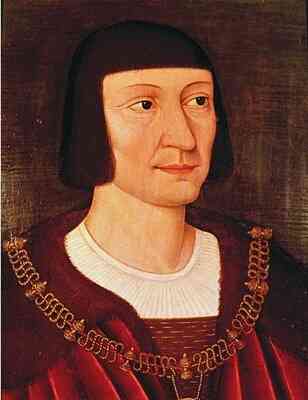
The illness progressed so rapidly that, four days later, the Constable found himself at death's door. A profound distress swept through the French army; knights and common soldiers alike shed bitter tears. "O honor and knighthood," some cried, "so much will be lost when this great man dies!". "Alas!" cried others, "now we lose our good father and captain, our good shepherd who gently nourished us and securely led us; if we have any wealth or honor, it is entirely thanks to him!". Lamentations and groans filled the air. The agitation in the French camp was so intense that the besieged English noticed it from their castle walls, though they could not decipher the cause.
Summoned to the Constable's bedside were the Marshal of Sancerre, whom he esteemed as "a very good knight," Sir de Mauny, and the assembled knights of the siege camp, gathered to receive his final farewells. "Lords," he told them, "I must shortly depart your company for death, which comes to us all. It is by your valor, and not my own, that fortune and great honor have favored me throughout France in my lifetime; the honor is truly yours, and to you, I commend my soul. Surely, Lords, I had intended to quickly conclude the wars of France by your bravery and restore the entire kingdom to the obedience of King Charles, but I can remain with you no longer. Yet I ask God, my Creator, to always grant you courage in the King's service, so that through you, Sir Marshal, and the valor of all the knighthood who have loyally fought by his side, his wars may finally be won".
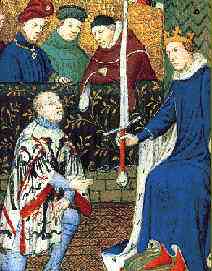
He then entrusted his brave brothers-in-arms with his soul, his wife, and all his kin. Requesting his Constable's sword, he turned toward the Marshal of Sancerre and spoke his final words: "To King Charles of France, my sovereign lord, you will recommend me. This sword, under whose governance France lies, I commend to you, for I can place it into the hands of no one more loyal". He barely had the strength to finish speaking, raised his hand to make the sign of the cross, and peacefully surrendered his soul to God (July 13, 1380).
Before his passing, the Constable had expressed to the Marshal of Sancerre his deep desire that Châteauneuf-de-Randon surrender before his death. The Marshal summoned the English governor to fulfill his commitments, carefully concealing the fact of Du Guesclin's terminal condition. According to a credible historical account, the suspicious Englishman demanded to see the Constable, but was told that Du Guesclin refused any direct communication with the castle's garrison. Pressed by the Marshal, the English captain finally agreed to capitulate. When brought before Du Guesclin to present the keys, he was shocked to find the great commander dying. According to a highly romanticized—and less plausible—version adopted by many historians, the English governor, fully aware of the French hero's death, still marched out to honorably place the keys upon his coffin.
The historian Villaret adds that this dramatic scene took place inside the Constable's tent, with the enemy commander marching in alongside his entire garrison. We, however, tend to trust the supplementary accounts of the old Chronicle of Du Guesclin, which present a much more plausible sequence of events. The English captain, acting like a true mercenary leader, would likely not have been so sentimental. Had he known of Du Guesclin's death, he would probably have ignored the Marshal of Sancerre's summons, considering himself released from his promise. In short, the Marshal would not have succeeded in forcing the castle to lower its drawbridge without threatening to execute the hostages in plain sight of the besieged garrison. What is widely accepted by history is that Du Guesclin lived just long enough to witness this final triumph of his forces. Following his death, the Marshal of Sancerre led the royal army to the siege of Montferrand, ensuring he left a garrison of soldiers and crossbowmen to secure Châteauneuf-de-Randon before his departure.
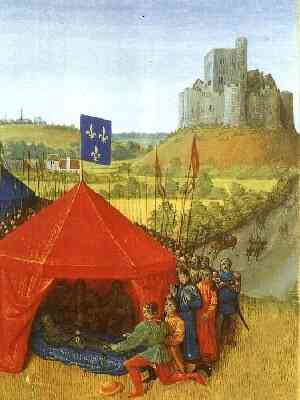
The Constable's body was embalmed and, under the guidance of Olivier de Mauny and Alain de Beaumont, initially transported to Le Puy-en-Velay. There, it lay in state for a day in the church of the Jacobins, where on July 23 the town's inhabitants held a solemn service honoring the illustrious commander. From there, the funeral procession set out across France, greeted everywhere by profound mourning and deep marks of respect from the grieving populations. The clergy, monastic orders, and common citizens marched in procession to meet his "glorious remains," offering religious homage in each city's main church before escorting the procession outside the walls by torchlight.
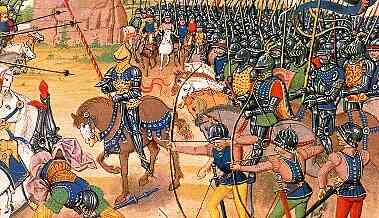
Even amidst these near-royal funerals, the people struggled to accept that Bertrand Du Guesclin had truly ceased to live. There is such an aura of immortality surrounding these great figures that it is hard to believe they are subject to death like ordinary men. As is well known, the funeral procession was ordered to turn back before it could reach Brittany. King Charles V commanded that the Constable's mortal remains be laid to rest in the royal vaults of Saint-Denis, right at the foot of the tomb the King had prepared for himself—and where Charles V himself would be buried just a few months later, in mid-September of the same year.
The church of the Jacobins in Le Puy retained Du Guesclin's entrails, while the Dominican church in Dinan preserved his heart. It is difficult to pinpoint the exact age at which this great hero died. The learned authors of the History of Languedoc state he was sixty-six, placing his birth in the year 1320. While we lean toward this date in our historical accounts of Rennes, we acknowledge it is not universally accepted. Some of Du Guesclin's biographers claim he was born in 1311, others in 1314, and some even suggest 1324—leaving a potential discrepancy of over a decade.
Regardless of the exact age at which the victor of Cocherel ended his noble career, he left an immense void behind him. The French army was effectively dissolved by his death, much like a body breaking down once the soul has departed. Never had a captain loved or served France more passionately; never had a brilliant military mind been paired with such a generous heart. His profound strategic intellect had bent the chaotic chances of war to strict military rules, creating a school of warfare from which France's most famous captains would emerge. Had the subsequent Kings of France not forgotten his lessons, they might have avoided the disastrous defeats of Agincourt, Pavia, and Saint-Quentin.
Setting aside the gap of centuries, there is less distance than one might think between Du Guesclin and Turenne, another heroic figure with whom he shared so many noble qualities. In our view, the Constable's greatest glory lay in his profound sense of national unity—a concept he grasped long before it was widely understood by the people. He spent his entire life striving to forge this unity, even at the cost of his own deep affections as a native Breton. It was an admirable vision driven by the natural superiority of his soul, demanding immense gratitude. Yet, ironically, for centuries afterward, certain writers among his compatriots criticized him for being more devoted to the greatness of France than to the isolated interests of Brittany.
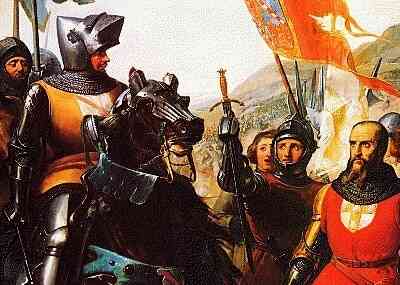
Following the memory of such a giant, the subsequent events at Châteauneuf-de-Randon seem minor by comparison. In 1385, Armand VI, Viscount of Polignac, lacking a direct heir, bequeathed all his domains to his brother Randon—specifically the baronies of Châteauneuf, Randonat, Solignac, Ceissac, Saint-Paulhan, Saint-Agrève, Servissas, and Molin-Neuf. Taking the name Armand VII, Randon became Viscount of Polignac and Baron of Châteauneuf. He served with great distinction in the military and was appointed by the Dauphin (later Charles VII) as his captain and lieutenant-general in Velay, Gévaudan, Vivarais, and Valentinois on February 4, 1418.
Armand VII died in 1421, bequeathing his domains to Armand de Montlaur, the son of his daughter Marguerite and Louis, Lord of Montlaur in Vivarais. However, an heir from the House of Chalençon contested this inheritance, relying on a substitution clause from the will of Armand VI (whose grandson he was). He challenged Armand de Montlaur for the viscounty of Polignac, the barony of Châteauneuf-de-Randon, and their dependent lordships. This bitter legal dispute occupied the Parliament of Paris from 1421 to 1464, ultimately ending in favor of Guillaume-Armand de Chalençon, the great-grandson of Guillaume de Chalençon and Walpurge de Polignac (the sister of both Armand VI and Armand VII).

With Guillaume-Armand, who adopted the name and arms of Polignac, the Chalençon-Randon branch began. However, during the chaotic disputes over Armand VII's succession, a rogue adventurer named André de Ribes forcibly seized Châteauneuf-de-Randon in 1426. He handed command of the fortress to a detachment of brigands he led, using it as a base to relentlessly pillage the seneschalties of Beaucaire and Toulouse. André de Ribes audaciously claimed the title of "Bastard of Armagnac," despite having no legitimate right to it, undoubtedly emboldened by the Count of Armagnac, who actively supported his criminal enterprises. King Louis XI did not forget this Count's complicity; twenty years later, the seizure of Châteauneuf-de-Randon featured prominently among the royal accusations against the Count of Armagnac, for which he was eventually granted letters of pardon in 1445.
Guillaume-Armand II, Viscount of Polignac and Baron of Châteauneuf-de-Randon, later participated in the War of the Public Weal (Guerre du Bien public). He led troops to support the Bastard of Bourbon, Bishop of Le Puy, in an unsuccessful attempt to seize control of that city. His rebellion was severely punished with imprisonment and the royal confiscation of the Polignac castle. He eventually made peace with the King in 1465 by marrying his son to the daughter of the Viscount of Dammartin, Grand Master of France, and consenting to the marriage of one of his daughters to the Lord of Lafayette. The ancient barony of Châteauneuf-de-Randon had long granted the Polignac-Chalençon family the right to sit in the Estates of Languedoc; this prestigious privilege was carefully preserved even when the number of baronial deputations from Gévaudan was reduced at the end of the 15th century.
In 1533, François-Armand, Viscount of Polignac and Baron of Randon, rode to Brioude accompanied by a hundred vassal gentlemen to meet King François I. Escorted by the Viscount, the King traveled to the castle of Polignac, where he spent the night of July 17. During the violent turmoil of the Wars of Religion and the Catholic League, the Lords of Polignac and Randon sided firmly with the Church and subsequently supported the King's faction. However, Claude-Armand—a son from François-Armand's first marriage—became deeply estranged from his father. François-Armand had tried to force Claude to join the clergy so he could leave his estates to a younger son, Louis, born of a second marriage. Seeking vengeance, Claude-Armand took up arms, allied himself with the Calvinists, and led their troops against his own family's lands.
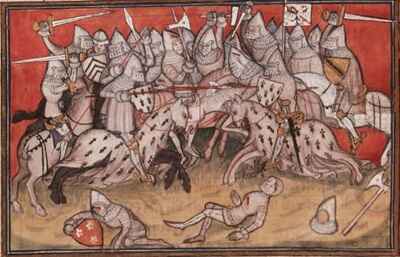
Claude-Armand captured the town of Genouillac, massacred the monks of the Jacobin convent founded by his ancestors, and completely razed the monastery. He then invaded the baronies of Randon and Randonat, seizing control and committing widespread violence. François-Armand quickly rallied his vassals, tracked down his rebellious son, and defeated him in battle. Overwhelmed with grief over the conflict, the father did not survive long after this tragic victory, passing away in 1562. Following his father's death, Claude-Armand seized all the castles and lands of the houses of Randon and Polignac, excluding his brother Louis. Claude died without heirs in 1564, leaving his entire estate to his father-in-law, Claude-Juste, Lord of Tournon. However, this donation was successfully overturned in 1671 by the Parliament of Toulouse, whose justice Louis had invoked to reclaim his rightful inheritance.
The reputation of the Lords of Polignac and Randon seems to have suffered significantly from these internal family feuds. This moral decline was glaringly apparent during the provincial estates of Gévaudan, held in Mende in 1605. The Viscount of Polignac, acting as Baron of Randon, aggressively disputed precedence with the Count of Apchier. When the Count of Apchier prevailed by the decision of his peers, Villefort—the brother of the Count of Polignac and a man notorious for his violent temper—could not bear the affront. The following day, accompanied by several loyal gentlemen and servants, Villefort ambushed d'Apchier during a church service in the Cathedral of Mende, leaving him mortally wounded on the floor. Three gentlemen and two servants were killed in the ensuing brawl. Villefort soon paid for d'Apchier's murder in Toulouse, where the parliament sentenced him to be publicly beheaded in Saint-Georges square.
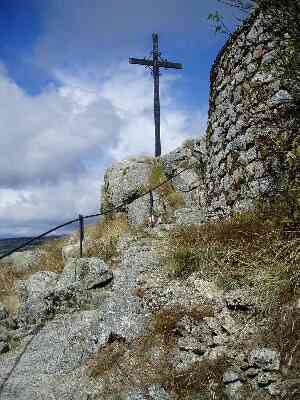
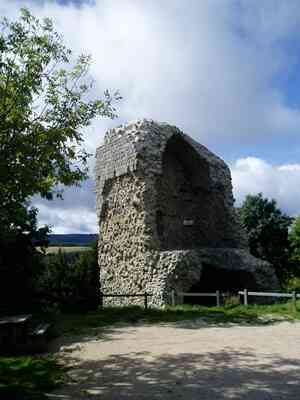
With this tragic event, our chronicles of the Barony of Randon come to a close. From the 12th century onward, its history gradually fades into the broader genealogical tapestry of the House of Polignac. As for the town itself, despite our most thorough investigations, we have been unable to determine whether it actively participated in the civil wars of Gévaudan during the reign of King Louis XIII. We have also failed to pinpoint the exact date the castle was destroyed; it was likely systematically razed, along with many other regional fortresses, following the pacification of the province. Of this formidable old castle, whose memory will live eternally in French history, nothing remains today but scattered ruins.

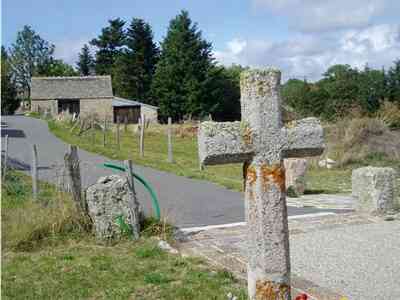
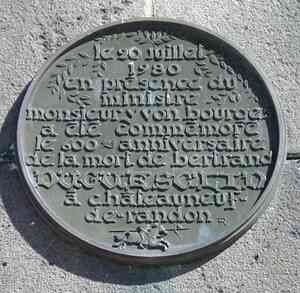
Châteauneuf-de-Randon, once one of the chief towns of the Mende arrondissement, today counts just over 600 inhabitants. A simple stone monument, erected in 1820 in the nearby hamlet of L'Habitarelle, is all that physically commemorates the death of the great Bertrand Du Guesclin. Nine annual fairs, highly frequented by local merchants and generating considerable trade, periodically infuse this quiet, historic little town with a lively, bustling atmosphere.
Excerpted from the History of the Towns of France. Published by Aristide Guilbert