


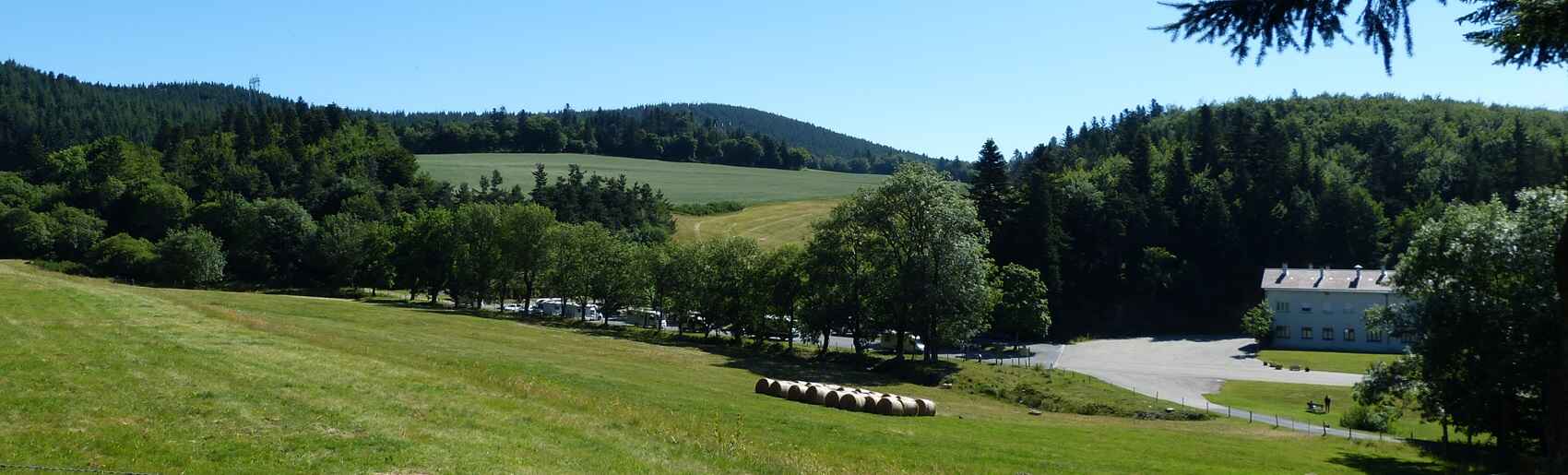
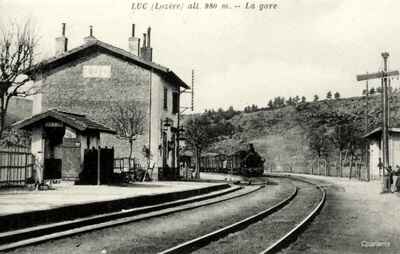
Robert Louis Stevenson, the Scottish writer famous for The Strange Case of Dr Jekyll and Mr Hyde, made a memorable journey through the Cévennes in 1878. His trek, which he chronicled in his book Travels with a Donkey in the Cévennes, took him to the village of Luc. This village, dominated by the ruins of its feudal castle, marks a significant stop on his route. Stevenson spent the night there before continuing south. His account provides a vivid description of this remote region and its inhabitants at the end of the 19th century. The memory of his passage is now preserved by the Stevenson Path (GR®70).
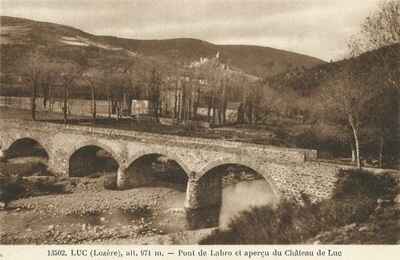 How anyone could desire to visit Luc or Le Cheylard-l'Évêque is beyond what my imagination can fathom. As for me, I travel not to go anywhere, but to walk. I travel for the pleasure of travel. The great affair is to move; to feel the necessities and hitches of our life more closely; to come down off this feather-bed of civilization, and find the globe granite underfoot and strewn with cutting flints. Alas! As we advance in life and become more preoccupied with our little egos, even a day off requires effort. However, holding a pack on a packsaddle against a biting north wind is not exactly a leisurely activity, but it nevertheless contributes to occupying and shaping one's character. And when the present is so demanding, who can care about the future?
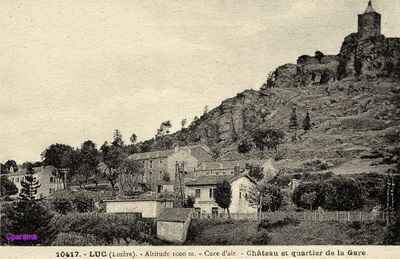
 I finally emerged above the Allier. It would be difficult to imagine a less attractive prospect at this time of year. Sloping hills formed a closed basin, alternating between woods and fields, and rising into peaks either bald or covered with pines. The atmosphere was dark and ashy from one end to the other, culminating at the ruins of the castle of Luc that rose proudly beneath my feet, carrying atop its pinnacle an immense white statue of Our Lady. I learned with interest that it weighed fifty quintals and was to be consecrated on October 6.
Through this desolate landscape flowed the Allier and a tributary of almost equal volume, which came down to join it through a wide, bare valley of the Vivarais. The weather had cleared a bit, and the clouds grouped in squadrons, but the fierce wind still pushed them across the sky, casting immense disjointed splashes of shadow and light across the scene.
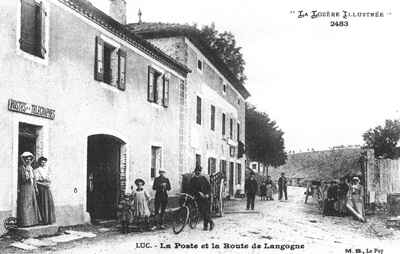
Luc itself consists of a double row of sparse houses squeezed between a mountain and a river. It offers the eye neither beauty nor a single notable feature, except for the ancient castle that overlooks it with its fifty quintals of Madonna shining brightly. But the inn was clean and spacious. The kitchen, with its beautiful compartmented beds draped with neat canvas curtains, the immense stone fireplace with its four-meter-long mantle adorned with lanterns and religious figurines, its array of chests, and its two ticking clocks, formed the true model of what a kitchen should be—a melodramatic kitchen perfect for bandits and disguised gentlemen.
 And the scene was not let down by the innkeeper, an old woman, a silent and dignified shadow, dressed in black like a nun. Even the common dormitory had an original character, with its long tables and white wooden benches where fifty guests could have dined, arranged as for a harvest festival, and its three compartmented beds along the wall. In one of them, lying on straw and covered by a pair of tablecloths, I did penance for a whole night, my body covered in gooseflesh and my teeth chattering. And I sighed from time to time as I awoke, longing for my sheepskin sack and the edge of some great wood out of the wind.
 The next morning (Thursday, September 26), I set out with a new arrangement. The sack was no longer folded in two but suspended entirely from the saddle—a green sausage six feet long with a tuft of blue wool sticking out at either end.
It was more picturesque, it spared the donkey, and, as I soon noticed, ensured stability regardless of the wind. But it was not without apprehension that I resolved to do so. Although I had purchased a new rope for this purpose and arranged it as securely as I could, I remained wary and anxious that the sides would detach and scatter my belongings along the route.
My route ascended the bare valley of the river along the borders of the Vivarais and the Gévaudan. The mountains of Gévaudan on the right were even more bare, if such a thing is possible, than those of Vivarais on the left. The former had the privilege of stunted bushes that grew thick in the gorges and died out in isolated shrubs on the slopes and peaks. Dark rectangles of fir trees were scattered here and there on both sides.
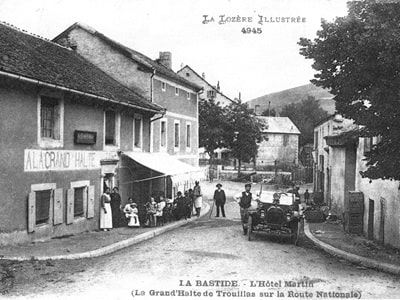 A railway ran parallel to the river. It is the only stretch of railway in the Gévaudan, although there are several projects underway, topographic studies have been undertaken, and, I have been assured, the location of a station ready to be built in Mende has even been determined. One or two more years and it will be another world. The wilderness is besieged. From now on, a few Languedocians can translate Wordsworth's sonnet into patois: "Mountains and vales and floods, heard YE that whistle?"
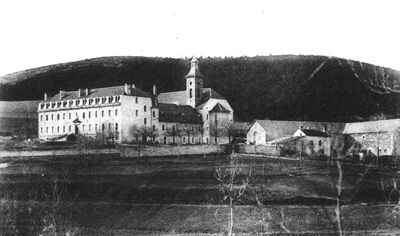
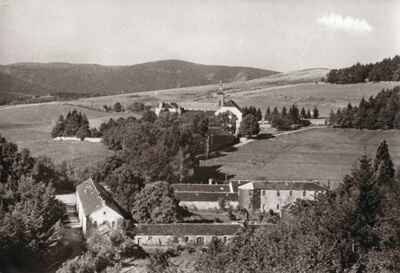 At a place called La Bastide, I was advised to leave the course of the river and follow a road climbing to the left among the mountains of the Vivarais, the modern Ardèche. For I had now reached the little path leading to my strange destination: the Trappist monastery of Notre Dame des Neiges.
The sun appeared as I left the cover of a pine wood, and suddenly I discovered a rather wild sight to the south. High rocky mountains, as blue as sapphire, closed the horizon. Between them, tier upon tier, were mountains covered with heather and rocks, the sun sparkling on the veins of stone, the thickets invading the ravines, as harsh as on the day of creation. There was no sign of a human hand in the entire landscape and, in truth, no trace of its passage, except where one generation after another had walked along narrow winding paths penetrating beneath the birches and emerging up and down the slopes they furrowed.
 The mists, which had surrounded me until then, had now dissolved into clouds and were fleeing quickly, shining brightly in the sun. I breathed deeply. It was delightful to arrive, after so long, at a place of some charm for the human heart. I admit I love a specific shape where my gaze can rest, and if landscapes were sold like the images of my childhood—a penny in black and white, and fourpence in color—I would gladly give fourpence every day of my life. But while the appearance of things had developed better to the south, it was still desolation and harshness just a stone's throw from me.
A tripod cross at the summit of each mountain indicated the proximity of a religious establishment. A quarter-mile beyond, the perspective to the south widened and became more pronounced step by step; a white statue of the Virgin at the edge of a young plantation directed the traveler toward Notre Dame des Neiges. Here, I turned left and continued on my way, leading my secular donkey with the creaking of my shoes and my lay gaiters, toward the asylum of silence. I had not progressed very far when the wind brought me the sound of a bell, and I hardly know why, but my heart tightened in my chest at that sound.
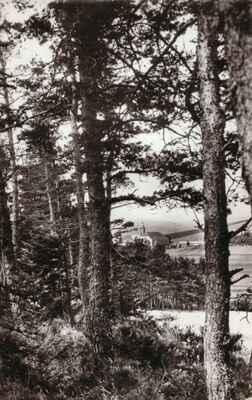 I have rarely felt more sincere anxiety than when approaching this monastery of Notre Dame des Neiges. Was it from having received a Protestant education? Suddenly, at a turn, a fear engulfed me from head to toe—superstitious fear, a slave's fear. Although I kept moving forward, I proceeded slowly, like a man who has unwittingly crossed a border and is now lost in the land of the dead.
There, indeed, on a newly opened narrow road among the young pines, was a medieval monk struggling with a wheelbarrow of grass. Every Sunday of my childhood, I used to leaf through The Hermits by Marco Sadeler, fascinating engravings filled with woods, fields, and medieval landscapes as wide as a county for the wandering imagination! And there was undoubtedly one of Sadeler's heroes. He was wrapped in white like a ghost, and the hood, falling over his back in his effort to push the wheelbarrow, revealed a skull as bald and yellow as a death's head. He might have been buried some thousand years ago, and all the life particles of his being reduced to dust and broken by the contact of a farmer's harrow. Moreover, my mind was troubled by etiquette.
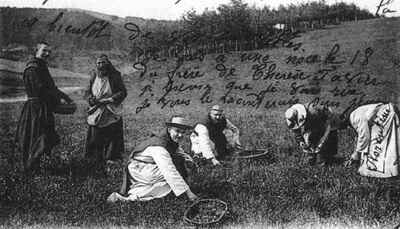 Should I speak to someone who had taken a vow of silence? Obviously not! However, as I approached, I removed my cap before him with a superstitious deference rooted in the depths of centuries. He gave me a slight nod in return and cordially addressed me. Was I going to the convent? Who was I? An Englishman? Ah! An Irishman, then? 'No,' I said, 'a Scot.' A Scot? Ah! He had never seen a Scot before. And he examined me from head to toe, his good honest face brightened with interest, much like a child looking at a lion or a caiman.
From him, I learned with displeasure that I would not be received at Notre Dame des Neiges. Perhaps I could have a meal there, but that was all. However, as our conversation continued and he discovered that I was not a peddler, but a man of letters who drew landscapes and intended to write a book, he changed his view regarding my reception (for I fear that even in a Trappist convent, people of quality are given regard). He told me that I must ask for the Father Prior and lay out my case without reserve.
Upon further reflection, he decided to descend with me himself. He thought he could arrange things better for me. Could he say I was a geographer? No. I thought, in the interest of truth, that he really could not. 'Very well, then,' (with annoyance) 'an author?'
It appeared that he had been in seminary at the same time as six Irishmen, all priests for a long time, who received newspapers and kept him informed of ecclesiastical affairs in England. He inquired eagerly about Dr. Pusey, for whose conversion the good man had continued, all along, to pray morning and evening. 'I think he is very close to the truth,' he said. 'And he will eventually succeed. There is much efficacy in prayer.' From "Travels with a Donkey in the Cévennes" by Robert Louis Stevenson.