


Luc, nestled in the upper Allier valley, is a village of discreet charm in the Occitanie region. Its landscape is shaped by the foothills of the Cévennes and the Margeride, offering untamed nature where alpine flora coexists with ancient forests. The wildlife is rich, notably featuring the return of the wolf and the presence of numerous birds of prey. The local history is dominated by the majestic ruins of its medieval castle, a testament to its past strategic importance. This historic monument, perched on a rocky outcrop, provides a spectacular panorama of the valley. The village itself retains beautiful granite houses typical of local architecture. As part of the historic Gévaudan, its past is closely intertwined with the legends and defining events of this land.
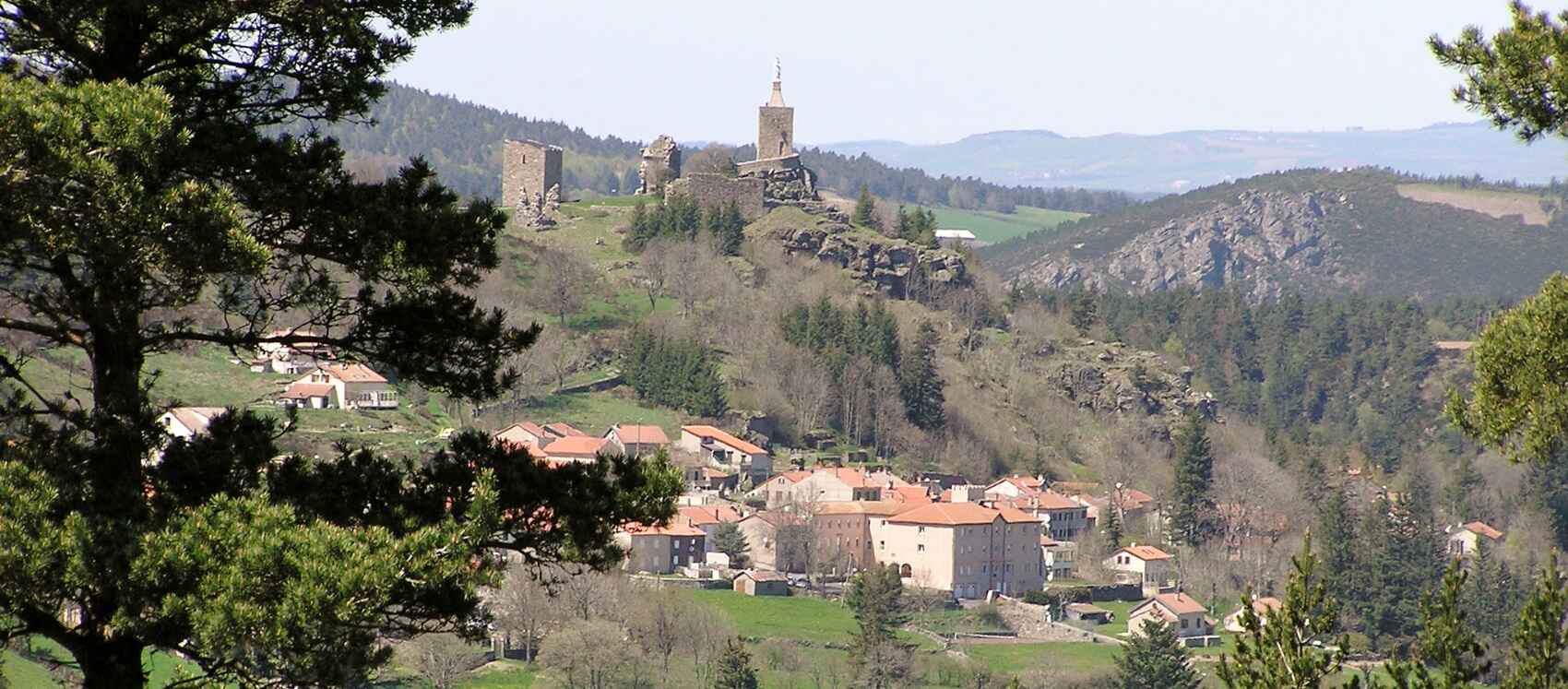
 Luc (from the Latin lucus, meaning sacred wood) undoubtedly has a very ancient origin. Its hospital and church, dating from the 12th or 13th century, constituted a priory that depended on the Aubrac domerie. On the main street, at the corner of a house near the post office, a small 14th-century statuette known as the "Cagassou" depicts a man squatting in an unambiguous pose.
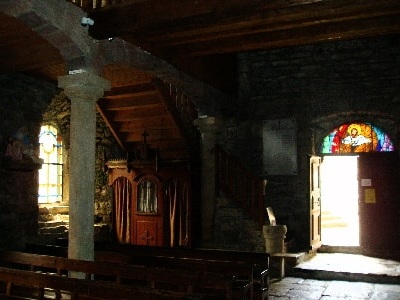 From the castle overlooking the village (featuring imposing ruins and 12th-century herringbone walls), one can enjoy a sweeping panorama. A statue of the Virgin Mary was erected in 1878 on a restored tower. The choir of the church still contains some remnants of the original 13th-century building. Across the street stands the old building of the priory.
Nestled between the Cévennes to the south and the Margeride to the north, facing the Tanargue massif to the east and the Mercoire forest to the west, the Allier River flows at the foot of the village of Luc. The settlement likely owes its origin to the Mercoire forest, which extended throughout the region at the beginning of our era and was dedicated to the worship of the Roman god Mercury. Today, the ruins of the castle dominating the village instantly draw the attention of hikers and passersby.
Built before the 12th century on a former Celtic site, the castle was one of the most important strongholds in the region. Its architecture in opus spicatum (herringbone pattern) is particularly remarkable. Enlarged over the years through strategic family alliances, it has retained, despite its current state of degradation, the imposing characteristics of a true military fortress. As the guardian of the Chemin de la Régordane (a crucial link between southern France and the Auvergne, frequently traveled by pilgrims heading to Saint-Gilles), the Castle of Luc was a highly strategic point between the provinces of Gévaudan and Vivarais.
The Golden Age of the Castle
Until the 13th century, this path (the current main street crossing the village) allowed for the development of numerous artisanal and commercial activities. The castle was then the seat of an important barony belonging to the De Luc family. Subsequently, through various alliances, it became the domain of the most illustrious noble families of the region: d'Anduze, de Randon, de Polignac, de Muras, de Merle, and de Périer.
 The Hundred Years' War, followed by the Wars of Religion, did not spare the village: there was an attack on the castle by the English and mercenaries around 1380, and the looting of the presbytery at the end of the 17th century. These conflicts led the states of Gévaudan to install "a foot and horse garrison at the Castle of Luc." The fortress seems to have been dismantled on the orders of Cardinal Richelieu around 1630.
Oblivion and Renaissance
The French Revolution and the abolition of feudal rights, combined with a harsh climate and the ravages of time, led the castle to its current ruined state. However, two important events occurred in the 19th century.
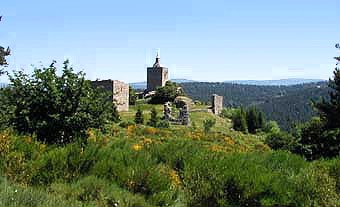 In 1878, the parishioners of Luc transformed the keep into a chapel and erected a statue of the Virgin Mary on its terrace. That same year, the Scottish writer Robert Louis Stevenson, accompanied by his donkey Modestine, undertook his famous Travels with a Donkey in the Cévennes. They passed by the castle and stopped in Luc on September 25, 1878. Coming from Langogne via Le Cheylard-l'Évêque, the Stevenson trail (now the GR®70) runs along the Allier River towards the Abbey of Notre-Dame-des-Neiges (historical variant) and continues to La Bastide-Puylaurent.
For a long time, the castle and its rich historical past faded from memory. But in 1978, a group of dedicated friends decided to restore its place in local life. They founded an association for the preservation and enhancement of the Castle of Luc. Its goal is to protect and restore the ruins, while also delving deeper into its history to make it accessible to a broader audience.
Since then, a joint effort by the municipality and the association has allowed several restoration campaigns to be undertaken. Soon, visitors will be able to climb to the top of the high tower, from where they can admire the entire volcanic chain of the Puys and the peaks of Vivarais and Velay.
The History of the Village
In the 18th and 19th centuries, mule caravans regularly used the Régordane way and stopped in Luc. The same was true for transhumant herds: several thousand heads of livestock grazed here every summer. It was the arrival of the railway that truly allowed Luc to become an important tourist destination, especially appreciated by visitors from the south.
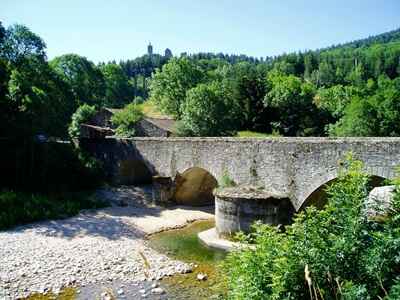 Some architectural remnants still exist in the village.
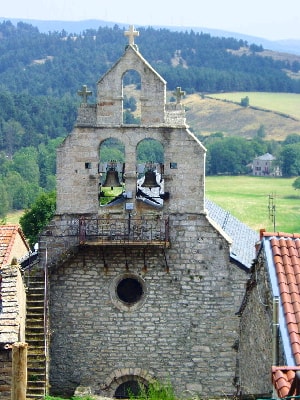
These include the calvary, built in 1904, and the Romanesque church, partly rebuilt in 1834 while retaining its original core and capitals from the 13th century. There is also a porch opposite the church, topped with a Maltese cross (1825), and the facade of the old priory adjacent to the church (1776). A stone lintel (1871) can be seen facing the former weighbridge (the old vicarage), along with a 14th-century sculpture affectionately called "Le Marmouset," located near the post office.
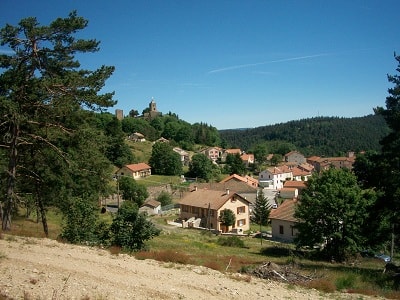 A stone cross topped with a coat of arms stands near the fountain in the middle of the village, and a vault keystone (bearing the coat of arms of an abbot of Les Chambons) can be seen near the old sawmill behind the station. There are also the remains of an old mill attached beneath the dam below the station, some crosses serving as reminders of ecclesiastical missions from the beginning of the 20th century, and a few statues salvaged from the former congregational schools that were previously established in Luc.
The ancestral Régordane Way (currently the GR®700 hiking trail) was the Cévennes section of the old road from Paris to lower Languedoc. It crossed the Massif Central through Clermont-Ferrand, Brioude, Le Puy-en-Velay, Pradelles, Lesperon, Luc, La Bastide-Puylaurent, Prévenchères, Villefort, Génolhac, Chamborigaud, Alès, Nîmes, and ended in Saint-Gilles.
The name "Régordane" originally only applied to the section between Alès and Luc. This route witnessed thousands of transhumant flocks, processions of Phoenicians, Greeks, Romans, warriors, and pilgrims heading from Orléans to reach the famous abbey of Saint-Gilles. It was also traveled heavily by merchants going from north to south to sell cloth and textiles from Flanders, or from south to north transporting products from the East, spices, and precious fabrics. In 1295, even Genoese sailors enlisted by the King of France to invade England marched along this very path.
"Régordane" was also the name of a prominent family that, in the 12th, 13th, and 15th centuries, included several legal scholars in Montpellier and Alès. This royal road was eventually supplanted after the 15th century by the straighter, more direct route through the Rhône valley. Source: Association "Friends of the Castle of Luc".
Regarding the name Luc: A number of toponyms based on Latin names of plants belong to the Gallo-Roman period. This is the case with the Latin "lucus" (meaning sacred wood, forest), which is the origin of many places named Luc, as well as Lux (7 municipalities and place names) and Luz in Old French (21 municipalities and place names). Since a Celtic occupation is proven in the area, one might also think of the Celtic god Lug (or "Lugh" in Irish), who is identified with Mercury. (For context, Lyon comes from "Lugdunum," meaning the fortified city of Lug; the same etymology applies to the cities of Laon, Loudun, and Loudon). See also "St-Étienne-de-Lugdarès".