


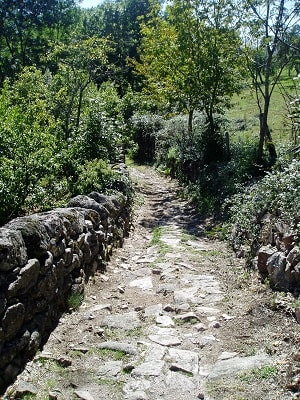
The Roman road winding through the mountains and valleys of the Vivarais and Cévennes regions was far more than a simple thoroughfare: it was a vital artery connecting these two areas, fostering commercial, cultural, and military exchanges. Today known as the "Roman road trail," it still reveals its ancient remnants along the way. Although its exact route remains somewhat of a mystery—partly reclaimed by vegetation or altered by human activity over the centuries—it undeniably passed through the villages of Loubaresse, Saint-Pierre-de-Colombier, Le Cheylard, and Thueyts. In these areas, sections of paved road and elegant stone bridges can still be admired. Once traversed by merchants, travellers, pilgrims, and stationed Roman legions, this ancient route has transformed into a popular hiking trail, offering exceptional panoramic views and invaluable historical insights.

In the 12th century, the Middle Ages radically transformed the landscape with the construction of the mighty Loubaresse fortress, standing majestically above the Ardèche valley. This stronghold marked the birth of the local lordship, which fell under the authority of the Counts of Toulouse. In exchange for their unwavering loyalty, the lords of Loubaresse enjoyed the protection and numerous privileges granted by their suzerains. Ranking among the most powerful lordships in the Vivarais, it spanned a vast territory and exercised extensive feudal rights, ranging from justice and tax collection to the strict control of roads and bridges.
Originally built by the de La Tour-Saint-Vidal family, who held it until the 14th century, the castle subsequently passed into the hands of several prominent noble lineages. These families continuously expanded and remodeled the estate, particularly during the 14th and 16th centuries. Serving as the seat of seigniorial power for over six hundred years, this square-plan edifice, flanked by four massive round towers, was an impressive sight with its ashlar masonry, thick walls, and narrow arrow slits. It was structured around a keep that provided both residence and defense, an inner courtyard housing stables and kitchens, as well as annexes for the garrison and servants. The institution came to an abrupt end during the French Revolution: confiscated and sold as national property, the castle was permanently converted into a working farm.
The estate's history was shaped by a succession of illustrious lords. In the 12th and 13th centuries, the de La Tour-Saint-Vidal family gave the site its name. By the 14th century, the de Roquefort family, having inherited the estate through marriage, fortified the stronghold to repel English assaults during the Hundred Years' War. The 15th and 16th centuries saw the de La Baume family acquire the property, enriching it with elegant Renaissance elements. During the 17th and 18th centuries, the de Vogüé family, successors by alliance, beautified the residence with subtle classical touches. Ultimately, in the 19th century, the de Chambon family purchased the property to transform it definitively into a farm.
Parallel to these events, the Abbey of Chambons, located in Borne, was founded in 1152 by Guillaume de Borne in a profound spirit of charity. He was greatly assisted by his sons, who made generous donations of land. Initially affiliated with the Dalonite order, following the Rule of Saint Benedict while enjoying significant autonomy, it eventually joined the Cistercian order in pursuit of a more ascetic and contemplative life. Placed under the aegis of the Abbey of Sénanque, it was established in an area known as Les Chambons, within the canton of Saint-Étienne-de-Lugdarès. This vast monastic complex included an impressive abbey church, a cloister, a refectory, an infirmary, and multiple agricultural outbuildings. Ruling over an extensive domain, the abbey was governed by eminent regular abbots such as Pierre Geofroi, Bernard Durand, and Pierre de Merle.
At its zenith in the 12th and 13th centuries, the abbey housed around forty monks and a hundred lay brothers who worked the land. Unfortunately, successive wars, epidemics, and pillaging initiated its slow decline, leading to its definitive suppression during the French Revolution. Its buildings were subsequently dismantled or sold. Today, only the ground layout hints at the grandiose contours of the Latin-cross abbey church, with its three naves and transept. Strolling through the village of Les Chambons reveals some of its beautiful cut stones, saved and repurposed in the facades of peasant homes—a testament to the enduring legacy of a place still steeped in history.
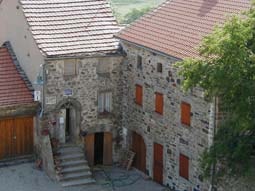
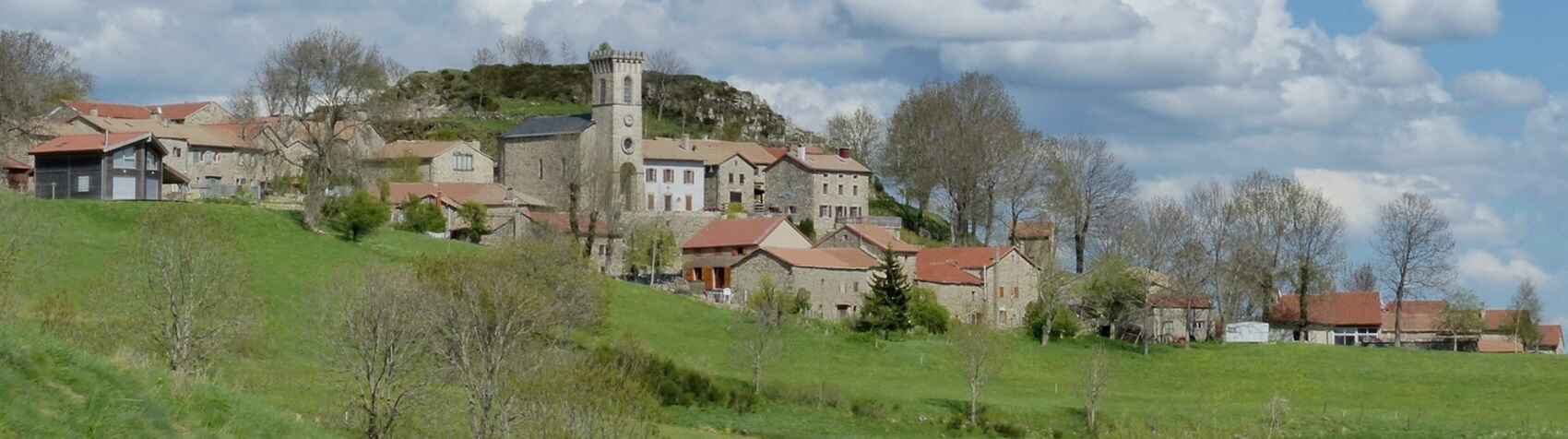
In the 14th century, Loubaresse’s strategic position on the ancient Roman road attracted much covetousness, particularly during the turmoil of the Hundred Years' War. To protect itself, the village was encircled by sturdy ramparts pierced by two gates and marked by watchtowers, while also finding a final refuge behind the walls of its castle. Despite numerous destructive sieges and terrible fires, the community resisted valiantly. Visitors today can still admire the legacy of this medieval past through its robust stone houses, winding alleyways, and the imposing remains of its fortifications.
From the 16th to the 18th century, livestock farming and transhumance ushered in an era of unprecedented prosperity for Loubaresse. Nestled at the foot of the mountains in a lush green setting, the village established itself as a major centre for sheep farming. The villagers obtained abundant wool from their flocks, which was woven locally or sold to thriving regional manufacturers. At the same time, the milk and meat gave rise to highly reputed and sought-after local cheeses and cured meats.
Each spring, the shepherds of Loubaresse set off towards the peaks of the Vercors with their animals, seeking bountiful alpine pastures, only to descend back to the valley in autumn along ancient drovers' roads. This flourishing pastoral economy significantly enriched the village, which became adorned with superb houses boasting slate or tile roofs. However, this brilliant dynamic eventually faded in the 19th century, devastated by livestock diseases, emerging competition, and an unrelenting rural exodus.
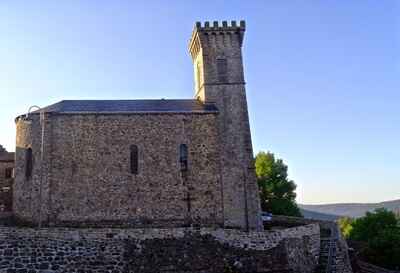
The parish church, dedicated to Saint Martin, was erected in 1845 on the very foundations of an older chapel. It stands out with its majestic crenellated bell tower, which is actually the final remnant of a powerful watchtower integrated into the 14th-century ramparts. Originally built by the Lord of Borne to monitor the entire Ardèche valley and anticipate English attacks, it now peacefully watches over the village roofs.
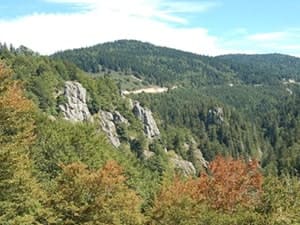
The toponym "Borne" originates from the colossal granite rock that once supported the castle of the de Randon family. It was, in fact, Guillaume de Randon, Lord of Borne, who granted a portion of these lands to the Cistercian monk Dom Amélius in 1152 to found the famous Abbey of Chambons, which evolved into a radiant spiritual centre. Perched on its spur dominating the majestic Tanargue massif, this keep offered a panoramic view up to an altitude of 1,511 metres. Devastated during the bloody Wars of Religion, the old Château de Borne now survives only as romantic ruins lost in nature.