


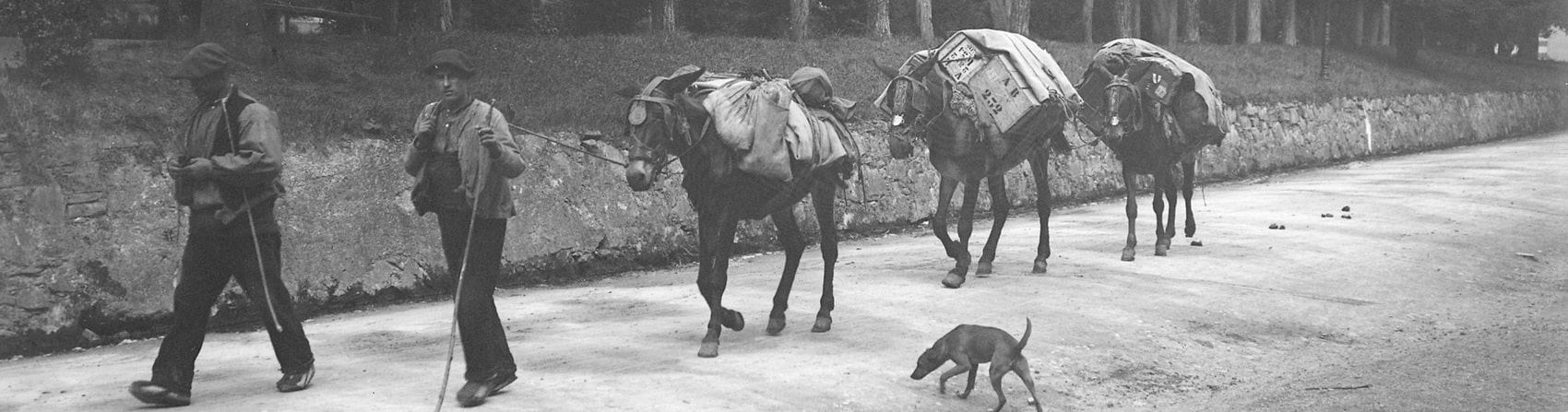
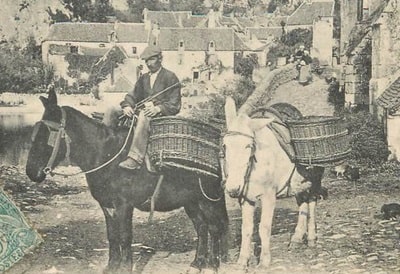
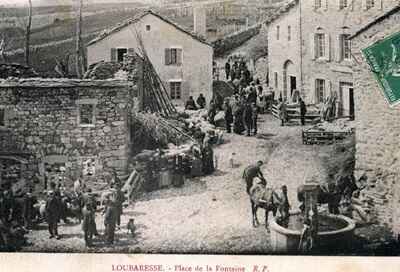
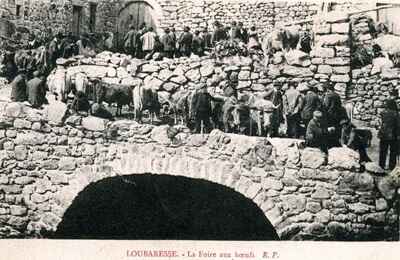
Hailing from the Cévennes slopes between Mont Mézenc and Mont Lozère, the muleteers enjoyed a formidable reputation. They originated from villages such as Saint-Étienne-de-Lugdarès, Montselgues, Loubaresse, Saint-Laurent-les-Bains, and Saint-Cirgues-en-Montagne. Throughout the Cévennes, being a muleteer was considered a genuine title, a mark of honour, and a source of deep pride.
There was a time when paved roads did not exist, when rivers posed insurmountable obstacles, and mountains stood as natural borders. It was a time when mules were the undisputed kings of the trails—loyal companions to the muleteers and essential players in trade and commerce. These mule tracks relentlessly crisscrossed the Vivarais and Velay regions, bridging valleys and plateaus, uniting villages and towns, and bringing regions and provinces closer together.
Skillfully traced along the ridges, these paths harmoniously followed the contours of the terrain, carefully avoided treacherous marshlands, and crossed ingeniously built passes and stone bridges. Serving as vital commercial arteries, they were traversed by long convoys of mules laden with a vast array of goods. Today, they remain a lasting testament to the history, culture, and rich heritage of these rugged territories.
Each group of muleteers had its own clearly defined specialities and routes. Some carefully transported wine from the Lower Vivarais and the banks of the Rhône up to the highlands of Auvergne, where vineyards could not flourish. Others carried salt from the Mediterranean saltworks and precious silk from Aubenas towards Saint-Étienne, a major manufacturing capital of the era. Still others descended from Le Puy-en-Velay carrying heavy loads of cereals, pulses, barley, and lentils, all cultivated in the fertile soils of the Velay basin.
Vast transhumance trails, known locally as drailles, were also heavily used. They allowed immense flocks of sheep and goats to safely reach their summer pastures or winter grazing grounds. The most famous of these ancient routes was undoubtedly the Régordane, linking Nîmes, Alès, Villefort, La Bastide-Puylaurent, Langogne, and Le Puy-en-Velay. This major thoroughfare saw a steady stream of pilgrims, Crusaders, merchants, and shepherds.
The critical importance of the Puy muleteers' trade has been recognized and documented since the 16th century. These itinerant merchants largely came from villages nestled on the slopes of Mont Mézenc, such as Le Monastier, Montpezat-sous-Bauzon, or Arlempdes. They formed a powerful and highly respected guild, boasting specific privileges and tax exemptions. Their prosperity was undeniable, as evidenced by the staggering price of a team: 500 livres for a pair of mules—equivalent at the time to the cost of a handsome bourgeois townhouse.
In times of crisis or conflict, these convoys played a crucial strategic role, particularly when led by civilians to secure the vital supplies necessary for the population's survival. During peacetime, the phenomenal physical strength of the mules and the courage of their drivers were often harnessed for great humanitarian causes. Such was the case during the terrible famine in Velay in 1694, when multiple convoys were hastily organised to transport desperately needed grain from the Rhône valley.
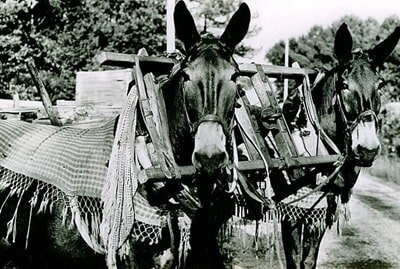
According to the chronicles of historian Albin Mazon, the traditional muleteer wore a red woollen cap, over which he would place a felt hat depending on the season. His hair was typically tied back, while his ears were adorned with fine gold hoops from which dangled miniature mule shoes. His attire consisted of a cravat, a scarlet waistcoat, heavy iron-studded shoes, and a broad red woollen sash. Tucked into this sash were a delicately decorated silver tasting cup (used for sampling wine or oil) and a trocart (a sharp knife used to pierce the animal-skin flasks in an emergency). In rainy weather, he wrapped himself in a thick, heavy mountain cloak known as a cape or limousine.
The varlet occupied the vital position of "second-in-command." His duties encompassed the daily care of the animals, the meticulous preparation of the loads, and the constant supervision of the convoy while on the move. This young apprentice learned the ropes of the demanding trade by attentively observing his master, listening to his tales, and perfectly mimicking his precise movements.
Exceptionally well-adapted to the rugged terrain and harsh mountain climate, mules proved to be far more enduring and resistant to fatigue than horses. Born of the patient crossbreeding between a donkey and a mare (or more rarely, a horse and a female donkey, producing a hinny), they combined robustness, docility, intelligence, and unfailing loyalty. They were cared for with immense devotion by the muleteers, who rightfully considered them true members of the family.
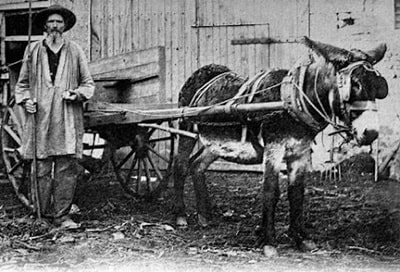
The undisputed leader of the team was known as the viegi: it was invariably the strongest, proudest, and most lavishly harnessed mule in the entire troupe. It marched majestically at the head of the convoy, guiding and reassuring its companions by example. It proudly displayed rich ornaments, colourful ribbons, feather plumes, and gleaming bells. Behind it came the roulet, wearing an impressive bell as large as a balloon around its neck. This powerful sound served to announce the convoy's imminent arrival, ward off prowling wolves, and set the steady rhythm of the march. It was reputed to be the most joyful, the loudest, and often the most mischievous animal. In the middle of the line walked the bardot (the sterile hybrid of a horse and a jenny), which carried the rambail—the precious wine sealing the pachel, or commercial pact concluded between the muleteer and the merchant. It also carried the ferrière: the heavy toolbox containing everything needed to repair leather harnesses, wineskins, and horseshoes.
The remaining animals were assigned tasks based on their physical abilities and temperament: the calmest and steadiest mule had the honour of wearing the alte around its neck. This was a large glass bottle protected by woven straw, allowing the men to quench their thirst during brief halts. The fastest mule was tasked with rapidly transporting perishable goods, such as fresh cheese, butter, or seasonal fruit. Finally, the most sure-footed and agile mule was entrusted with the fragile cargo: precious crockery, fine glassware, or mirrors.
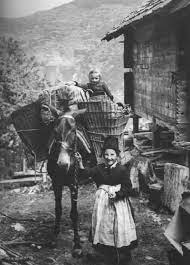
A sturdy mule could carry a load of up to 168 litres of wine, distributed in boutes—traditional flasks sewn from ox, cow, or occasionally goat skins. Using these boutes offered numerous advantages: they were infinitely more manageable and lighter than oak barrels, and they perfectly molded to the anatomy of the animal's back. Furthermore, they were unbreakable and posed no risk of tipping over in treacherous passages. Sewn with strong hemp thread, they were then generously coated with pitch on the inside to guarantee absolute waterproofing.
Viticulture, which had flourished in Ardèche since its boom in the 3rd century, generated substantial production. Renowned white wines from Largentière, Montréal, or Vinezac, along with the famous light wines of Villeneuve-de-Berg, were produced in abundance. The vast majority of this local wealth was packaged and transported on muleback, supplying local markets and being exported far beyond the valleys.
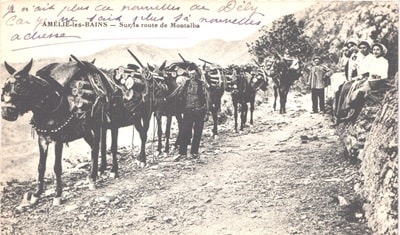
The passage of these convoys through high-perched villages and hamlets, such as Loubaresse, was always a memorable event that broke the gentle monotony of daily life. The muleteers would announce their arrival from afar, the jingling of their bells echoing through the valley and instantly sparking wonder in the children. The young ones would rush out to meet them, chanting "balalin, balalan," in the joyous hope of gathering a few sweets, a small coin, listening to tales of adventure, or even securing a short ride on the back of a docile mule. The muleteers gladly returned their smiles, shared a few jokes, sang popular folk songs, or taught them small tricks of dexterity.
Peyre, for instance, was a major muleteer staging post—a true crossroads where merchants of all origins mingled with spa-goers traveling to or from Saint-Laurent-les-Bains, a thermal resort prized since Antiquity for its healing waters. In those days, the town provided weary travellers with welcoming inns, a multitude of artisan shops, and vibrant festive entertainment.
At the end of a long day's march, the muleteers were welcomed as true guests of honour by innkeepers and landowners, who extended them genuine hospitality. They were served hearty traditional stews generously accompanied by local wine. They were offered smoking tobacco, and accordions and hurdy-gurdies were brought out to fill the common room with music. The evenings were punctuated by laughter, the stomping feet of the bourrée dance on the wooden floorboards, the exchange of the latest news, valley gossip, and the recounting of old local legends. When night fell, after ensuring that their faithful beasts had been groomed and abundantly fed, the muleteers often fell asleep fully clothed, buried deep in the hay of the barn. At dawn, they would once again harness their animals to resume their journey along the ridges, sent off with the waves and thanks of grateful villagers.