


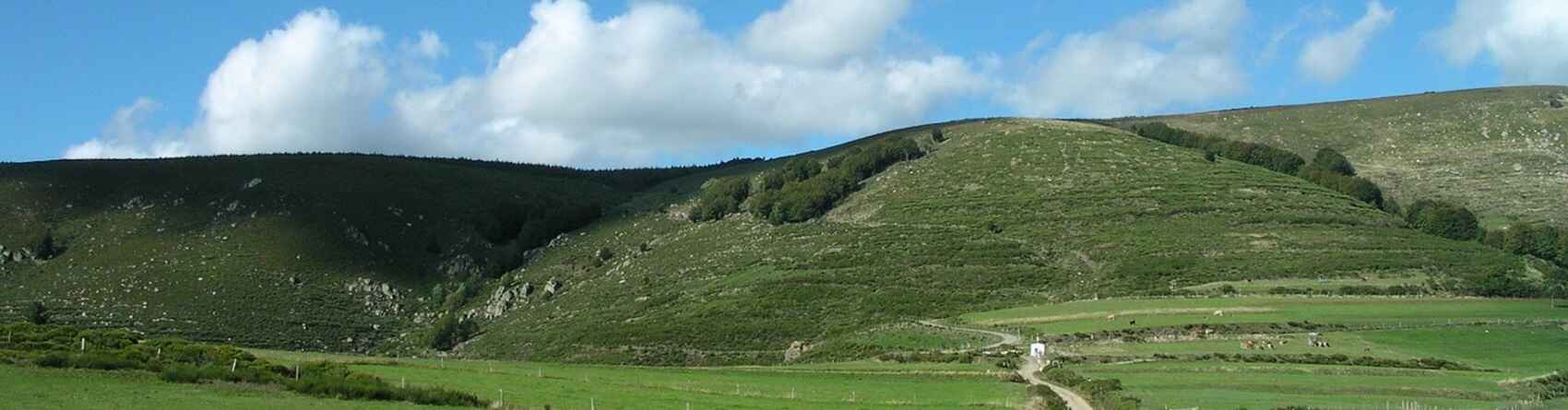
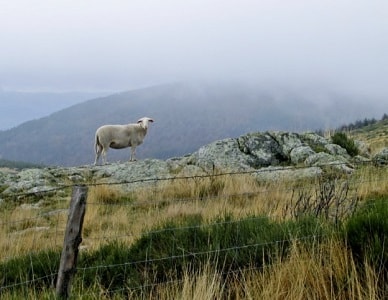
The Abbey of Les Chambons had to regulate the passage of transhumant flocks through the Bauzon forest, which belonged to it. A few rare documents from the 15th century show lowland peasants pasturing their sheep on the high plateaus during the summer. From the 16th century onward, documents multiply, affirming the considerable role of peasant transhumance: herds from the parishes of the lower Vivarais plateaus (Chandolas, Saint-Alban-sous-Sampzon, etc.) and the lower Cévennes (Joannas, Lablachère, etc.) would move up in the summer to the region of Saint-Étienne-de-Lugdarès. Flocks from Jaujac, in the heart of the Cévennes, would spend the summer towards La Chapelle-Grailhouse. These movements amplified during the Modern Era. On one hand, monastic herds had been severely reduced after the Hundred Years' War and the Wars of Religion, leading to the decline of monasteries—so much so that by the 18th century, the Abbey of Mazan had only 800 sheep left. On the other hand, the monasteries gradually renounced direct exploitation: in 1781, Mazan began welcoming foreign herds for a fee.
At the beginning of the 19th century, foreign herds arrived in such vast numbers on the high plateaus that they began to worry the local mountain dwellers. Under the Empire, mayors in Sagnes and Cros-de-Géorand complained about these massive flocks devouring all the grass, and even the broom (genêts) essential for roofing houses. It was during this time that herds from Gard—wintering between Alès and Nîmes—and even from Vaucluse (Monteux) began to arrive, reinforcing the classic Vivarais transhumance. The first half of the 19th century, marking the peak of rural population density, was undoubtedly the golden age of sheep transhumance. Each summer, the vast majority of animals from the Cévennes valleys of Ardèche, Lignon, Beaume, Drobie, and the more eastern limestone plateaus were driven up to the high plateaus, joining large contingents from Gard and Vaucluse. For instance, in 1840, the small municipality of Loubaresse, covering 900 hectares, welcomed 1,700 foreign sheep, adding to its 500 native ones for the three to four months of the summer season. While knowing the exact number of summering animals at that time is difficult, some texts mention over 100,000 head of sheep. This is entirely plausible since the heathlands could host three to four head per hectare, not to mention the 40,000 native sheep that must also be added.
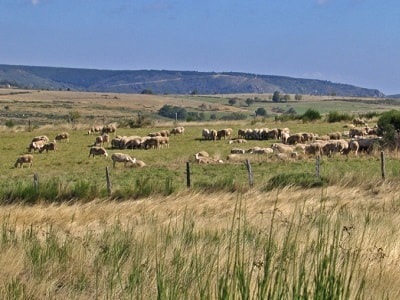
Almost all the high plateaus were more or less involved. On the Saint-Agrève plateau, already quite far north, only the municipality of Devesset was affected due to the ancient possessions of the Knights Hospitaller. This tradition endured after the Revolution; in 1837, Devesset welcomed over 3,000 sheep, mainly from Provence. The surroundings of Mount Mézenc, from Mézilhac to Les Estables and the nascent Loire river, also welcomed many flocks from Gard and Vaucluse, as reported by 18th-century documents. However, further south, between the Loire and the Allier rivers around the heights of Tanargue, lay the true summer kingdom of the transhumants. Here rolled vast grassy heathlands perfectly suited for sheep, most of which remained the property of various hamlets, making them easy to rent to foreign shepherds. The mountain communities lived primarily from rye cultivation, combined with a modest breeding of cattle and sheep. The inability to feed a large herd in winter due to a lack of hay meadows prevented them from owning large flocks capable of fully exploiting the abundant summer grass. Consequently, the arrival of foreign sheep was highly appreciated, as they provided essential manure for the rye fields according to carefully established rules.
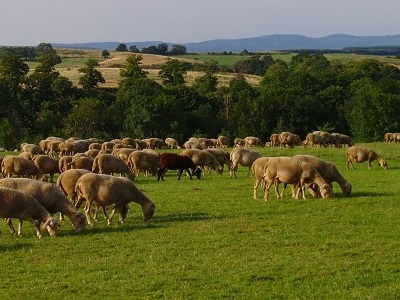
Thanks to an abundance of documentation from the 19th century, we have a clear understanding of the transhumants' lives and their integration into the economic and social system of the high Vivarais plateaus. However, the situation was likely quite similar in previous centuries, as this breeding method relies on time-honored customs. A notable difference was that the herds now exclusively belonged to lowland farmers, whereas in the past, immense flocks were owned by the highland monks. The 19th-century herds were smaller—200 to 500 head per flock—and belonged to regular farmers rather than specialized breeders. There were two main ways to organize. The first involved grouping animals from one or more villages to form a "parjade" (transhumance flock) under the leadership of a shepherd appointed by the community. This communal shepherd system was the rule in the cantons of Joyeuse and Valgorge. The second method involved a summer grazing contractor who transported and cared for the animals for a fee. In the canton of Thueyts, for instance, animals were marked before departure, and the shepherd received an agreed price per head for the summer—a practice that had been standard since the 17th century.
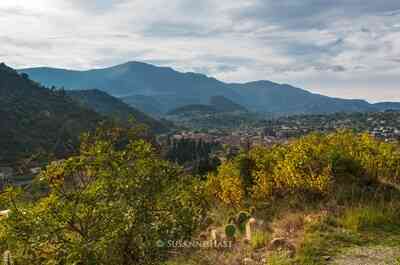
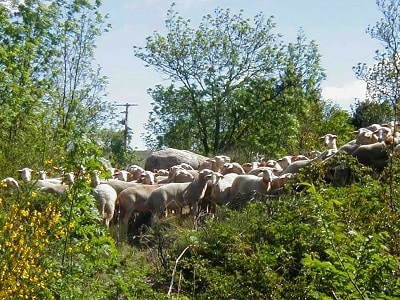
Departures usually took place in the first half of June, with returns in early September, meaning the mountain stay lasted about a hundred days. The journeys followed ancient pathways known as "drailles," wide trails 12 to 20 meters across that served as true corridors for the herds. There were three main routes. The first led from Saint-Ambroix and Les Vans to the heights of Tanargue via Montselgues, Loubaresse, and the Col du Bez. The second followed the Ardèche valley and the Chavade pass. The third started from the low Vivarais plateaus, climbed to Saint-Laurent-sous-Coiron and the Escrinet pass, and continued toward Mount Gerbier-de-Jonc and Mézenc. It was this last path that the sheep of Mazan took in 1337 from the barns of Berg to Montlaur, requiring a formal agreement with the local lord for passage rights. As a fine example of longevity, even in 1905, nearly 6,000 sheep were still seen traveling this route in 28 parjades.
The journey along these ancient paths in June and September was undoubtedly a colorful and noisy spectacle. The lead ram wore talismanic stones embedded in its collar, known as the "peyrassou," intended to protect the animals from diseases and misfortune—a testament to the antiquity of these pastoral beliefs. Once in the mountains, life obeyed precise rules, often codified in pasture rental contracts. Except for the former monastic herds, shepherds owned no land on the heights and had to rent it. Around Tanargue in the mid-19th century, the rental price for common lands was about 5 francs per hectare, with a density of three to four sheep per hectare. In some cases, the fee could be much lower. For example, on the Villevieille estate—an old Carthusian farm near Mézenc—1,000 to 1,500 sheep were hosted for three months for just a few sols per head, as these sheep grazed on cattle leftovers and fertilized the meadows. Similarly, in 1862, all common pastures in La Chapelle-Grailhouse were leased to a shepherd from Jaujac. He brought 400 ewes in exchange for fertilizing private lands and caring for 100 local sheep, while the inhabitants took charge of feeding the shepherd and his dogs.
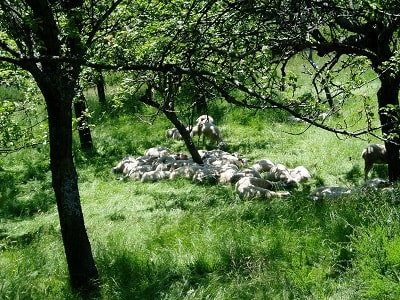
The most remarkable custom was that of the "folding nights" (nuits de fumature). Documented since the 13th century, it was still practiced well into the 20th century. This is evidenced by a 1923 lawsuit involving residents of the Masméjan hamlet (municipality of Saint-Étienne-de-Lugdarès) over the distribution of profits from these nights—a practice stemming from an ancient document of the Abbey of Les Chambons dated May 17, 1457. The sheep were required to sleep at night in pens erected on the fallow fields of private landowners. In return, the owners paid a fee to the shepherd, who spent the night nearby in a simple stone hut called a "chabotte." This created a close symbiosis between the visiting pastoralists and the local mountain agriculture, each benefiting from the other's resources.
Transhumance began to decline after 1870 as economic conditions shifted. In Devesset, the sale of common lands severely harmed the transhumants; their numbers dropped from over 3,000 in the late 18th century to just 500 or 600 a century later, disappearing entirely before 1914. In Loubaresse, reforestation efforts led by the Forestry Commission after 1877 dealt a fatal blow to the practice. Concurrently, rye cultivation was in steep decline, making fertilization by foreign sheep obsolete. In the lowlands, sheep herds were progressively vanishing for various agricultural and social reasons. By the early 20th century, transhumance had certainly halved, involving barely 40,000 to 50,000 heads. By 1930, this number fell to about 20,000, almost exclusively concentrated around Tanargue. Twenty years later, only a dozen herds from Gard remained, totaling just over 3,000 sheep. Today, traditional sheep transhumance on the high Vivarais plateaus has completely vanished.
From this overview of seven centuries of history on the eastern edge of the Massif Central, several conclusions can be drawn. Transhumance relied both on the agricultural vocation of the Vivarais mountains (and secondarily on cattle breeding around Mézenc) and on the vastness of the heathlands. Local mountain farmers could not fully exploit these expansive areas, as they were unable to sustain large flocks through the winter. The arrival of foreign herds thus provided them with a natural and cheap fertilizer. It is a peculiar phenomenon, specific to the Massif Central, quite different from practices observed in alpine-style mountains rich in summer pastures, like the Alps. This practice reached its extreme northern limit in Devesset, favored by the opening of the Rhône Valley, which allows Mediterranean influences to extend northward up to the Coiron plateau. The pronounced relief of the Massif Central in this area provided high-altitude summer pastures at a very short distance. In the Middle Ages, highland monasteries organized a short-distance "descending" transhumance that lasted, albeit diminishing, until the Revolution. It coexisted with an "ascending" transhumance led by small peasant farmers. This latter form eventually took precedence at the beginning of the Modern Era, favored jointly by the decline of monastic power and the spectacular demographic boom of the 18th century.