


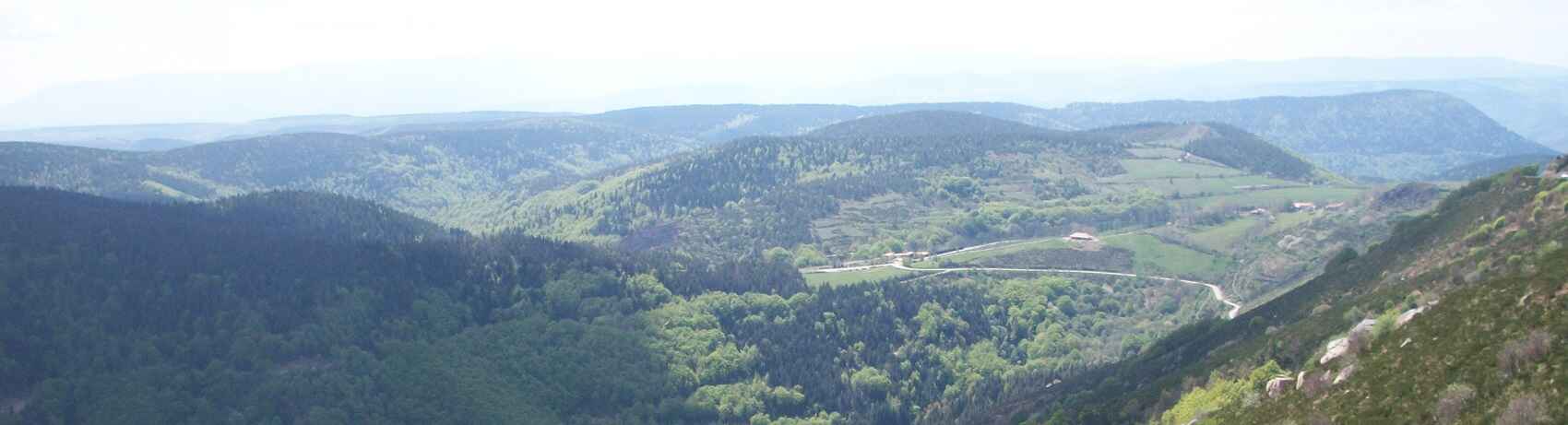
The Tanargue, a majestic giant of the Massif Central, stands as a stone guardian, reaching an elevation of 1,511 meters at the summit of Grand Tanargue. Stretching 15 to 20 kilometers from west to east, its perimeter spans nearly 50 kilometers, covering a total area of 4,726 hectares. Nicknamed the "Mountain of Thunder," it seems to still resonate with the echoes of past storms.
Its typical Cévenol climate, characterized by some of the heaviest rainfall in mainland France, blankets its slopes in a constant veil of mist and lush greenery. A living canvas and a muse for both storytellers and artists, the Tanargue has inspired numerous legends and artistic works in the heart of Ardèche.
Today, its trails are trodden by modern adventurers, cyclists, and hikers seeking the echoes of a wild and unspoiled nature. In winter, its slopes are adorned in white, hosting a ski resort that operates to the sometimes capricious rhythm of the weather. Classified as a Type I ZNIEFF and nestled within the Monts d'Ardèche Regional Nature Park, the massif is a true sanctuary of biodiversity—an environmental treasure that must be carefully preserved.
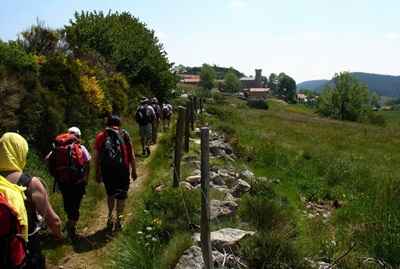
At the heart of this landscape, the agropastoral tradition lives on, symbolized by Ardèche's last transhumance, where sheep roam the heathlands in a timeless pastoral scene. The chestnut groves, a legacy of a bygone era, continue to thrive thanks to those who perpetuate this precious heritage of the land. The Mountain of Thunder thus remains a vibrant symbol of the resilience and richness of the Ardèche territory.
This jewel of southwestern Ardèche rises at the borders of Lozère, embraced by the unspoiled nature of the Monts d'Ardèche Regional Nature Park. It is bordered by the Vivarais mountains and the Devès massif to the north, the Rhône Valley to the east, Mont Lozère to the south, and the Margeride mountains to the west. While it shares the spirit of the Cévennes, the Tanargue remains distinct from the strictly Cévenol area, whose borders end at Mont Lozère, 35 kilometers further south.
Eleven municipalities are scattered like pearls around this massif: Borne, Jaujac, Joannas, Laboule, Loubaresse, Prunet, Rocles, Saint-Étienne-de-Lugdarès, Saint-Laurent-les-Bains, La Souche, and Valgorge. They once formed the S.I.A.T., an intercommunal syndicate dedicated to the region's tourism and agricultural development, which was eventually dissolved on February 22nd by administrative decree. This syndicate also brought together other localities guarding the gates to the Tanargue, such as Astet, Cellier-du-Luc, Laval-d’Aurelle, Lanarce, Laveyrune, Le Plagnal, Montselgues, and Saint-Alban-en-Montagne, all keepers of the history and culture of this unique territory.
In the deep valleys and steep gorges of Ardèche, the land holds the echoes of a very distant past. The caves of Soyons, acting as silent witnesses, tell a 150,000-year-old story from a time when prehistoric humans already walked these mysterious lands. The Chauvet cave, hidden near the tumultuous gorges, reveals priceless frescoes depicting an era when mankind and nature were intimately connected.
When Julius Caesar expanded his empire, this proud massif stood within the territory of the Helvii, a Gallic people renowned for being as robust as the mountains they inhabited. Following the tumult of the Gallic Wars, the Helvii and their lands were integrated into the Roman province of Gallia Narbonensis, opening a new chapter in their millennia-old history.
The Middle Ages saw the Tanargue awaken in a new light. A local nobleman, in a gesture blending faith and power, offered these lands to the diocese of Viviers. Thus, as early as the 9th century, the Tanargue was firmly woven into the region's ecclesiastical network. In 1271, similar to Gévaudan and Velay, Vivarais was absorbed into Languedoc, uniting these diverse lands under a single royal banner.
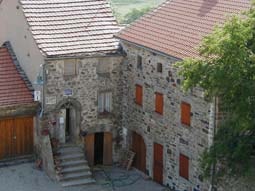
The Renaissance brought with it the turbulent winds of the Wars of Religion. As the Cévennes and the rest of Vivarais were torn apart by bloody conflicts, the Tanargue remained a fervent bastion of the Catholic faith. This steadfast loyalty turned its lands into a battlefield against Huguenot troops, leaving Vivarais permanently marked by the scars of these struggles. The siege of Privas, the merciless dragonnades, and the massacres of civilians left indelible footprints on the province's heart and soul.
In the early 18th century, the Tanargue was once again shaken by the repercussions of the Camisard War, a final surge of violence that set the Cévennes ablaze. Later, in the 1760s, the infamous Beast of Gévaudan spread terror throughout the region: young Jeanne Boulet, who fell west of the massif, became the very first victim of its wild fury. Steeped in history and legend, these lands continue to captivate those who listen closely to the whispers of the past.
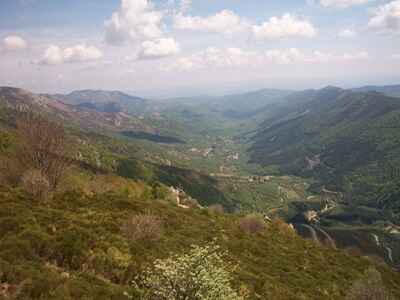
At the twilight of the 18th century, this sleeping stone giant awakened to join the newly formed department of Sources-de-la-Loire, soon to be renamed Ardèche. March 4, 1790, marked the dawn of a new era: the Tanargue, like a patriarch, gave its name to the newly established district. Joyeuse, and subsequently Jaujac, became its successive capitals, lighting the administrative path of this local history.
Nestled in the folds of its mountains, the neighboring villages of the Tanargue regularly witnessed the fury of the elements and suffered repeated assaults from overflowing rivers. Violent Cévenol episodes ravaged the land like unleashed torrents in 1840 and 1856. However, it was in September 1890 that the sky unleashed an unparalleled rage, pouring nearly 950 mm of rain in just five days and sculpting the landscape with unprecedented destructive force.
At the dawn of the 20th century, the Tanargue saw a large portion of its children depart, swept away by the massive rural exodus. The once-vigorous chestnut trees withered from ink disease, while silkworm farming collapsed as pebrine decimated the mulberry trees. The fields gradually emptied, and residents turned toward the lights of Lyon, Saint-Étienne, and Marseille in search of an industrial future. The Great War dealt a final, devastating blow, claiming lives and leaving behind near-ghost villages where a heavy silence replaced the roar of cannons.
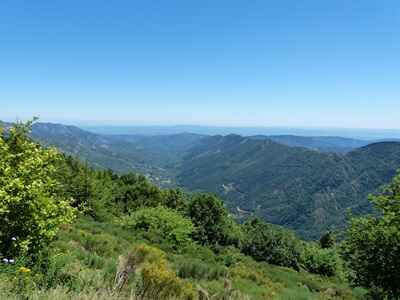
Yet, like a phoenix rising from its ashes, the Tanargue experienced a true renaissance at the dawn of the 1990s. Green tourism blossomed on its slopes, and new rural inhabitants, drawn by the promise of a natural haven of peace, arrived to sow the seeds of a more prosperous future. Aubenas, amidst its strong suburban expansion, reached out to the eastern municipalities, weaving a dynamic network that embraced the massif in this beautiful wave of rebirth.
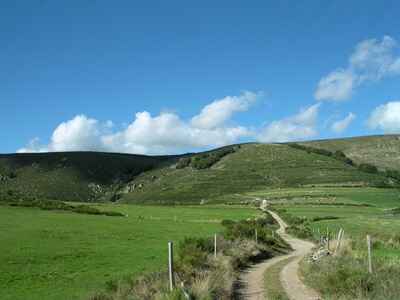
On the vast Tanargue plateau, an unchanging pastoral ballet unfolds every summer from June to September: nearly 1,300 sheep (of the Blanche du Massif Central, Rouge du Roussillon breeds, etc.) are led up for transhumance by devoted shepherds. This is one of the very last ancestral transhumance traditions preserved in Ardèche, a true, living echo of a time once thought gone forever.
The sunny slopes of the Tanargue are adorned with dense chestnut groves, acting as green sentinels standing guard up to 1,000 meters in altitude. Often isolated, they are sometimes accessible only via ancient mule tracks or on foot, testifying to the harshness of past peasant life. However, near the hamlets of Valousset, Valos, or Laboule, these iconic trees still thrive, nurtured by those who earn part of their livelihood from this nourishing fruit. On the shaded side of the massif, where cold and humidity reign supreme, chestnut trees naturally give way to wilder vegetation.
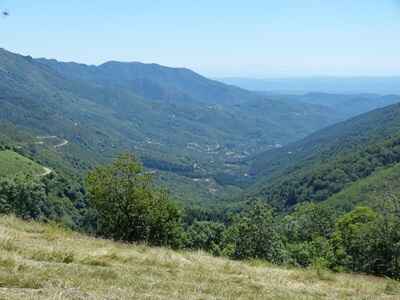
In the past, driven by almost superhuman effort, the peasants of these hamlets would scythe the grass on the high plateaus and carry hay bales weighing up to 80 kg down on their own shoulders. It was a steep three-hour trek—a true Sisyphean task repeated day after day—to feed the approximately 7,000 sheep that populated the summer pastures. These tales of intense labor and perseverance now weave the rich tapestry of the Tanargue’s human history.
In the more mystical western part, where ancient beech and fir forests whisper centuries-old stories, stretches the majestic Chambons state forest. This green sanctuary harbors high-altitude meadows that touch the sky, while vast subalpine heathlands unfold like a carpet at the foot of the rocky cliffs. Here, mineral screes serve as a bed for numerous streams that sing thanks to the abundant ambient humidity.
At the heart of this natural canvas, a few artificial plantations, remnants of 1980s forestry policies, still stand, largely dominated by conifers. Planted by human hands after the post-war turmoil, they recall an era when the National Forestry Office saw massive conifer planting as the sole future of forestry. Today, the winds of change are blowing across the Tanargue: a major ecological restoration project aims to gradually erase the traces of these plantations, returning the mountain to its original pastoral face. Thus, about twenty hectares of pines have been felled to make way once again for open heathland, revitalized with the support of the regional nature park. In the state forest, delicate thinning operations now help preserve precious peat bogs and subalpine flora jewels, such as bog bilberries, which are the true guarantors of this biotope's fragile balance.
The local fauna offers a magnificent symphony of wildlife. Large birds of prey, such as the noble Short-toed snake eagle and the graceful Montagu's harrier, reign supreme in the skies, while the highly discreet otter has recolonized the clear waters of the Borne river since 1998. The Lignon river, for its part, provides a prosperous home for European beavers, those tireless architects of waterways. In the secrecy of the undergrowth, wild boar and deer populations have grown significantly, standing as a powerful testament to the restored vitality of these ancestral lands.