
 A sanctuary of nature at the edge of the Cévennes
Imagine an enchanted forest where stones take on fantastic shapes, where animals hide among the trees, and where rivers sing and whisper. Welcome to the Païolive Forest, a sanctuary of nature inviting discovery and wonder.
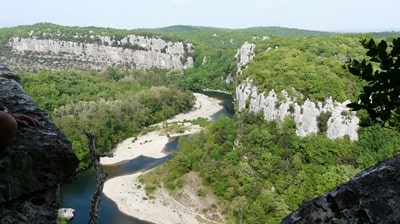 The Païolive Forest is located at the borders of three departments: Ardèche, Gard, and Lozère. It spans three communes: Les Vans, Banne, and Berrias-et-Casteljau. Nestled at the foot of the Cévennes, between the Auvergne-Rhône-Alpes and Occitanie regions, it is about 30 kilometers from Aubenas, the sub-prefecture of Ardèche.
Humans have visited it for over 50,000 years, leaving traces of their passage in caves and rock shelters. They also erected dolmens, ancient tomb monuments that testify to their respect for the dead. It has seen the rise of early civilizations: those who tamed the land and fire, created pottery, tools, and jewelry, and cultivated vineyards, olives, and wheat. They shaped the landscape with stone walls, terraces, and huts.
The history and legend of Jean de la Lune
The Païolive Forest has witnessed adventures that inspired novelists. It was a refuge for rebels, resistance fighters, and lovers. It served as the setting for Firmin Boissin’s novel, Jan de la Lune, which tells the story of a young man fighting for freedom and love. "Jean de la Lune in Païolive Forest" is an Ardèche legend about a young man named Jean who lived in the region.
According to legend, Jean was in love with a young girl from the village, but their love was forbidden by her parents. One evening, desperate, Jean decided to leave the village and seek refuge in the Païolive forest. There, he wandered, searching for meaning to his life and a solution to his sorrow. It is said that he wandered so long in the woods that he eventually disappeared and transformed into a mysterious figure known as Jean de la Lune, a benevolent spirit watching over the forest and its inhabitants. Some even say you can still see Jean de la Lune wandering among the trees on full moon nights, seeking peace and love.
 A geological and underground treasure
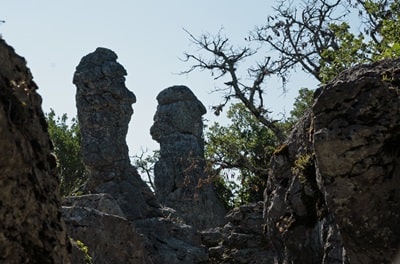
The Païolive Forest is a true treasure and a gift of nature. It consists of limestone rocks dating back 180 million years, which have been sculpted by erosion to create wonders: gorges where the clear and lively Chassezac river flows, lapiaz with deep fissures and crevasses, and chaos where massive stone blocks are piled up, resembling animals, faces, or figures.
The Païolive Forest remains a mystery deeply rooted underground. It contains caves and springs connected through networks of underground galleries. The first to explore and describe them was the geologist Jules de Malbos in the 19th century. He discovered stalactites, stalagmites, draperies, columns, and cave pearls.
Païolive is also a reference in geology. It gave its name to a geological period: the Berriasian. It is in the hamlet of Berrias, in the commune of Berrias-et-Casteljau, that a particular limestone was studied, marking the beginning of the Cretaceous period 145 million years ago.
 The exceptional biodiversity of Païolive
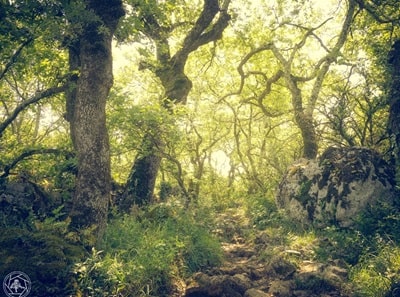
It is a thriving ecosystem, home to a rich biodiversity. It hosts many natural habitats, supporting a variety of plant and animal species: aquatic environments with riverbank plants like willows, alders, and reeds; rocky habitats with plants like saxifrages, houseleeks, and orchids; old forests with majestic trees like white oaks, green oaks, and pines; and dry garrigue where Mediterranean plants like thyme, rosemary, and lavender bloom.
Imagine a place where nature reigns supreme, where rocks take strange and fantastic shapes, and where plants and animals are unique and precious. This place exists—it's the Païolive Forest, a hidden treasure in Ardèche. Since 1934, Païolive has been protected by law because it hosts an exceptional biodiversity. It is part of ecological areas of interest, Natura 2000 sites, and Sensitive Natural Spaces.
The Païolive Forest is a paradise for botanists, zoologists, and the simply curious. It constantly reveals new plant and animal species, often endemic and rare. Among the flowers brightening the landscape, you can admire the almost whitish centaury with petals tinged with pale pink; Lecoq's centranthus, named after a famous French botanist; the colorful crocus blooming in spring; the small-leaved orchid, discreet and elegant; the large-fruited silver basket resembling a small white cauliflower; and an epiphytic moss that clings to the branches of trees.
The forest is also a refuge for mammals, notably the European beaver, which builds dams and lodges along the river, and for various bats (chiropters) living in the caves. It is a nesting site for many birds, including the European kingfisher, diving into the water to catch fish; the European eagle owl, the largest nocturnal raptor on the continent; the European roller with its bright blue and green plumage; the woodpecker drumming on tree trunks; the hobby falcon hunting insects in flight; the skylark singing as it rises into the sky; the black kite soaring majestically above the woods; the blackbird known for its metallic blue back; the osprey capturing aquatic prey with its talons; the common chiffchaff mimicking the songs of other birds; and the hoopoe displaying its fan-shaped crest.
 Myths and legends of the Païolive Forest
Païolive is an ancient and mysterious forest located in southern Ardèche. Its strangely shaped rocks, sculpted by erosion, are home to many legends and secrets. Among them is another version of the legend of Jean de la Lune, a young boy living in a cave with his mother, a witch. Jean de la Lune had sky-blue eyes and sun-blonde hair. He loved wandering the woods at night, illuminated by the moon, and gazing at the stars.
One day, he met a girl named Marie. She was the daughter of the lord of the neighboring village, and very beautiful. Her eyes were green like the leaves, and her brown hair like the branches. She enjoyed walking in the woods during the day, accompanied by her dog, and picking flowers. When they met, they fell in love with each other. They decided to meet every evening by the Chassezac river, which flows through the forest.
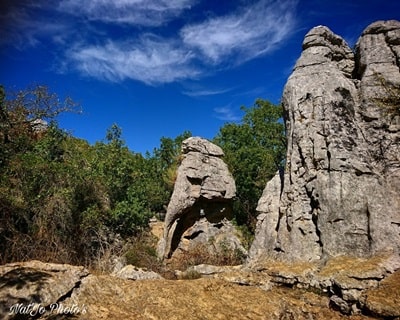
But their love was forbidden because Jean de la Lune’s mother did not want him to associate with a village girl, and Marie’s father did not want her to marry the son of a witch. They did everything to keep them apart, in vain. Jean de la Lune and Marie continued to meet secretly, dreaming of running away together. One evening, when they met at the Bear and Lion rock—a triple arch resembling two fighting animals—they were surprised by soldiers sent by Marie’s father. The soldiers chased them into the woods, forcing them to the edge of a cliff. Jean de la Lune and Marie took each other's hands and jumped into the void.
But instead of dying, they were saved by the magic of the moon, which transformed them into two stars. Since then, they can be seen shining in the sky above Païolive. They have become the symbol of eternal love, defying obstacles and prejudices.
 Païolive is a place full of history and mystery, inspiring many legends over time. Here are some other examples of these fantastic tales:
The Legend of the Water Fairy: A beautiful young woman lived in a hidden spring deep within the forest. She loved bathing in the Chassezac and lured men with her melodious voice. But if one tried to approach her, she would drown them mercilessly. One day, a shepherd named Pierre managed to catch her and bring her home. He kept her locked in a cage, hoping she would fall in love with him. But the water fairy withered away far from her element, begging Pierre to free her. He refused, and she died of grief. Since then, it is said that her plaintive voice can still be heard in the woods, and that the waters of the Chassezac are cursed.
The legend of the Knight of Casteljau: This noble warrior defended Casteljau Castle, located at the entrance of the forest. Known for his bravery and generosity, he loved riding through the woods in search of adventures. One day, he met a beautiful lady in distress, asking for his help to escape a bandit. The knight agreed and fought the outlaw. But it was in fact a trap: the lady was an accomplice of the bandit, and she took advantage of the knight's distraction to stab him in the back with a dagger. The knight fell from his horse and died cursing the traitor. Since then, it’s said that his ghost roams the forest, and his white horse appears to lost travelers, guiding them towards the exit.
The legend of the Bear and the Lion rock: This triple arch formed by erosion resembles two fighting animals. According to legend, long ago, a bear and a lion lived in the forest and disputed territory. One day, they decided to settle their disputes with a fight at the edge of the Chassezac. They attacked each other with such violence that the land trembled. Their clash was so powerful that they petrified on the spot, giving birth to the rock named after them. Since then, the rock has come to symbolize strength and courage, and anyone daring to cross it is said to be blessed by nature.