


The History of Les Vans


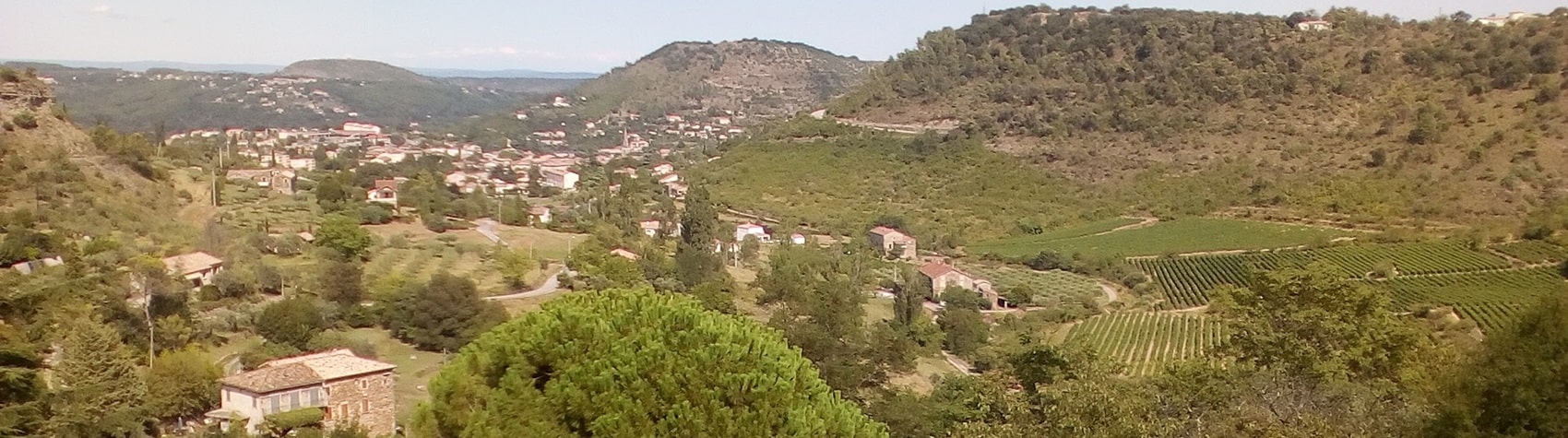
 Long before the Romans set foot in Gaul, thousands of years ago, men and women were already living in the Les Vans region, south of Ardèche. They built dolmens to honor their dead and defensive sites to protect themselves from invasions. On the Croix de Bauzon plateau, they founded an oppidum, a fortified city where they practiced trade and agriculture. They belonged to the Helvian people, who valiantly resisted the Roman invaders before finally allying with them.
The Romans brought their civilization, language, and religion. They built a Roman road linking Alba-la-Romaine to Uzès, passing through Les Vans. This ancient road connected Alba-la-Romaine (Alba Helvia) to Uzès (Ucetia). It went through the city of Aventicum (Les Vans), which was an important Roman city in Gaul. The Roman road is still visible today in some places, especially on the Lance plateau near Les Vans. It consists of a paved road with large stone slabs, about six meters wide, bordered by ditches. The Romans built villas, temples, and baths along it. They cultivated vineyards, olive trees, and wheat, and promoted art and culture. Their mark remains visible today.
 In the Middle Ages, Les Vans experienced a new golden age. In the 10th century, the Lords of La Garde-Adhémar built the Château de Banne, which overlooked the Beaume Valley for centuries. Sitting on a limestone rock overlooking the Chassezac plain, the Château de Banne has a long and rich history.
Its construction began in the 12th century by the Lords of Banne, when it was just a simple castrum. Over the centuries, it was expanded and transformed into a true medieval fortress—one of the most powerful and opulent of its time. In the 11th century, the castle belonged to the de Châteauneuf family, then to the Joyeuse family.
From the 15th century, it came into the possession of the Beauvoir du Roure family, who kept it until the French Revolution. The Château de Banne witnessed many important events in French history. It played a key role during the Camps of Jalès, a series of royalist and Catholic gatherings in the 1790s.
In 1792, the castle was burned by revolutionary troops in retaliation for its involvement in the Camps of Jalès. The ruins were later sold to a merchant from Les Vans, who used them as a quarry.
 Since the beginning of the 20th century, restoration efforts have been undertaken at Château de Banne. Archaeological excavations uncovered significant remains, and ongoing efforts aim to consolidate and preserve the site for future generations.
Today, the ruins of Château de Banne stand proudly on the hilltop, offering an exceptional panoramic view of the Chassezac valley. The site is free to access and is a must-visit for history and heritage enthusiasts.
Around Saint-Pierre Church, founded in the 12th century, the village of Les Vans developed, attracting farmers, artisans, and traders. In the same century, Benedictine monks founded the Priory of Notre-Dame-des-Vans, which became a renowned spiritual and intellectual center. The priory was established in 1137 by the Abbey of Saint-Gilles-du-Gard. It was built on a site that already had a Gallo-Roman sanctuary dedicated to the goddess Vesta.
 The priory experienced prosperity during the 12th and 13th centuries but declined from the 14th century onwards. It comprises a church, a cloister, and monastic buildings. The church is Romanesque, built in the 12th century and classified as a historic monument since 1927. The cloister, also Romanesque from the same period, is now in ruins. The monastic buildings were built at different times in various styles. The priory houses a wooden statue of the Virgin Mary, which became an important pilgrimage site. Dating from the 14th century, it is also classified as a historic monument.
In the 14th century, the town of Les Vans was fortified with a defensive enclosure featuring 14 towers and 4 gates to protect against raiders and bandits. During the Hundred Years' War, it became a key Protestant stronghold. The history of the fortifications of Les Vans is fascinating, spanning centuries with key events and figures. Construction began in the 12th century, likely initiated by the Lords of Vogüé. The early defenses consisted of stone ramparts and watchtowers guarding a modest village.
By the 14th century, the town expanded, and the ramparts were reinforced with new defensive walls, fortified gates, and moats. During the Wars of Religion, Les Vans became a Protestant stronghold. The ramparts were modernized, with new bastions and gun emplacements, turning the town into a real fortress. After these conflicts, their military significance waned, and over time, the walls and towers were dismantled or converted into homes. In the 20th century, restoration efforts have aimed to preserve these historical remains.
Between the 16th and 18th centuries, Les Vans experienced a golden age thanks to sericulture (silk farming). The history of silk farming in this area dates back to the 15th century, reaching a peak in the 19th century as a key economic activity.
The introduction of sericulture to Les Vans is attributed to the Ventabren family, co-lords from the 15th century. Mulberry cultivation, essential for feeding silkworms, became widespread in the region, transforming the landscape.
 In the 18th century, sericulture expanded with the creation of silkworm nurseries and silk mills. The 19th century was the golden age, with silk becoming a luxury commodity, bringing wealth and prosperity to the area.
Starting in the late 19th century, sericulture declined due to competition from artificial silk and international markets, especially from the Far East. By the 20th century, it had almost disappeared, with mulberry trees uprooted and farms abandoned. Recently, there has been a revival of artisanal silk farming, with local initiatives aiming to bring back this traditional craft.
 Les Vans became an important commercial and artisanal center, producing fabrics, hats, shoes, furniture, jewelry, and weapons. Many mansions and public buildings were constructed, reflecting the town’s prosperity and refinement. Les Vans also attracted the attention of notable visitors.
In 1629, King Louis XIII and his minister Richelieu stopped by during their campaign against the Protestants of Languedoc. In the 19th and 20th centuries, the town faced hard times. Sericulture declined at the end of the 19th century due to foreign competition and silkworm diseases.
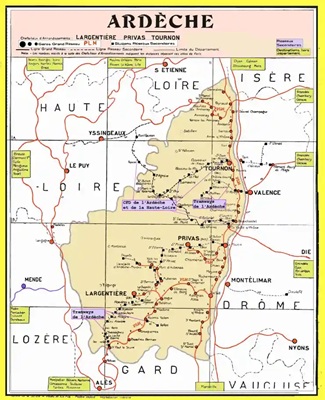
The town subsequently turned to tourism and agriculture. In 1868, the Le Puy-en-Velay – Aubenas railway line was built, easing transportation and exchanges. From the mid-19th century, railway expansion across France sparked ambitions in regions like Ardèche. The project of the Transcévenol railway line, linking Le Puy-en-Velay to Aubenas via Saint-Cirgues-en-Montagne, was ambitious: it would span 87 km to connect Clermont-Ferrand to Nîmes and boost the local economy. The route was complex, requiring massive engineering, including a tunnel of over 3 km. The high costs and technical challenges delayed its completion. Despite political declarations in 1906 and 1921, the Transcévenol was never finished. WWI, economic crises, and the rise of automobiles eventually put an end to the project.
 Today, remnants of the Transcévenol still exist, such as the Roux tunnel, old bridges, and abandoned stations—silent witnesses to an unfulfilled railway dream. The story isn’t just a failure; it symbolizes the ambition and determination of locals to connect and develop their territory.
Current studies and discussions are exploring alternative, cheaper options, like light rail or tram-trains, to revive connectivity between Le Puy-en-Velay and Aubenas.
Les Vans became a renowned health resort, with visitors coming to enjoy the pure air and sunshine. But the town was also hard-hit during both world wars, suffering losses and damages. In 1944, Les Vans was liberated by partisans after intense battles against German troops.
In the 21st century, Les Vans is a lively and attractive town of about 2,700 inhabitants. It is known for its rich history and natural beauty, drawing many visitors. Tourism is a vital sector, offering diverse, high-quality services. Les Vans is an ideal starting point for hiking, cycling, and climbing amidst Ardèche’s breathtaking scenery. The city is also proud of its traditions and notable personalities like Jean-Étienne Championnet (Revolutionary general), Pierre-Paul Riquet (engineer of the Canal du Midi), and Charles-Ferdinand Ramuz (Swiss author).

Copyright©etoile.fr